
Book lens / Published
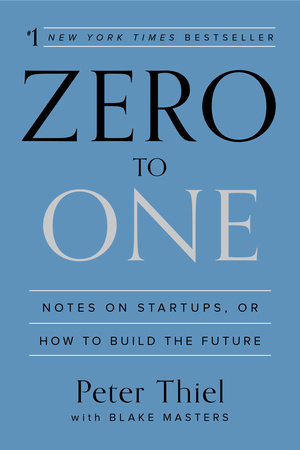
Zero to One: Notes on Startups, or How to Build the Future
How can a startup create something distinct instead of competing to make more of what already exists?
A curated lens on Peter Thiel and Blake Masters' argument for creating new value, finding overlooked truths, building a durable advantage, and treating distribution as part of the product.
- Edition
- Ebook edition. 224 pages. ISBN 9780804139304. The publisher credits the work to Peter Thiel with Blake Masters. Exact reading-copy confirmation remains required.
- Reviewed
- August 24, 2026
- Sources
- 1
Lens
Copying a proven model can improve what already exists. It does not create a new category of value.
Thiel and Masters distinguish horizontal progress, moving from 1 to n, from vertical progress, moving from 0 to 1. Their startup lens asks a demanding question: what important truth is not yet widely accepted, and what could be built if that truth is right?
The point is not novelty for its own sake. A useful zero-to-one move creates value that did not exist before and gives a company a reason to matter beyond being another participant in a crowded market.
Evidence
Look for a secret worth building around
A contrarian belief is not valuable merely because most people reject it. It becomes useful when it identifies a real but overlooked possibility and survives contact with evidence.
The practical discipline is to ask what others may be missing, why they are missing it, and what would have to be true for the insight to support a product or company.
Create a distinct advantage
The book argues that a strong company should seek a form of monopoly by solving a specific problem so well that it becomes difficult to substitute.
In this lens, monopoly is best read as a prompt to build distinct value and durable advantage. It is not permission to suppress competition, capture regulators, or extract value without continuing to serve customers.
Start with a small market
A startup can learn more by serving a clearly defined group deeply than by declaring that everyone is its market.
Dominating a small market is not the final goal. It creates a base from which the company can test whether its advantage is real, strengthen distribution, and expand into adjacent markets without losing focus.
Treat distribution as part of the product
A valuable product does not distribute itself. Sales, positioning, channels, and customer acquisition determine whether the product reaches the people for whom it creates value.
This corrects a common founder bias: technical quality and commercial reach are separate capabilities, and both require deliberate design.
Build for a definite future
Thiel and Masters favor deliberate plans over treating the future as a lottery. A startup needs a view of the future specific enough to guide choices about product, people, market, and timing.
A plan should create direction without becoming immune to evidence. Definite thinking is most useful when the goal is clear and the path remains open to revision.
Apply to my situation
This lens is useful when a startup is imitating visible competitors, describing an enormous market without a credible entry point, or assuming that a good product will find customers by itself.
A practical inquiry is to ask:
- What important problem are we solving in a genuinely different way?
- What evidence supports the belief that others have overlooked this opportunity?
- Which narrow market can we serve exceptionally well first?
- What makes the advantage durable without depending on coercion or lock-in?
- How will the product reach customers, and who owns that work?
Counter-lens
The book draws heavily from venture-backed technology companies. Its principles do not transfer unchanged to every small business, public institution, regulated market, or company whose advantage comes from reliable execution rather than a technological breakthrough.
The language of monopoly can also hide harmful concentration. A company can be distinct and profitable while remaining accountable to customers, workers, law, and society. Competition may improve price, access, service, and innovation.
Contrarian thinking carries its own risk. A belief rejected by others may be overlooked, or it may simply be wrong. Evidence, customer behavior, technical feasibility, and ethical consequences matter more than the founder’s confidence.
Power-law outcomes and famous successes can produce survivorship bias. The lens helps frame a startup’s choices. It does not predict which company will succeed.
Limits
The transfer boundary for Zero to One: Notes on Startups, or How to Build the Future is built into its question: How can a startup create something distinct instead of competing to make more of what already exists? Do not generalize from a memorable example or retrospective success. Test domain, timing, resources, incentives, power, consent, and who bears the downside.
Experiment
Use the proposed move from Zero to One: Notes on Startups, or How to Build the Future: Test one bounded application before generalizing. Run one low-cost, reversible case. Record the baseline, expected signal, alternative explanation, affected parties, stop condition, and review date. Preserve contrary observations.
Reflection
- What did Zero to One: Notes on Startups, or How to Build the Future help me notice about this question: How can a startup create something distinct instead of competing to make more of what already exists?
- Which part is book-derived claim, independent evidence, interpretation, application, or metaphor?
- What alternative explanation fits the same result?
- Who benefits, who pays, who did not choose the exposure, and who can appeal?
- What observation would make me narrow or abandon this specific lens?
Sources
- Peter Thiel with Blake Masters, Zero to One: Notes on Startups, or How to Build the Future. Crown Currency, 2014. Ebook, 224 pages, ISBN 9780804139304. Publisher edition record.
Revision
This is a curated knowledge lens, not a claim that its applications happened to the lens author. Curated and authored by Utpal Vaishnav.
Continue the inquiry
Research this book lens with AI
Research Zero to One: Notes on Startups, or How to Build the Future as a maintained KNOLTOK lens, not as a summary or endorsement. Reader question: How can a startup create something distinct instead of competing to make more of what already exists? Current synthesis: A curated lens on Peter Thiel and Blake Masters' argument for creating new value, finding overlooked truths, building a durable advantage, and treating distribution as part of the product. Current evidence status: not stated. Selected primary edition and provenance: title: "Zero to One: Notes on Startups, or How to Build the Future"; author: "Peter Thiel and Blake Masters"; publisher: "Crown Currency"; publication date: "2014-09-16"; edition note: "Ebook edition. 224 pages. ISBN 9780804139304. The publisher credits the work to Peter Thiel with Blake Masters. Exact reading-copy confirmation remains required."; URL: "https://www.penguinrandomhouse.com/books/234730/zero-to-one-by-peter-thiel-with-blake-masters/9780804139304/" Current Lens claim to test: Copying a proven model can improve what already exists. It does not create a new category of value. Thiel and Masters distinguish horizontal progress, moving from 1 to n, from vertical progress, moving from 0 to 1. Their startup lens asks a demanding question: what important truth is not yet widely accepted, and what could be built if that truth is right? The point is not novelty for its own sake. A useful zero-to-one move creates value that did not exist before and gives a company a reason to matter beyond being another participant in Current Counter-lens to strengthen or correct: The book draws heavily from venture-backed technology companies. Its principles do not transfer unchanged to every small business, public institution, regulated market, or company whose advantage comes from reliable execution rather than a technological breakthrough. The language of monopoly can also hide harmful concentration. A company can be distinct and profitable while remaining accountable to customers, workers, law, and society. Competition may improve price, access, service, and innovation. Contrarian thinking carries its own risk. A belief rejected by others may be overlooked, or it may simply be wrong. Evidence, customer behavior, technical feasibility, and ethical Current Limits to verify: The transfer boundary for Zero to One: Notes on Startups, or How to Build the Future is built into its question: How can a startup create something distinct instead of competing to make more of what already exists? Do not generalize from a memorable example or retrospective success. Test domain, timing, resources, incentives, power, consent, and who bears the downside. Practical move under consideration: Run one reversible test and preserve contrary evidence. Research these claims through literary form, authorial context, reception, and the boundary between interpretation and external fact; strategy, organizational evidence, incentives, base rates, selection effects, and stakeholder outcomes; psychology, behavior change, construct validity, intervention evidence, and structural explanations; finance, survivorship, leverage, downside allocation, distribution, and institutional opportunity. Verify book-derived formulations against the selected edition and do not silently substitute another edition. Separate: what the book claims; KNOLTOK's interpretation; independent evidence; application proposals; recognition or influence; credible disagreement; and unresolved uncertainty. Treat sales, fame, anecdotes, cases, and publisher or company claims as reach or self-description, not independent proof. Do not invent quotations, page numbers, personal experience, outcomes, authorial intent, or consensus. Do not infer Utpal Vaishnav's private view beyond the text above. Start with the registered sources below, assess their interests and limitations, and then find stronger primary records, peer-reviewed research, authoritative datasets, critical scholarship, or stakeholder evidence. Do not merely repeat the registered sources: - https://www.penguinrandomhouse.com/books/234730/zero-to-one-by-peter-thiel-with-blake-masters/9780804139304/ Return a claim ledger with 6 to 12 material claims. For each provide: exact claim; claim class; attribution; edition or page verification status; best supporting evidence with a direct link; strongest counterevidence or alternative explanation with a direct link; confidence as high, medium, low, or unresolved; transfer conditions; affected stakeholders; possible harm if overstated; and a keep, narrow, rewrite, or remove recommendation. Then provide source-quality notes, missing perspectives, contradictions with the current lens, 3 to 5 proposed revisions, one reversible experiment with baseline and stop condition, and explicit revision or retirement triggers. Use direct links and full citations. Quote only when exact wording materially matters and has been verified.
About this lens
Primary book: Zero to One: Notes on Startups, or How to Build the Future by Peter Thiel and Blake Masters, Ebook edition. 224 pages. ISBN 9780804139304. The publisher credits the work to Peter Thiel with Blake Masters. Exact reading-copy confirmation remains required.
Lens author: Utpal Vaishnav. The interpretation, personal experience, and conclusions belong to the lens author.
AI assistance: AI assisted with bibliographic research, structure, and editing. Utpal Vaishnav selected the book and accepted responsibility for the published synthesis.
Human review: Utpal Vaishnav
- 2026-08-24: Created a books-first review lens using the Crown Currency ebook edition.