
Book lens / Published
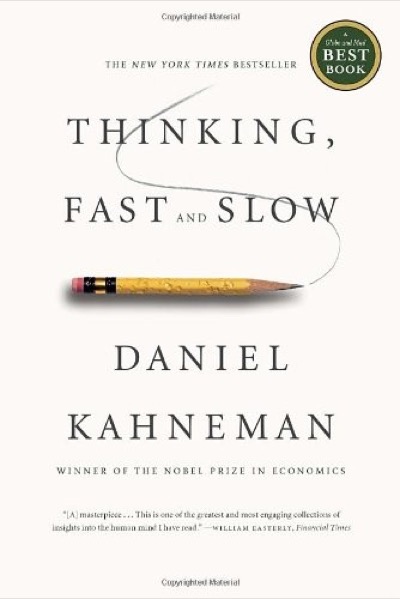
Thinking, Fast and Slow
When should I trust my intuition, and when should I slow down?
A practical test for deciding when experience has earned trust and when consequence, novelty, or uncertainty calls for deliberate review.
- Edition
- Confirmed paperback edition. 512 pages. ISBN 9780385676533; Open Library edition OL28227306M.
- Reviewed
- August 24, 2026
- Sources
- 6
Lens
Do not ask whether intuition or analysis is better in the abstract. Ask whether this environment could have trained the intuition, and whether the cost of an untested first answer justifies intervention.
The useful distinction in Thinking, Fast and Slow is functional. Some mental operations are rapid, automatic, associative, and effortless. Others require attention, working memory, and deliberate control. The labels help us notice a handoff problem: a fast answer appears, then reflective thought may accept, test, correct, or rationalize it.
They are not 2 literal characters in the brain.
Intuition can contain real skill
Gary Klein’s research on naturalistic decision making describes how experienced people can recognize a familiar situation, identify a plausible course of action, and mentally simulate it without comparing a long list of alternatives. This matters in environments where time is limited and experience has exposed the decision maker to recurring patterns.
Fast judgment is not automatically careless. In the right environment, it can be compressed experience.
Experience does not always create expertise
Daniel Kahneman and Gary Klein reached an important area of agreement. Skilled intuition is more likely to develop when an environment contains sufficiently regular patterns and when the person has enough opportunity to learn those patterns through feedback.
Some environments do not provide those conditions. Outcomes may be noisy, feedback may arrive too late, and similar-looking situations may operate differently. Experience in such an environment can increase confidence without increasing accuracy.
Deliberation is a check, not a guarantee
Slowing down creates room to inspect assumptions, compare evidence, invite disagreement, or run a reversible test. It does not make a decision objective. More time can also produce delay, motivated reasoning, or a more elaborate defense of the first impression.
The purpose of deliberation is to test the first answer where the cost of being wrong justifies the effort.
High-pressure decisions may use both modes
A systematic review of professional decision making during high-risk events found both recognition-primed and analytical strategies in the literature it examined. Analytical approaches appeared more often when time pressure was lower and when training encouraged people to generate multiple explanations.
This is a warning against turning intuition and analysis into opposing identities. A skilled decision maker may recognize quickly, then verify selectively.
Use a decision threshold, not a bias catalog
Naming a bias after a decision is easy and often unhelpful. Many bias labels can be fitted to the same event. The operational question is whether a safeguard should be triggered before commitment.
Five factors matter in this lens:
- Consequence: How much harm can a wrong answer create?
- Reversibility: Can the decision be corrected after new evidence arrives?
- Uncertainty: How wide is the plausible range of outcomes?
- Expertise fit: Is this inside a domain where the decision maker received repeated, timely, diagnostic feedback?
- Time pressure: What is the cost of delay, and which check remains possible before action?
These factors are an editorial decision aid, not a validated psychological scale. Their purpose is to allocate scarce attention.
Counter-lens
Fast thinking is not the problem, and slow thinking is not the cure.
Naturalistic decision research shows that experts can act rapidly by recognizing a situation and mentally simulating a plausible action. Deliberation can damage performance when it interrupts trained perception, introduces irrelevant options, or arrives too late.
The reverse problem is equally serious. Slow reasoning can anchor on the first impression, defend identity, manipulate assumptions, and create false confidence through detail. A spreadsheet does not remove judgment. A committee does not remove bias. More analysis can delay feedback that only action would produce.
Critical reviews also caution against treating dual-process theory as one settled, unified model. Researchers distinguish kinds of processing more carefully than the popular image of 2 coherent systems suggests. The metaphor remains useful if it directs attention to process and loses authority when it is used as a literal neural map.
The synthesis is selective verification: recognize quickly where expertise is earned, then spend deliberate effort on the few assumptions that dominate consequence.
Evidence
Strong for conditional expertise: Kahneman and Klein agreed that valid intuition requires a sufficiently regular environment and adequate opportunity to learn its regularities through feedback. Subjective confidence alone does not establish those conditions.
Strong for expert rapid recognition in studied domains: Klein’s recognition-primed model describes experienced decision makers assessing a situation, recognizing a workable action, and mentally simulating it. Transfer to a new domain is not automatic.
Mixed across high-risk settings: the 2023 systematic review found both recognition-primed and analytical strategies across 32 empirical studies. Lower time pressure and training to generate alternatives were associated with more analytical processing in the reviewed literature. The studies span domains and methods, so the result supports contingency rather than a universal rule.
Conceptually useful, theoretically contested: dual-process families remain influential, but their definitions and mechanisms vary. System 1 and System 2 are best treated here as descriptive handles for processing features.
Uneven at the level of individual book examples: Thinking, Fast and Slow synthesizes a large research program, but findings should be checked claim by claim. The book’s broad account should not be used to inherit every priming or social-psychology result as equally secure.
Personal evidence has a narrow role: my reported use of slower reasoning shows why the threshold matters to me. It does not prove that the threshold improved a particular outcome.
UV’s perspective
This is a personal perspective, not external evidence.
Thinking, Fast and Slow gave me a vocabulary for noticing how I was deciding. I deliberately started applying slower reasoning in certain areas. It made me more aware of my decision-making process.
That awareness mattered because some of my decisions affected hundreds of lives at once. The lesson was not to distrust every intuition. It was to recognize when the consequence of a decision justified the cost of slowing down.
I have not provided the private context needed to describe those decisions safely. This perspective therefore explains why I use the threshold; it does not claim that the threshold produced a particular outcome.
Limits
The popular System 1 and System 2 labels are useful descriptions of different kinds of processing. They should not be treated as 2 literal, isolated parts of the brain.
The evidence does not support a universal rule that intuition is inferior to analysis. It also does not support trusting intuition merely because it feels fluent or confident. Domain, task, feedback, time pressure, and the structure of the environment matter.
The reversibility test in this lens is an editorial decision aid. It is not presented as a validated psychological law. Reversibility matters because a wrong decision can be corrected after new information arrives, but it does not by itself make an intuitive choice accurate.
For medical, legal, financial, safety, employment, or similarly consequential decisions, this lens is not a substitute for qualified advice, required process, or specialist review.
Apply to my situation
My documented boundary is consequence. Some decisions I have made affected hundreds of lives, so awareness of my process mattered. The private facts are not present here and should not be invented.
The immediate application can still be concrete. For a consequential decision across a federation, venture, publication, or knowledge system, write the first judgment before researching further. Then classify it:
- Is the situation genuinely similar to cases in which I received timely, reliable feedback?
- Which part is inside my demonstrated expertise, and which part merely feels familiar?
- Who bears the consequence if the pattern match is wrong?
- Which assumption is irreversible, and which can be tested cheaply?
- What incentive, identity, fear, or group pressure could make the first answer attractive?
This preserves intuition as evidence. It does not give intuition the final vote by default.
Experiment
Keep a prospective decision record for 10 decisions over 30 days. Include routine and consequential decisions.
Before the outcome is known, record:
- the first answer and confidence from 0 to 100;
- consequence, reversibility, uncertainty, expertise fit, and time pressure;
- the feedback history that could have trained intuition in this exact class of decision;
- one disconfirming check;
- the decision, review date, and expected observable result.
For high-consequence or hard-to-reverse decisions, add an independent estimate or a premortem before commitment. For reversible decisions, prefer a small test when it can produce better feedback than more discussion.
At day 30, do not score only outcomes. Score calibration, assumption quality, and process. Did 80-percent confidence judgments succeed roughly 8 times in 10? Did deliberation change the decision or merely decorate it? Which environment produced learnable feedback? Revise the trigger rule from those observations.
Reflection
- How can a team test a confident leader’s intuition without creating procedural delay?
- When does a reversible experiment produce better evidence than further analysis?
- How can decision records improve the feedback needed to develop expertise?
- What did I know before analysis, and what story did I construct afterward?
- Is this familiar because the causal structure repeats, or because the surface resembles a memorable case?
- Where has experience increased confidence without providing timely, diagnostic feedback?
- Which single check has the highest chance of changing the decision?
- If I slow down, what new evidence will I obtain?
Revision
Revise this lens when the 30-day record shows poor calibration, when a domain lacks the feedback conditions assumed here, when a safeguard adds delay without changing decisions, or when updated research changes the standing of a book-derived claim.
A revision should distinguish 4 possibilities: the intuition was untrained, the environment changed, the deliberate check was weak, or the outcome was noisy despite a sound process. Do not rewrite the rule from one vivid success or failure.
Sources
- Daniel Kahneman and Gary Klein, “Conditions for Intuitive Expertise: A Failure to Disagree”, American Psychologist 64, no. 6 (2009): 515-526. DOI: 10.1037/a0016755.
- Gary A. Klein, “A Recognition-Primed Decision Model of Rapid Decision Making”, in Decision Making in Action: Models and Methods (1993).
- Anna M. Power and colleagues, “Decision-Making During High-Risk Events: A Systematic Literature Review”, Journal of Cognitive Engineering and Decision Making (2023).
- Daniel Kahneman, Thinking, Fast and Slow. Anchor Canada, 2013. Confirmed paperback edition, ISBN 9780385676533. Open Library edition record.
- James D. Grayot, “Dual Process Theories in Behavioral Economics and Neuroeconomics: A Critical Review”, Review of Philosophy and Psychology 11 (2020): 105-136.
- Andrei Shleifer, “Psychologists at the Gate: A Review of Daniel Kahneman’s Thinking, Fast and Slow”, Journal of Economic Literature 50, no. 4 (2012): 1080-1091.
Lens notes
- Evidence status: mixed. The conditions for skilled intuition are supported, but their application remains domain-specific.
- Last substantive revision: August 15, 2026.
Continue the inquiry
Research this book lens with AI
Research Thinking, Fast and Slow as a maintained KNOLTOK lens, not as a summary or endorsement. Reader question: When should I trust my intuition, and when should I slow down? Current synthesis: A practical test for deciding when experience has earned trust and when consequence, novelty, or uncertainty calls for deliberate review. Current evidence status: mixed. Selected primary edition and provenance: title: "Thinking, Fast and Slow"; author: "Daniel Kahneman"; publisher: "Anchor Canada"; publication date: "2013-04-02"; edition note: "Confirmed paperback edition. 512 pages. ISBN 9780385676533; Open Library edition OL28227306M."; URL: "https://openlibrary.org/books/OL28227306M/Thinking_Fast_and_Slow" Current Lens claim to test: Do not ask whether intuition or analysis is better in the abstract. Ask whether this environment could have trained the intuition, and whether the cost of an untested first answer justifies intervention. The useful distinction in Thinking, Fast and Slow is functional. Some mental operations are rapid, automatic, associative, and effortless. Others require attention, working memory, and deliberate control. The labels help us notice a handoff problem: a fast answer appears, then reflective thought may accept, test, correct, or rationalize it. They are not 2 literal characters in the brain. Intuition can contain real skill Current Counter-lens to strengthen or correct: Fast thinking is not the problem, and slow thinking is not the cure. Naturalistic decision research shows that experts can act rapidly by recognizing a situation and mentally simulating a plausible action. Deliberation can damage performance when it interrupts trained perception, introduces irrelevant options, or arrives too late. The reverse problem is equally serious. Slow reasoning can anchor on the first impression, defend identity, manipulate assumptions, and create false confidence through detail. A spreadsheet does not remove judgment. A committee does not remove bias. More analysis can delay feedback that only action would produce. Critical Current Limits to verify: The popular System 1 and System 2 labels are useful descriptions of different kinds of processing. They should not be treated as 2 literal, isolated parts of the brain. The evidence does not support a universal rule that intuition is inferior to analysis. It also does not support trusting intuition merely because it feels fluent or confident. Domain, task, feedback, time pressure, and the structure of the environment matter. The reversibility test in this lens is an editorial decision aid. It is not presented as a validated psychological law. Reversibility matters because a wrong decision Practical move under consideration: Before acting, ask whether this environment has given you enough reliable feedback to train your intuition. Then check consequence, novelty, uncertainty, and reversibility. If any is high, pause long enough to test the first answer. Research these claims through literary form, authorial context, reception, and the boundary between interpretation and external fact; psychology, behavior change, construct validity, intervention evidence, and structural explanations; systems research, causal mechanisms, measurement, feedback, boundary conditions, and second-order effects; finance, survivorship, leverage, downside allocation, distribution, and institutional opportunity. Verify book-derived formulations against the selected edition and do not silently substitute another edition. Separate: what the book claims; KNOLTOK's interpretation; independent evidence; application proposals; recognition or influence; credible disagreement; and unresolved uncertainty. Treat sales, fame, anecdotes, cases, and publisher or company claims as reach or self-description, not independent proof. Do not invent quotations, page numbers, personal experience, outcomes, authorial intent, or consensus. Do not infer Utpal Vaishnav's private view beyond the text above. Start with the registered sources below, assess their interests and limitations, and then find stronger primary records, peer-reviewed research, authoritative datasets, critical scholarship, or stakeholder evidence. Do not merely repeat the registered sources: - https://doi.org/10.1037/a0016755 - https://www.macrocognition.com/documents/Decision-Making-in-Action-Models-and-Methods-0316.pdf - https://pmc.ncbi.nlm.nih.gov/articles/PMC10564111/ - https://openlibrary.org/books/OL28227306M/Thinking_Fast_and_Slow - https://doi.org/10.1007/s13164-019-00446-9 - https://scholar.harvard.edu/files/shleifer/files/kahneman_review_jel_final.pdf Return a claim ledger with 6 to 12 material claims. For each provide: exact claim; claim class; attribution; edition or page verification status; best supporting evidence with a direct link; strongest counterevidence or alternative explanation with a direct link; confidence as high, medium, low, or unresolved; transfer conditions; affected stakeholders; possible harm if overstated; and a keep, narrow, rewrite, or remove recommendation. Then provide source-quality notes, missing perspectives, contradictions with the current lens, 3 to 5 proposed revisions, one reversible experiment with baseline and stop condition, and explicit revision or retirement triggers. Use direct links and full citations. Quote only when exact wording materially matters and has been verified.
About this lens
Primary book: Thinking, Fast and Slow by Daniel Kahneman, Confirmed paperback edition. 512 pages. ISBN 9780385676533; Open Library edition OL28227306M.
Lens author: Utpal Vaishnav. The interpretation, personal experience, and conclusions belong to the lens author.
AI assistance: AI assisted with source discovery, comparison, structure, and editing. UV contributed the labeled personal perspective and accepted responsibility for the published synthesis.
Human review: Utpal Vaishnav
- 2026-08-13: Prepared with AI as a research scaffold based on Thinking, Fast and Slow.
- 2026-08-15: Added Utpal Vaishnav's decision-making experience and confirmed the physical book edition.
- 2026-08-15: Expanded the book lens with independent research and retained it in review pending exact-text approval.
- 2026-08-23: Restored the book title and canonical book route for the books-first v0.1 workflow.
- 2026-08-26: Deepened the lens with a counter-lens, evidence tiers, replication and dual-process qualifications, a decision experiment, reflection questions, and revision triggers.