
Book lens / Published
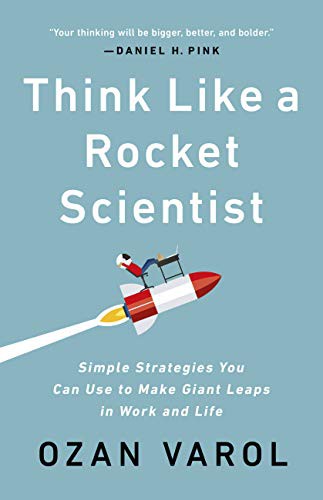
Think Like a Rocket Scientist
How can the thinking practices associated with rocket science improve decisions when uncertainty is high and established answers are insufficient?
A curated lens on Ozan Varol's practices for reasoning from first principles, testing assumptions, learning from failure, and turning uncertainty into discovery.
- Edition
- Trade paperback. 368 pages. ISBN 9781541762602.
- Reviewed
- August 24, 2026
- Sources
- 1
Lens
Uncertainty is not only a condition to reduce. It can be a field for disciplined discovery.
Varol translates practices associated with rocket science into a broader method: question inherited assumptions, reason from fundamentals, generate alternatives, test before certainty arrives, and learn from what fails.
The useful lesson is not that every problem should become a moonshot. It is that consequential work benefits from a more explicit relationship with uncertainty.
Evidence
Reason from first principles
Analogy asks what has worked before. First-principles reasoning asks which constraints are fundamental and which are merely inherited practice.
Both modes matter. Analogy provides accumulated knowledge. First principles become especially useful when precedent has hardened into an assumption that no longer fits the problem.
Make uncertainty visible
Unknowns become more manageable when separated into assumptions, probabilities, constraints, and questions that an experiment could answer.
Confidence should follow the quality of evidence, not the force with which a forecast is presented.
Use thought experiments and tests
A thought experiment can expand the solution space before resources are committed. A real test then creates contact with evidence.
The sequence matters. Imagination without testing remains speculation. Testing without a clear question can generate activity without learning.
Learn from failure before and after it happens
Teams can examine how a plan might fail before execution, build safeguards, and investigate anomalies rather than hiding them.
After failure, the purpose of review is not to celebrate the event or find a convenient person to blame. It is to improve the model, the system, and the next decision.
Apply to my situation
This lens is useful in startups, engineering, strategy, AI development, and other environments where the path is incomplete and a decision can affect many people.
A practical inquiry is to ask:
- Which constraint is physical, legal, ethical, or economic?
- Which constraint is an inherited assumption?
- What would need to be true for the idea to work?
- What is the smallest responsible test?
- What evidence would stop or redirect the effort?
Counter-lens
Rocket science is a productive analogy, not a universal operating system. Aerospace programs often have technical objectives, specialized expertise, and safety practices that differ from markets and social systems.
First-principles rhetoric can become overconfidence when it ignores institutional memory or domain expertise. Experiments can also impose costs on people who did not choose to participate.
The responsible form of bold thinking pairs imagination with ethics, evidence, reversibility, and clear stopping conditions.
Limits
The transfer boundary for Think Like a Rocket Scientist is built into its question: How can the thinking practices associated with rocket science improve decisions when uncertainty is high and established answers are insufficient? Do not generalize from a memorable example or retrospective success. Test domain, timing, resources, incentives, power, consent, and who bears the downside.
Experiment
Use the proposed move from Think Like a Rocket Scientist: Test one bounded application before generalizing. Run one low-cost, reversible case. Record the baseline, expected signal, alternative explanation, affected parties, stop condition, and review date. Preserve contrary observations.
Reflection
- What did Think Like a Rocket Scientist help me notice about this question: How can the thinking practices associated with rocket science improve decisions when uncertainty is high and established answers are insufficient?
- Which part is book-derived claim, independent evidence, interpretation, application, or metaphor?
- What alternative explanation fits the same result?
- Who benefits, who pays, who did not choose the exposure, and who can appeal?
- What observation would make me narrow or abandon this specific lens?
Sources
- Ozan Varol, Think Like a Rocket Scientist: Simple Strategies You Can Use to Make Giant Leaps in Work and Life. PublicAffairs, 2021. Trade paperback, 368 pages, ISBN 9781541762602. Publisher edition record.
Revision
This is a curated knowledge lens, not a claim that its applications happened to the lens author. Curated and authored by Utpal Vaishnav.
Continue the inquiry
Research this book lens with AI
Research Think Like a Rocket Scientist as a maintained KNOLTOK lens, not as a summary or endorsement. Reader question: How can the thinking practices associated with rocket science improve decisions when uncertainty is high and established answers are insufficient? Current synthesis: A curated lens on Ozan Varol's practices for reasoning from first principles, testing assumptions, learning from failure, and turning uncertainty into discovery. Current evidence status: not stated. Selected primary edition and provenance: title: "Think Like a Rocket Scientist: Simple Strategies You Can Use to Make Giant Leaps in Work and Life"; author: "Ozan Varol"; publisher: "PublicAffairs"; publication date: "2021-09-14"; edition note: "Trade paperback. 368 pages. ISBN 9781541762602."; URL: "https://www.hachettebookgroup.com/titles/ozan-varol/think-like-a-rocket-scientist/9781541762602/" Current Lens claim to test: Uncertainty is not only a condition to reduce. It can be a field for disciplined discovery. Varol translates practices associated with rocket science into a broader method: question inherited assumptions, reason from fundamentals, generate alternatives, test before certainty arrives, and learn from what fails. The useful lesson is not that every problem should become a moonshot. It is that consequential work benefits from a more explicit relationship with uncertainty. Current Counter-lens to strengthen or correct: Rocket science is a productive analogy, not a universal operating system. Aerospace programs often have technical objectives, specialized expertise, and safety practices that differ from markets and social systems. First-principles rhetoric can become overconfidence when it ignores institutional memory or domain expertise. Experiments can also impose costs on people who did not choose to participate. The responsible form of bold thinking pairs imagination with ethics, evidence, reversibility, and clear stopping conditions. Current Limits to verify: The transfer boundary for Think Like a Rocket Scientist is built into its question: How can the thinking practices associated with rocket science improve decisions when uncertainty is high and established answers are insufficient? Do not generalize from a memorable example or retrospective success. Test domain, timing, resources, incentives, power, consent, and who bears the downside. Practical move under consideration: Run one reversible test and preserve contrary evidence. Research these claims through strategy, organizational evidence, incentives, base rates, selection effects, and stakeholder outcomes; systems research, causal mechanisms, measurement, feedback, boundary conditions, and second-order effects; learning science, epistemology, replication, transfer, measurement, and alternative explanations; power, consent, reciprocity, unequal alternatives, privacy, and relationship-specific evidence. Verify book-derived formulations against the selected edition and do not silently substitute another edition. Separate: what the book claims; KNOLTOK's interpretation; independent evidence; application proposals; recognition or influence; credible disagreement; and unresolved uncertainty. Treat sales, fame, anecdotes, cases, and publisher or company claims as reach or self-description, not independent proof. Do not invent quotations, page numbers, personal experience, outcomes, authorial intent, or consensus. Do not infer Utpal Vaishnav's private view beyond the text above. Start with the registered sources below, assess their interests and limitations, and then find stronger primary records, peer-reviewed research, authoritative datasets, critical scholarship, or stakeholder evidence. Do not merely repeat the registered sources: - https://www.hachettebookgroup.com/titles/ozan-varol/think-like-a-rocket-scientist/9781541762602/ Return a claim ledger with 6 to 12 material claims. For each provide: exact claim; claim class; attribution; edition or page verification status; best supporting evidence with a direct link; strongest counterevidence or alternative explanation with a direct link; confidence as high, medium, low, or unresolved; transfer conditions; affected stakeholders; possible harm if overstated; and a keep, narrow, rewrite, or remove recommendation. Then provide source-quality notes, missing perspectives, contradictions with the current lens, 3 to 5 proposed revisions, one reversible experiment with baseline and stop condition, and explicit revision or retirement triggers. Use direct links and full citations. Quote only when exact wording materially matters and has been verified.
About this lens
Primary book: Think Like a Rocket Scientist by Ozan Varol, Trade paperback. 368 pages. ISBN 9781541762602.
Lens author: Utpal Vaishnav. The interpretation, personal experience, and conclusions belong to the lens author.
AI assistance: AI assisted with intake extraction, bibliographic research, structure, and editing. Utpal Vaishnav selected the book and lens, determined the synthesis and boundaries, and accepted responsibility for the published synthesis.
Human review: Utpal Vaishnav
- 2026-08-23: Created a books-first review lens using the current PublicAffairs trade paperback edition.