
Book lens / Published
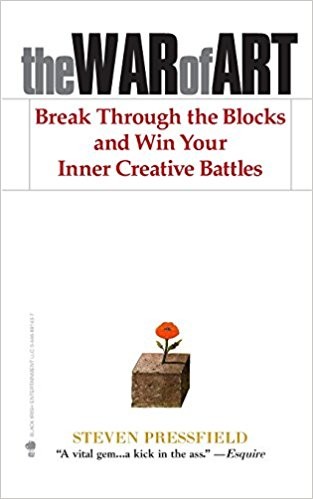
The War of Art
How can treating resistance as a recurring force help a creator move from intention to disciplined practice?
A curated lens on Steven Pressfield's practical metaphor of Resistance and the shift from waiting for inspiration to showing up as a professional.
- Edition
- Current Black Irish Books edition. 190 pages. ISBN 9781936891023. The work was first published in 2002 by Rugged Land.
- Reviewed
- August 24, 2026
- Sources
- 1
Lens
The work a person most wants to create can attract the strongest avoidance.
Pressfield names this force Resistance. The name turns a vague experience into something observable: delay, distraction, perfectionism, fear, or the sudden importance of easier tasks. The practical value of the metaphor is that Resistance can be expected without being obeyed.
Evidence
Resistance is recurrent
Resistance is not a final obstacle cleared before the real work begins. It can return each time the work becomes uncertain, exposed, or meaningful.
Expecting its return reduces the temptation to treat discomfort as proof that the project is wrong.
Turn professional
Pressfield contrasts the amateur, who waits for favorable conditions, with the professional, who establishes a practice and returns to it.
Professionalism here is a posture toward the work, not a job title. It includes consistency, patience, boundaries, and a willingness to learn without making mood the sole condition for action.
Serve the work
Creative work becomes less fragile when attention moves from self-image toward the task and the people it may serve.
This does not eliminate fear. It gives fear less authority over whether the work receives an honest attempt.
Apply to my situation
This lens is useful when preparation, research, or perfection repeatedly postpones contact with the work.
A practical use is to identify:
- The work being avoided.
- The form Resistance takes today.
- The smallest meaningful session that can begin now.
- The routine that makes returning easier tomorrow.
Counter-lens
Resistance is a metaphor, not a diagnosis. Delay can arise from burnout, depression, disability, unsafe conditions, financial pressure, unclear goals, or missing skills. Discipline alone does not solve every barrier.
The amateur and professional distinction can also become moralizing. Rest, incubation, and changing direction are not automatically avoidance.
Use the lens to question a pattern, not to condemn the person experiencing it. The work benefits from discipline, and the worker still requires care, context, and judgment.
Limits
The transfer boundary for The War of Art is built into its question: How can treating resistance as a recurring force help a creator move from intention to disciplined practice? Do not generalize from a memorable example or retrospective success. Test domain, timing, resources, incentives, power, consent, and who bears the downside.
Experiment
Use the proposed move from The War of Art: Test one bounded application before generalizing. Run one low-cost, reversible case. Record the baseline, expected signal, alternative explanation, affected parties, stop condition, and review date. Preserve contrary observations.
Reflection
- What did The War of Art help me notice about this question: How can treating resistance as a recurring force help a creator move from intention to disciplined practice?
- Which part is book-derived claim, independent evidence, interpretation, application, or metaphor?
- What alternative explanation fits the same result?
- Who benefits, who pays, who did not choose the exposure, and who can appeal?
- What observation would make me narrow or abandon this specific lens?
Sources
- Steven Pressfield, The War of Art: Break Through the Blocks and Win Your Inner Creative Battles. Black Irish Entertainment, 2012. Current edition, 190 pages, ISBN 9781936891023. Publisher edition record.
Revision
This is a curated knowledge lens, not a claim that its applications happened to the lens author. Curated and authored by Utpal Vaishnav.
Continue the inquiry
Research this book lens with AI
Research The War of Art as a maintained KNOLTOK lens, not as a summary or endorsement. Reader question: How can treating resistance as a recurring force help a creator move from intention to disciplined practice? Current synthesis: A curated lens on Steven Pressfield's practical metaphor of Resistance and the shift from waiting for inspiration to showing up as a professional. Current evidence status: not stated. Selected primary edition and provenance: title: "The War of Art: Break Through the Blocks and Win Your Inner Creative Battles"; author: "Steven Pressfield"; publisher: "Black Irish Entertainment"; publication date: "2012-01-11"; edition note: "Current Black Irish Books edition. 190 pages. ISBN 9781936891023. The work was first published in 2002 by Rugged Land."; URL: "https://blackirishbooks.com/product/the-war-of-art/" Current Lens claim to test: The work a person most wants to create can attract the strongest avoidance. Pressfield names this force Resistance. The name turns a vague experience into something observable: delay, distraction, perfectionism, fear, or the sudden importance of easier tasks. The practical value of the metaphor is that Resistance can be expected without being obeyed. Current Counter-lens to strengthen or correct: Resistance is a metaphor, not a diagnosis. Delay can arise from burnout, depression, disability, unsafe conditions, financial pressure, unclear goals, or missing skills. Discipline alone does not solve every barrier. The amateur and professional distinction can also become moralizing. Rest, incubation, and changing direction are not automatically avoidance. Use the lens to question a pattern, not to condemn the person experiencing it. The work benefits from discipline, and the worker still requires care, context, and judgment. Current Limits to verify: The transfer boundary for The War of Art is built into its question: How can treating resistance as a recurring force help a creator move from intention to disciplined practice? Do not generalize from a memorable example or retrospective success. Test domain, timing, resources, incentives, power, consent, and who bears the downside. Practical move under consideration: Run one reversible test and preserve contrary evidence. Research these claims through psychology, behavior change, construct validity, intervention evidence, and structural explanations; learning science, epistemology, replication, transfer, measurement, and alternative explanations. Verify book-derived formulations against the selected edition and do not silently substitute another edition. Separate: what the book claims; KNOLTOK's interpretation; independent evidence; application proposals; recognition or influence; credible disagreement; and unresolved uncertainty. Treat sales, fame, anecdotes, cases, and publisher or company claims as reach or self-description, not independent proof. Do not invent quotations, page numbers, personal experience, outcomes, authorial intent, or consensus. Do not infer Utpal Vaishnav's private view beyond the text above. Start with the registered sources below, assess their interests and limitations, and then find stronger primary records, peer-reviewed research, authoritative datasets, critical scholarship, or stakeholder evidence. Do not merely repeat the registered sources: - https://blackirishbooks.com/product/the-war-of-art/ Return a claim ledger with 6 to 12 material claims. For each provide: exact claim; claim class; attribution; edition or page verification status; best supporting evidence with a direct link; strongest counterevidence or alternative explanation with a direct link; confidence as high, medium, low, or unresolved; transfer conditions; affected stakeholders; possible harm if overstated; and a keep, narrow, rewrite, or remove recommendation. Then provide source-quality notes, missing perspectives, contradictions with the current lens, 3 to 5 proposed revisions, one reversible experiment with baseline and stop condition, and explicit revision or retirement triggers. Use direct links and full citations. Quote only when exact wording materially matters and has been verified.
About this lens
Primary book: The War of Art by Steven Pressfield, Current Black Irish Books edition. 190 pages. ISBN 9781936891023. The work was first published in 2002 by Rugged Land.
Lens author: Utpal Vaishnav. The interpretation, personal experience, and conclusions belong to the lens author.
AI assistance: AI assisted with intake extraction, bibliographic research, structure, and editing. Utpal Vaishnav selected the book and lens, determined the synthesis and boundaries, and accepted responsibility for the published synthesis.
Human review: Utpal Vaishnav
- 2026-08-23: Created a books-first review lens using the current Black Irish Books edition.