
Book lens / Published
The Slight Edge
When do small repeated choices produce meaningful change, and where does The Slight Edge oversimplify that idea?
A personal reading of compounding beyond finance, and why some projects require process excellence instead.
- Edition
- Confirmed physical edition. 280 pages. ISBN 9781626340466; Open Library edition OL26842952M.
- Reviewed
- August 24, 2026
- Sources
- 1
Lens
When do small repeated choices produce meaningful change, and where does The Slight Edge oversimplify that idea?
Evidence
The Slight Edge helped me see compounding outside finance. Small actions, repeated over time, can accumulate into results that are difficult to notice at the beginning.
I began applying this idea in other contexts. I saw its value most clearly in learning and relationships. Both became more valuable through continuity over time.
But I also learned not to use compounding as a universal explanation for progress. Not every project improves simply because the same actions continue for longer.
Some projects require process excellence. The work must become more reliable, precise, or effective. Repetition can multiply the value of a sound process, but it can also repeat the limitations of a weak one.
The useful question is not only whether an action can compound. It is whether the underlying process deserves to be repeated.
Evidence and reasoning
The book’s compounding thesis gave me a way to think about progress beyond money. An action may appear insignificant in isolation while its repeated effects become meaningful over time.
Learning and relationships helped make this idea concrete for me. Their value accumulated over time rather than arriving through a single decisive action. The exact mechanisms behind that accumulation still need to be described from my experience.
That principle depends on what repetition produces. When each cycle retains or builds upon some value from the previous cycle, compounding may occur. When the process loses quality, creates rework, or repeats the same limitation, consistency alone is insufficient.
This creates a practical distinction between two kinds of improvement:
- Compounding asks whether repeated actions accumulate value over time.
- Process excellence asks whether the system producing those actions is capable, reliable, and improving.
Some work may need both. A good process creates value worth accumulating, while repetition gives that value time to grow.
Counter-lens
The boundary between compounding and process excellence needs further investigation. Learning and relationships belong on the compounding side of my experience, but I have not yet described what repeated actions created that effect. It is also not yet clear which projects I would place in the process excellence category, or when a project moves from one requirement to the other.
The lens should also test the thesis against delayed feedback, unequal starting conditions, randomness, and systems that overpower individual consistency.
Reflection
- Describe how compounding appeared in learning and relationships without turning personal experience into a universal claim.
- Identify projects where process excellence mattered more than repetition.
- Separate memorable metaphors from evidence-backed mechanisms.
- Find primary research for any behavioral or causal claims retained in the lens.
- Refine the boundary between compounding and process excellence through concrete examples.
Limits
The transfer boundary for The Slight Edge is built into its question: When do small repeated choices produce meaningful change, and where does The Slight Edge oversimplify that idea? Do not generalize from a memorable example or retrospective success. Test domain, timing, resources, incentives, power, consent, and who bears the downside.
Apply to my situation
For KNOLTOK, treat The Slight Edge as a proposed decision aid rather than a personal claim. Its book-specific move is: test one bounded application before generalizing. For this application, record why ‘test one bounded application’ fits the current case, which source supports it, who is affected, and what evidence would block transfer.
Experiment
Use the proposed move from The Slight Edge: Test one bounded application before generalizing. Run one low-cost, reversible case. Record the baseline, expected signal, alternative explanation, affected parties, stop condition, and review date. Preserve contrary observations.
Sources
- Jeff Olson and John David Mann, The Slight Edge: Turning Simple Disciplines into Massive Success and Happiness. Greenleaf Book Group Press, 2013. Confirmed physical edition, ISBN 9781626340466. Open Library edition record
Revision
- Prepared with AI on 2026-08-13 as a research scaffold.
- Human author: Utpal Vaishnav.
- Human reviewer: Utpal Vaishnav.
- Exact text approved for publication on August 24, 2026.
Continue the inquiry
Research this book lens with AI
Research The Slight Edge as a maintained KNOLTOK lens, not as a summary or endorsement. Reader question: When do small repeated choices produce meaningful change, and where does The Slight Edge oversimplify that idea? Current synthesis: A personal reading of compounding beyond finance, and why some projects require process excellence instead. Current evidence status: not stated. Selected primary edition and provenance: title: "The Slight Edge: Turning Simple Disciplines into Massive Success and Happiness"; author: "Jeff Olson and John David Mann"; publisher: "Greenleaf Book Group Press"; publication date: "2013-11-04"; edition note: "Confirmed physical edition. 280 pages. ISBN 9781626340466; Open Library edition OL26842952M."; URL: "https://openlibrary.org/books/OL26842952M/The_Slight_Edge_Turning_Simple_Disciplines_into_Massive_Success_and_Happiness" Current Lens claim to test: When do small repeated choices produce meaningful change, and where does The Slight Edge oversimplify that idea? Current Counter-lens to strengthen or correct: The boundary between compounding and process excellence needs further investigation. Learning and relationships belong on the compounding side of my experience, but I have not yet described what repeated actions created that effect. It is also not yet clear which projects I would place in the process excellence category, or when a project moves from one requirement to the other. The lens should also test the thesis against delayed feedback, unequal starting conditions, randomness, and systems that overpower individual consistency. Current Limits to verify: The transfer boundary for The Slight Edge is built into its question: When do small repeated choices produce meaningful change, and where does The Slight Edge oversimplify that idea? Do not generalize from a memorable example or retrospective success. Test domain, timing, resources, incentives, power, consent, and who bears the downside. Practical move under consideration: Run one reversible test and preserve contrary evidence. Research these claims through psychology, behavior change, construct validity, intervention evidence, and structural explanations; systems research, causal mechanisms, measurement, feedback, boundary conditions, and second-order effects; finance, survivorship, leverage, downside allocation, distribution, and institutional opportunity; learning science, epistemology, replication, transfer, measurement, and alternative explanations. Verify book-derived formulations against the selected edition and do not silently substitute another edition. Separate: what the book claims; KNOLTOK's interpretation; independent evidence; application proposals; recognition or influence; credible disagreement; and unresolved uncertainty. Treat sales, fame, anecdotes, cases, and publisher or company claims as reach or self-description, not independent proof. Do not invent quotations, page numbers, personal experience, outcomes, authorial intent, or consensus. Do not infer Utpal Vaishnav's private view beyond the text above. Start with the registered sources below, assess their interests and limitations, and then find stronger primary records, peer-reviewed research, authoritative datasets, critical scholarship, or stakeholder evidence. Do not merely repeat the registered sources: - https://openlibrary.org/books/OL26842952M/The_Slight_Edge_Turning_Simple_Disciplines_into_Massive_Success_and_Happiness Return a claim ledger with 6 to 12 material claims. For each provide: exact claim; claim class; attribution; edition or page verification status; best supporting evidence with a direct link; strongest counterevidence or alternative explanation with a direct link; confidence as high, medium, low, or unresolved; transfer conditions; affected stakeholders; possible harm if overstated; and a keep, narrow, rewrite, or remove recommendation. Then provide source-quality notes, missing perspectives, contradictions with the current lens, 3 to 5 proposed revisions, one reversible experiment with baseline and stop condition, and explicit revision or retirement triggers. Use direct links and full citations. Quote only when exact wording materially matters and has been verified.
About this lens
Primary book: The Slight Edge by Jeff Olson and John David Mann, Confirmed physical edition. 280 pages. ISBN 9781626340466; Open Library edition OL26842952M.
Lens author: Utpal Vaishnav. The interpretation, personal experience, and conclusions belong to the lens author.
AI assistance: AI assisted with structure and editing. The distinction between compounding and process excellence is Utpal Vaishnav's and was accepted by Utpal Vaishnav for publication.
Human review: Utpal Vaishnav
- 2026-08-13: Prepared with AI as a research scaffold.
- 2026-08-14: Added Utpal Vaishnav's working thesis on compounding beyond finance and the limits of applying it to every project.
- 2026-08-14: Identified learning and relationships as two areas where Utpal experienced compounding.
- 2026-08-14: Promoted the authorial draft to review and added a bounded research prompt.
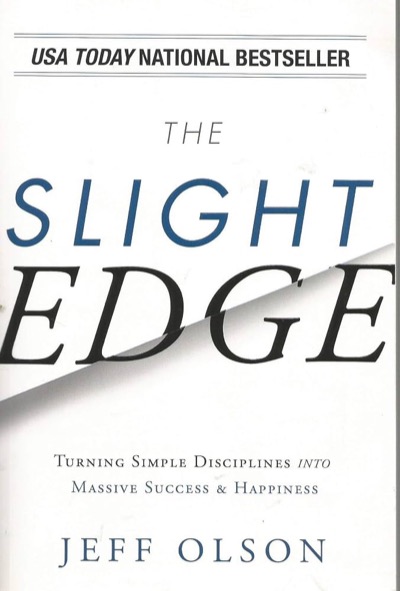
- 2026-08-14: Added the author-supplied book cover. Edition details remain unverified.
- 2026-08-15: Confirmed the physical copy against Open Library edition OL26842952M and accepted it as the primary source.
- 2026-08-15: Replaced the original cover asset with an optimized local JPEG.