
Book lens / Published
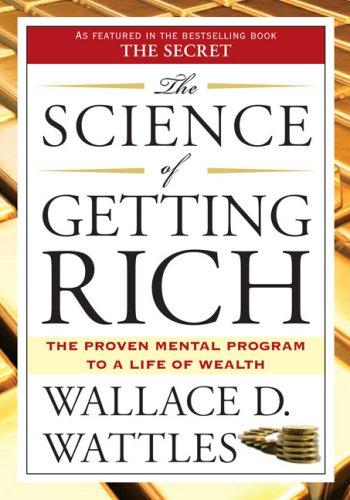
The Science of Getting Rich
What remains useful in purposeful prosperity once metaphysical certainty and guaranteed wealth are removed?
A critical lens on disciplined economic agency, New Thought metaphysics, and the limits of treating prosperity as a guaranteed mental law.
- Edition
- ISBN 9781585426010. The work was first published in 1910.
- Reviewed
- August 26, 2026
- Sources
- 5
Lens
The title makes a scientific promise that the book does not meet. Wallace D. Wattles presents prosperity as the result of thinking and acting in a certain way, supported by a metaphysical picture in which thought works upon a responsive substance. That proposition is not established economic or behavioral science.
Discarding the metaphysics does not leave nothing. The book asks readers to replace passive wishing with a chosen direction, sustained attention, useful action, and the creation of value. Those practices can improve decisions because they influence what a person notices, attempts, learns, and repeats. They do not guarantee wealth. They change behavior inside conditions that the individual only partly controls.
The useful tension is therefore between agency and certainty. Agency says that a person can take consequential action even within constraints. Certainty says the desired economic result must follow if the mental formula is performed correctly. The first claim can be tested. The second converts failure into a defect of belief and hides luck, power, health, discrimination, inheritance, and market structure.
What this lens retains
- Define prosperity in terms more precise than wanting to be rich.
- Direct attention toward value that can be created for other people.
- Turn intention into repeated, observable action.
- Refuse the idea that deprivation is spiritually superior.
- Treat gratitude as a way of noticing resources, not as a mechanism that commands the universe.
These are working propositions, not laws. A clear aim may help organize action. It may also be mistaken, harmful, or impossible under current conditions. Feedback must remain able to revise it.
Counter-lens
Prosperity is produced through a relationship among agency, opportunity, institutions, cooperation, bargaining power, and chance.
The counter-lens does not say individual action is irrelevant. It says the causal unit is larger than thought. Education, health, credit, inheritance, infrastructure, geography, discrimination, regulation, property, networks, and macroeconomic conditions influence which actions are available and which people capture the return.
There is also a behavioral counter-lens to positive certainty. Optimism can support persistence, but it can also distort forecasts and encourage entry into weak opportunities. Clear-eyed planning needs aspiration and base rates, conviction and disconfirming evidence.
Evidence
The book is historically situated in New Thought prosperity teaching. Scholarship traces how mind-power and prosperity ideas entered mainstream accounts of American success around the turn of the 20th century. That history explains the text. It does not validate its metaphysics.
There is independent evidence for narrower practices that can be separated from the doctrine. Implementation-intention research supports specifying when, where, and how a chosen action will occur. The result is support for concrete planning, not for a responsive universal substance or guaranteed wealth.
OECD evidence shows that inherited circumstances and place materially influence market income and mobility. Its 2025 analysis estimates that more than a quarter of market-income inequality across the studied OECD countries is attributable to measured inherited circumstances. The measure is explicitly a lower bound and does not capture every circumstance. Even with that qualification, it contradicts any account in which prosperity reliably follows correct thought.
The evidence grades are therefore:
- Historically supported: the book’s role in New Thought prosperity literature.
- Behaviorally supported in narrower form: specific plans can improve goal pursuit in studied settings.
- Economically supported: structural circumstances affect opportunity and mobility.
- Unsupported: thought operating as a universal law that guarantees material prosperity.
Limits
Where the argument breaks
The doctrine is morally dangerous when it makes prosperity proof of correct thought. It can imply that people experiencing poverty, illness, exploitation, or exclusion have failed to think properly. It also understates collective institutions. Property rules, public infrastructure, education, credit, labor protections, and social networks shape which actions become possible and who captures their value.
The book’s age matters. Its language belongs to early twentieth century New Thought, not to contemporary research. Later self-help publishing amplified its influence, but a long publication history is evidence of cultural durability rather than truth. The many public domain editions also vary in introductions, subtitles, and editorial framing. Claims should be tied to a chosen text.
A better prosperity question
Ask four questions together. What outcome matters? What can I do next? What conditions shape the result? What evidence would show that the plan is failing?
This preserves initiative without pretending that thought overrides reality. It also places value creation beside value capture. An action that increases income by transferring hidden costs to employees, customers, neighbors, or the environment is not automatically meaningful success.
Apply to my situation
For a venture, acquisition, or professional decision, replace the formula “believe, act, receive” with an evidence ledger:
- the economic outcome sought;
- the value created and for whom;
- the action under my control;
- the structural conditions I can influence;
- the conditions I cannot presently change;
- the base rate or comparison class;
- the observation that would cause exit, redesign, or further investment.
For KNOLTOK, the title itself requires a visible warning: “science” is part of the historical title, not the evidence status of the book. The lens is valuable only if it helps a reader separate disciplined agency from metaphysical certainty.
Experiment
Choose one financial or professional aim for 30 days. Write one concrete action that is under your control, one assumption about the surrounding system, and one measure of useful value created. Review the record weekly. If effort rises while learning, demand, or value does not, change the method instead of blaming belief.
The experiment cannot prove a universal law of prosperity. It can reveal whether clarity and repeated action improve this decision under these conditions.
Record one forecast before acting: the expected demand signal, learning result, or economic change. At day 30, compare the forecast with what occurred. Attribute neither success nor failure entirely to mindset. Identify action, condition, and chance separately.
Reflection
- Which passages make metaphysical claims, and which give practical behavioral advice?
- How did the book travel through later prosperity literature?
- Which findings on goal pursuit support narrower claims about planning and feedback?
- How should economic agency be discussed without erasing unequal starting conditions?
- Am I using gratitude to notice available resources or to avoid contrary evidence?
- Who creates the value, who captures it, and who absorbs hidden cost?
- What would I conclude about the same outcome if another person began with fewer resources?
- Which part of the plan is a testable mechanism and which part is an article of faith?
Revision
Revise this lens when better historical scholarship changes the New Thought lineage, when updated evidence changes the estimated effects of implementation intentions, or when the structural-opportunity evidence changes materially.
Do not upgrade the metaphysical evidence status on the basis of testimonials, personal success, cultural endurance, or a successful 30-day experiment. Those observations cannot identify the claimed universal mechanism.
Lens notes
- Evidence status: contested.
- Recognition concerns historical influence, not scientific validity.
- Curated and authored by Utpal Vaishnav; no personal reading or application is claimed.
- Publication state: published on August 26, 2026; materially deepened later the same day.
Continue the inquiry
Research this book lens with AI
Research The Science of Getting Rich as a maintained KNOLTOK lens, not as a summary or endorsement. Reader question: What remains useful in purposeful prosperity once metaphysical certainty and guaranteed wealth are removed? Current synthesis: A critical lens on disciplined economic agency, New Thought metaphysics, and the limits of treating prosperity as a guaranteed mental law. Current evidence status: contested. Selected primary edition and provenance: title: "The Science of Getting Rich"; author: "Wallace D. Wattles"; publisher: "Tarcher"; publication date: "2007-04-19"; edition note: "ISBN 9781585426010. The work was first published in 1910."; URL: "https://www.penguinrandomhouse.com/books/301913/the-science-of-getting-rich-by-wallace-d-wattles/" Current Lens claim to test: The title makes a scientific promise that the book does not meet. Wallace D. Wattles presents prosperity as the result of thinking and acting in a certain way, supported by a metaphysical picture in which thought works upon a responsive substance. That proposition is not established economic or behavioral science. Discarding the metaphysics does not leave nothing. The book asks readers to replace passive wishing with a chosen direction, sustained attention, useful action, and the creation of value. Those practices can improve decisions because they influence what a person notices, attempts, learns, and repeats. They Current Counter-lens to strengthen or correct: Prosperity is produced through a relationship among agency, opportunity, institutions, cooperation, bargaining power, and chance. The counter-lens does not say individual action is irrelevant. It says the causal unit is larger than thought. Education, health, credit, inheritance, infrastructure, geography, discrimination, regulation, property, networks, and macroeconomic conditions influence which actions are available and which people capture the return. There is also a behavioral counter-lens to positive certainty. Optimism can support persistence, but it can also distort forecasts and encourage entry into weak opportunities. Clear-eyed planning needs aspiration and base rates, conviction and disconfirming evidence. Current Limits to verify: Where the argument breaks The doctrine is morally dangerous when it makes prosperity proof of correct thought. It can imply that people experiencing poverty, illness, exploitation, or exclusion have failed to think properly. It also understates collective institutions. Property rules, public infrastructure, education, credit, labor protections, and social networks shape which actions become possible and who captures their value. The book's age matters. Its language belongs to early twentieth century New Thought, not to contemporary research. Later self-help publishing amplified its influence, but a long publication history is evidence of cultural durability rather than truth. Practical move under consideration: Name one economic aim, one controllable action, one structural constraint, and one observation that would make you change course. Research these claims through strategy, organizational evidence, incentives, base rates, selection effects, and stakeholder outcomes; psychology, behavior change, construct validity, intervention evidence, and structural explanations; systems research, causal mechanisms, measurement, feedback, boundary conditions, and second-order effects; finance, survivorship, leverage, downside allocation, distribution, and institutional opportunity. Verify book-derived formulations against the selected edition and do not silently substitute another edition. Separate: what the book claims; KNOLTOK's interpretation; independent evidence; application proposals; recognition or influence; credible disagreement; and unresolved uncertainty. Treat sales, fame, anecdotes, cases, and publisher or company claims as reach or self-description, not independent proof. Do not invent quotations, page numbers, personal experience, outcomes, authorial intent, or consensus. Do not infer Utpal Vaishnav's private view beyond the text above. Start with the registered sources below, assess their interests and limitations, and then find stronger primary records, peer-reviewed research, authoritative datasets, critical scholarship, or stakeholder evidence. Do not merely repeat the registered sources: - https://www.penguinrandomhouse.com/books/301913/the-science-of-getting-rich-by-wallace-d-wattles/ - https://us.macmillan.com/books/9781250624888/thescienceofgettingrich/ - https://doi.org/10.1525/nr.2014.18.2.28 - https://doi.org/10.1016/S0065-2601(06)38002-1 - https://www.oecd.org/en/publications/2025/09/to-have-and-have-not-how-to-bridge-the-gap-in-opportunities_f642138a.html Return a claim ledger with 6 to 12 material claims. For each provide: exact claim; claim class; attribution; edition or page verification status; best supporting evidence with a direct link; strongest counterevidence or alternative explanation with a direct link; confidence as high, medium, low, or unresolved; transfer conditions; affected stakeholders; possible harm if overstated; and a keep, narrow, rewrite, or remove recommendation. Then provide source-quality notes, missing perspectives, contradictions with the current lens, 3 to 5 proposed revisions, one reversible experiment with baseline and stop condition, and explicit revision or retirement triggers. Use direct links and full citations. Quote only when exact wording materially matters and has been verified.
About this lens
Primary book: The Science of Getting Rich by Wallace D. Wattles, ISBN 9781585426010. The work was first published in 1910.
Lens author: Utpal Vaishnav. The interpretation, personal experience, and conclusions belong to the lens author.
AI assistance: AI assisted with research, structure, and drafting. No personal experience, quotation, outcome, or scientific consensus was invented.
Human review: Utpal Vaishnav
- 2026-08-26: Prepared the K200-B03 local review lens.
- 2026-08-26: Deepened the distinction between New Thought metaphysics, testable self-regulation practices, structural opportunity, and ethical value creation.