
Book lens / Published
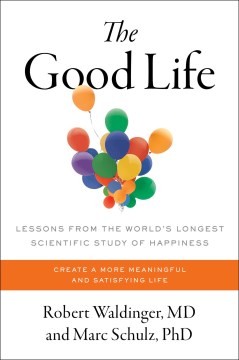
The Good Life
If relationships are central to a good life, which relationships deserve repair, and which require distance?
A lens on longitudinal evidence linking social connection with well-being, bounded by the quality, safety, culture, and unequal distribution of relationships.
- Edition
- First US hardcover edition. ISBN 9781982166694.
- Reviewed
- August 26, 2026
- Sources
- 3
Lens
Relationships can be a major source of health and meaning, but connection is not a command to preserve every tie. Invest in mutual, safe relationships and treat distance as legitimate when contact causes harm.
A lens on longitudinal evidence linking social connection with well-being, bounded by the quality, safety, culture, and unequal distribution of relationships. The useful move is not to adopt a slogan. It is to distinguish the book’s proposal from the conditions under which that proposal is responsible.
Attention
Relationships are maintained through repeated allocation of time and notice.
Quality
Distinguish supportive connection from mere contact or obligation.
Life course
Expect relationships and their functions to change across age and circumstance.
Safety
Let boundaries and distance count as relational wisdom.
Counter-lens
Relationships can protect health and also damage it. Family contact can include violence, control, prejudice, and care burden. Social connection is shaped by transport, housing, disability, work schedules, migration, discrimination, and digital infrastructure. Advice to “invest in relationships” is incomplete without these conditions.
Evidence
The book draws principally on the Harvard Study of Adult Development and related research. Longitudinal data can reveal durable associations and trajectories, but it does not turn one cohort into humanity or settle every causal pathway. The publisher identifies the book as a New York Times bestseller and records starred Kirkus reception.
The applications for The Good Life are editorial transfers directed at this question: If relationships are central to a good life, which relationships deserve repair, and which require distance? They remain proposed experiments, not reported outcomes or claims that Utpal Vaishnav has used the method. Their evidence must be assessed separately from the book’s influence or the coherence of its argument.
Limits
- The earliest Harvard cohorts were historically narrow and predominantly male.
- Observational associations do not prove one simple causal direction.
- Relationship quantity is not a substitute for quality or safety.
- Chosen family and culturally varied forms of connection require equal visibility.
Apply to my situation
Draw a relationship map with four labels: nourishing, reciprocal but neglected, demanding but repairable, and unsafe or depleting. Choose one action only from the first three. For the fourth, seek boundary, support, or safety planning rather than forced reconciliation.
Experiment
For four weeks, make one specific, low-burden bid each week to a safe relationship. Record response, mutuality, energy, and whether support moves both ways. Do not score affection as a productivity metric; use the notes to notice neglected reciprocity and limits.
Reflection
- Which ties are mutual and which depend on silent labor?
- What structural condition prevents connection?
- Where is distance healthier than repair?
- How should a good life include solitude as well as relationship?
Revision
Revise when cohort analyses change, when the lens marginalizes chosen family or solitude, or when an application implies that unsafe relationships should be preserved.
Sources
- Robert Waldinger and Marc Schulz, The Good Life. Simon & Schuster, 2023. ISBN 9781982166694. Edition record.
- Robert Waldinger and Marc Schulz, The Good Life. Simon & Schuster, 2023.
- Robert Waldinger, director, Harvard Study of Adult Development. Harvard Medical School.
Continue the inquiry
Research this book lens with AI
Research The Good Life as a maintained KNOLTOK lens, not as a summary or endorsement. Reader question: If relationships are central to a good life, which relationships deserve repair, and which require distance? Current synthesis: A lens on longitudinal evidence linking social connection with well-being, bounded by the quality, safety, culture, and unequal distribution of relationships. Current evidence status: mixed. Selected primary edition and provenance: title: "The Good Life"; author: "Robert Waldinger and Marc Schulz"; publisher: "Simon & Schuster"; publication date: "2023-01-10"; edition note: "First US hardcover edition. ISBN 9781982166694."; URL: "https://www.simonandschuster.com/books/The-Good-Life/Robert-Waldinger/9781982166694" Current Lens claim to test: Relationships can be a major source of health and meaning, but connection is not a command to preserve every tie. Invest in mutual, safe relationships and treat distance as legitimate when contact causes harm. A lens on longitudinal evidence linking social connection with well-being, bounded by the quality, safety, culture, and unequal distribution of relationships. The useful move is not to adopt a slogan. It is to distinguish the book's proposal from the conditions under which that proposal is responsible. Attention Relationships are maintained through repeated allocation of time and notice. Quality Distinguish supportive connection Current Counter-lens to strengthen or correct: Relationships can protect health and also damage it. Family contact can include violence, control, prejudice, and care burden. Social connection is shaped by transport, housing, disability, work schedules, migration, discrimination, and digital infrastructure. Advice to “invest in relationships” is incomplete without these conditions. Current Limits to verify: - The earliest Harvard cohorts were historically narrow and predominantly male. - Observational associations do not prove one simple causal direction. - Relationship quantity is not a substitute for quality or safety. - Chosen family and culturally varied forms of connection require equal visibility. Practical move under consideration: Choose one relationship that is both important and basically safe. Make one specific bid for attention, help, appreciation, repair, or shared time this week. Research these claims through strategy, organizational evidence, incentives, base rates, selection effects, and stakeholder outcomes; organizational behavior, power, worker experience, governance, law, and accountable dissent; power, consent, reciprocity, unequal alternatives, privacy, and relationship-specific evidence. Verify book-derived formulations against the selected edition and do not silently substitute another edition. Separate: what the book claims; KNOLTOK's interpretation; independent evidence; application proposals; recognition or influence; credible disagreement; and unresolved uncertainty. Treat sales, fame, anecdotes, cases, and publisher or company claims as reach or self-description, not independent proof. Do not invent quotations, page numbers, personal experience, outcomes, authorial intent, or consensus. Do not infer Utpal Vaishnav's private view beyond the text above. Start with the registered sources below, assess their interests and limitations, and then find stronger primary records, peer-reviewed research, authoritative datasets, critical scholarship, or stakeholder evidence. Do not merely repeat the registered sources: - https://www.simonandschuster.com/books/The-Good-Life/Robert-Waldinger/9781982166694 - https://www.simonandschuster.net/books/The-Good-Life/Robert-Waldinger/9781982166700 - https://www.adultdevelopmentstudy.org/ Return a claim ledger with 6 to 12 material claims. For each provide: exact claim; claim class; attribution; edition or page verification status; best supporting evidence with a direct link; strongest counterevidence or alternative explanation with a direct link; confidence as high, medium, low, or unresolved; transfer conditions; affected stakeholders; possible harm if overstated; and a keep, narrow, rewrite, or remove recommendation. Then provide source-quality notes, missing perspectives, contradictions with the current lens, 3 to 5 proposed revisions, one reversible experiment with baseline and stop condition, and explicit revision or retirement triggers. Use direct links and full citations. Quote only when exact wording materially matters and has been verified.
About this lens
Primary book: The Good Life by Robert Waldinger and Marc Schulz, First US hardcover edition. ISBN 9781982166694.
Lens author: Utpal Vaishnav. The interpretation, personal experience, and conclusions belong to the lens author.
AI assistance: AI assisted with source discovery, comparison, structure, and drafting. Utpal Vaishnav accepted the exact K200-B04 lens text for publication and remains responsible for the released synthesis. No personal experience, outcome, quotation, or page reference was invented.
Human review: Utpal Vaishnav
- 2026-08-26: Created the K200-B04 private review draft from the confirmed selection, with a full eight-section architecture and edition-specific source record.
- 2026-08-26: Accepted the exact K200-B04 lens text and prepared it for publication with the verified local cover.