
Book lens / Published
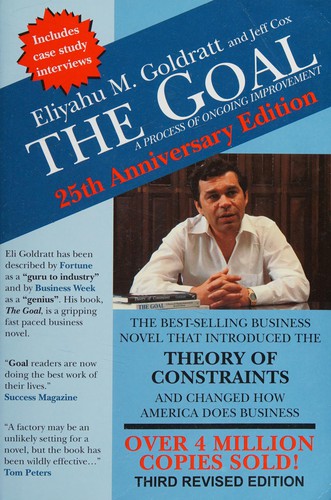
The Goal
What should improve first when every part of a system appears busy but the whole system is still underperforming?
A lens on finding the constraint that governs system performance, organizing work around it, and resisting local efficiency that does not improve the whole.
- Edition
- 25th anniversary, third revised edition. 408 pages. ISBN 9780884271956.
- Reviewed
- August 25, 2026
- Sources
- 5
Lens
Improving every part can make the whole worse.
That is the productive discomfort inside The Goal. A machine can run more often, a team can close more tickets, and a department can report better utilization while customer orders take longer to finish. Activity is not the same as flow.
The lens asks a harder question: what currently limits the system’s progress toward its goal?
What this lens retains
Define the goal before improving the system
An improvement only makes sense in relation to an outcome. Without a clear goal, local measures take over because they are easy to see.
For a commercial production system, Goldratt frames the goal in financial terms and connects operations to throughput, inventory, and operational expense. Other systems may have different or plural obligations. The principle remains useful: state what the system exists to achieve, then make the measure answer to that purpose.
The definition needs scrutiny. A narrow goal can make harmful behavior look efficient. Safety, quality, resilience, legality, and human consequences cannot be treated as invisible side conditions.
Find the factor that governs flow
Every system has a point, rule, resource, market condition, or decision that limits its present performance. Work added elsewhere cannot raise total output beyond that limit. It often creates more waiting.
The constraint may be physical, but it may also be a policy, approval queue, batch size, missing skill, unreliable input, or incorrect assumption. The most crowded place is not automatically the real constraint. The test is whether changing it improves the system’s chosen outcome.
Exploit before adding capacity
Time lost at the constraint is unusually expensive because the system cannot recover it by producing more elsewhere. Protecting it can mean ensuring that suitable work is ready, preventing avoidable interruptions, improving quality before work arrives, or moving tasks away that do not require the constrained capability.
This is not a demand to keep a person permanently overloaded. If a human being is the constraint, the diagnosis should expose an organizational design problem rather than justify pressure on that person.
Goldratt’s term “exploit” means using the existing constraint without avoidable loss before buying more capacity. Ensure usable work is ready. Remove work that does not require the constrained resource. Prevent defects from consuming the scarce slot. Protect recovery and maintenance where their absence would reduce sustainable capacity.
This is not a demand to keep a person permanently overloaded. If a human being is the constraint, the diagnosis should expose an organizational design problem rather than justify pressure on that person.
Let the rest of the system follow
Nonconstraints should support the rate the constraint can use. Producing more upstream merely because capacity is available can increase inventory, work in progress, coordination cost, and lead time.
This is where local efficiency becomes dangerous. A department can look productive while feeding the system more work than it can finish. The visible utilization gain is purchased with hidden delay.
Elevate only after alignment
If exploitation and subordination are insufficient, increase the constraint’s capacity. Add equipment, skill, authority, supplier capacity, demand, or a redesigned policy as the diagnosis requires.
Elevation can be costly and difficult to reverse. It comes fourth because added capacity at the wrong point can create cost without increasing the system’s goal units.
Expect the constraint to move
Once a constraint is relieved, another factor becomes limiting. Improvement is therefore a cycle, not a permanent fix.
The useful discipline is to look again. Yesterday’s operating rule may preserve a constraint that no longer exists. Goldratt’s fifth step warns that inertia itself can become the constraint.
Counter-lens
The system is not always governed by one stable, visible bottleneck.
Queueing theory shows why utilization, variability, and processing time interact. Waiting can rise sharply as a variable service process approaches full utilization, even when no resource looks permanently blocked. In such a system, the intervention may be to reduce variability, reserve protective capacity, change arrival patterns, or separate work classes rather than merely work the busiest stage harder.
Resilience offers another counter-lens. Redundancy and spare capacity can look inefficient until the environment changes. Safety, care, learning, and recovery may require resources that do not maximize short-term throughput.
Finally, the goal may be contested. A production novel can state a financial goal more cleanly than a public institution, creative practice, federation, or knowledge library can. Where multiple duties matter, constraint management must operate inside explicit guardrails rather than collapse all value into one metric.
Evidence
Directly grounded in Goldratt’s method: identify the constraint, exploit it, subordinate other decisions, elevate it, then repeat without allowing inertia to become the new constraint. Throughput, inventory, and operational expense connect local decisions to whole-system performance.
Strong analytical support for the flow logic: operations and queueing theory independently support the claims that local utilization can increase waiting and that variability becomes more damaging near full utilization.
Promising but uneven implementation evidence: a systematic review of 42 healthcare implementations reported positive productivity and timeliness outcomes. The review also included conference proceedings and other non-journal sources to address the shape of the available literature. Because all included implementations reported positive outcomes, publication and selection bias remain serious possibilities.
Limited general causal evidence: Gupta and Boyd concluded that TOC offers a coherent way to avoid local optimization, while noting that it had mostly not been empirically tested. Case reports show possibility and implementation detail. They do not establish universal effect sizes.
Interpretive extension: applying the constraint lens to editorial review, knowledge work, or personal attention is a transfer. It should be validated by measured flow, not by analogy alone.
Limits
- The busiest or most visible queue may not be the true system constraint.
- A constraint can move by work type, demand mix, time horizon, or failure state.
- Several non-substitutable duties can constrain a system at once.
- Average capacity can conceal damaging variability and tail risk.
- A throughput measure can reward low-quality completion or externalized harm.
- Elevating a human constraint can become chronic overload disguised as improvement.
- Subordination can silence useful local judgment if treated as centralized obedience.
- The method can become self-sealing if every disappointing result is attributed to incorrect implementation.
Apply to my situation
For these 5 KNOLTOK lenses, the apparent work is writing. The actual constraint may sit elsewhere: exact-source verification, independent evidence review, your authorial judgment, release isolation, or future maintenance capacity.
Do not infer the constraint from where the most files are waiting. Measure where a unit of reader-ready value loses the most time or returns for the most rework. If AI-assisted drafting creates text faster than exact claims can be checked, more drafting will enlarge inventory without increasing trustworthy output. If your review is the constraint, the remedy is not to bypass it. The system must protect your scarce judgment by presenting fewer, sharper decisions and keeping mechanical validation elsewhere.
The goal should also be explicit: not maximum lens count, but a small maintained corpus whose source, application, counterview, and revision state a reader can inspect.
Experiment
Choose one outcome for the next 2 weeks: 5 deep lenses ready for exact-text owner review with no unresolved high-materiality claim hidden in prose.
- Track each lens through research, claim classification, drafting, validation, and owner review.
- Record active time, waiting time, and rework at each stage.
- Identify the stage whose lost hour most delays the 5-lens outcome.
- Exploit it by preparing complete evidence decisions before work reaches it.
- Subordinate upstream drafting by limiting work in progress to what that stage can absorb.
- Measure elapsed time, unresolved material claims, revision loops, and hard-rule defects.
- Recheck the constraint after the first 2 lenses. Do not assume it stayed put.
The experiment is small on purpose. It tests the diagnosis without requiring a system-wide reorganization.
Reflection
- How can a team distinguish the real constraint from the most visible queue?
- When do policy constraints matter more than physical capacity?
- How should constraint management change when demand and work types vary sharply?
- Where do Lean, queueing theory, and Theory of Constraints reinforce or challenge one another?
- What measures reveal better flow without rewarding overload or hidden harm?
- What goal does the current metric omit?
- Which buffer protects variability, and which buffer merely hides delay?
- If a person appears to be the constraint, what task, rule, or missing capability is consuming that person’s scarce judgment?
- What evidence would show that the constraint diagnosis is wrong?
Revision
Revise this lens when measured flow contradicts the single-constraint diagnosis, when a different work type exposes another constraint, or when improvement in throughput damages quality, resilience, privacy, authorial control, or reader trust.
The revision record should identify the old constraint hypothesis, the intervention, the measures observed, and the new diagnosis. A moved constraint is not a failure of the method. A protected theory that cannot admit disconfirming evidence is.
Sources
- Eliyahu M. Goldratt and Jeff Cox, The Goal: A Process of Ongoing Improvement. 25th anniversary, third revised edition, North River Press, 2008. ISBN 9780884271956. Open Library edition record.
- Goldratt Marketing, official book and Theory of Constraints overview.
- Mahesh C. Gupta and Lynn H. Boyd, “Theory of Constraints: A Theory for Operations Management”, International Journal of Operations & Production Management 28, no. 10 (2008): 991-1012.
- Gustavo M. Bacelar-Silva, James F. Cox III, and Pedro Pereira Rodrigues, “Outcomes of Managing Healthcare Services Using the Theory of Constraints: A Systematic Review”, Health Systems 11, no. 1 (2022): 1-16. First published online in 2020.
- Michael A. Lewis and Christos Vasilakis, Operations Management. Cambridge University Press, 2026.
Lens notes
- Evidence status: practice-informed. The page presents a bounded synthesis of the book’s operating logic, not evidence that the lens author applied it in a specific organization.
- Curated and authored by Utpal Vaishnav with disclosed AI assistance.
- Last substantive revision: August 25, 2026.
Continue the inquiry
Research this book lens with AI
Research The Goal as a maintained KNOLTOK lens, not as a summary or endorsement. Reader question: What should improve first when every part of a system appears busy but the whole system is still underperforming? Current synthesis: A lens on finding the constraint that governs system performance, organizing work around it, and resisting local efficiency that does not improve the whole. Current evidence status: practice-informed. Selected primary edition and provenance: title: "The Goal: A Process of Ongoing Improvement"; author: "Eliyahu M. Goldratt and Jeff Cox"; publisher: "North River Press"; publication date: "2008-01-01"; edition note: "25th anniversary, third revised edition. 408 pages. ISBN 9780884271956."; URL: "https://openlibrary.org/books/OL27153187M/The_goal" Current Lens claim to test: Improving every part can make the whole worse. That is the productive discomfort inside The Goal. A machine can run more often, a team can close more tickets, and a department can report better utilization while customer orders take longer to finish. Activity is not the same as flow. The lens asks a harder question: what currently limits the system's progress toward its goal? What this lens retains Define the goal before improving the system An improvement only makes sense in relation to an outcome. Without a clear goal, local measures take over because they Current Counter-lens to strengthen or correct: The system is not always governed by one stable, visible bottleneck. Queueing theory shows why utilization, variability, and processing time interact. Waiting can rise sharply as a variable service process approaches full utilization, even when no resource looks permanently blocked. In such a system, the intervention may be to reduce variability, reserve protective capacity, change arrival patterns, or separate work classes rather than merely work the busiest stage harder. Resilience offers another counter-lens. Redundancy and spare capacity can look inefficient until the environment changes. Safety, care, learning, and recovery may require resources that do not Current Limits to verify: - The busiest or most visible queue may not be the true system constraint. - A constraint can move by work type, demand mix, time horizon, or failure state. - Several non-substitutable duties can constrain a system at once. - Average capacity can conceal damaging variability and tail risk. - A throughput measure can reward low-quality completion or externalized harm. - Elevating a human constraint can become chronic overload disguised as improvement. - Subordination can silence useful local judgment if treated as centralized obedience. - The method can become self-sealing if every disappointing result is Practical move under consideration: Choose one outcome and one time period. Identify the point that most limits that outcome, remove one source of lost capacity there, and measure whether total flow improves before optimizing anywhere else. Research these claims through strategy, organizational evidence, incentives, base rates, selection effects, and stakeholder outcomes; psychology, behavior change, construct validity, intervention evidence, and structural explanations; systems research, causal mechanisms, measurement, feedback, boundary conditions, and second-order effects; organizational behavior, power, worker experience, governance, law, and accountable dissent. Verify book-derived formulations against the selected edition and do not silently substitute another edition. Separate: what the book claims; KNOLTOK's interpretation; independent evidence; application proposals; recognition or influence; credible disagreement; and unresolved uncertainty. Treat sales, fame, anecdotes, cases, and publisher or company claims as reach or self-description, not independent proof. Do not invent quotations, page numbers, personal experience, outcomes, authorial intent, or consensus. Do not infer Utpal Vaishnav's private view beyond the text above. Start with the registered sources below, assess their interests and limitations, and then find stronger primary records, peer-reviewed research, authoritative datasets, critical scholarship, or stakeholder evidence. Do not merely repeat the registered sources: - https://openlibrary.org/books/OL27153187M/The_goal - https://www.toc-goldratt.com/en/product/product/The-Goal-A-Process-of-Ongoing-Improvement - https://doi.org/10.1108/01443570810903122 - https://pmc.ncbi.nlm.nih.gov/articles/PMC8812771/ - https://doi.org/10.1017/9781009325868 Return a claim ledger with 6 to 12 material claims. For each provide: exact claim; claim class; attribution; edition or page verification status; best supporting evidence with a direct link; strongest counterevidence or alternative explanation with a direct link; confidence as high, medium, low, or unresolved; transfer conditions; affected stakeholders; possible harm if overstated; and a keep, narrow, rewrite, or remove recommendation. Then provide source-quality notes, missing perspectives, contradictions with the current lens, 3 to 5 proposed revisions, one reversible experiment with baseline and stop condition, and explicit revision or retirement triggers. Use direct links and full citations. Quote only when exact wording materially matters and has been verified.
About this lens
Primary book: The Goal by Eliyahu M. Goldratt and Jeff Cox, 25th anniversary, third revised edition. 408 pages. ISBN 9780884271956.
Lens author: Utpal Vaishnav. The interpretation, personal experience, and conclusions belong to the lens author.
AI assistance: AI assisted with bibliographic research, structure, and drafting. Utpal Vaishnav requested publication of the lens and accepted responsibility for the released synthesis. No personal experience or book quotation was invented.
Human review: Utpal Vaishnav
- 2026-08-25: Published the initial lens using the 25th anniversary, third revised North River Press edition and an Open Library edition record.
- 2026-08-26: Deepened the lens with formal focusing steps, queueing and empirical counterweights, a KNOLTOK application, an experiment, reflection questions, and revision triggers.