
Book lens / Published
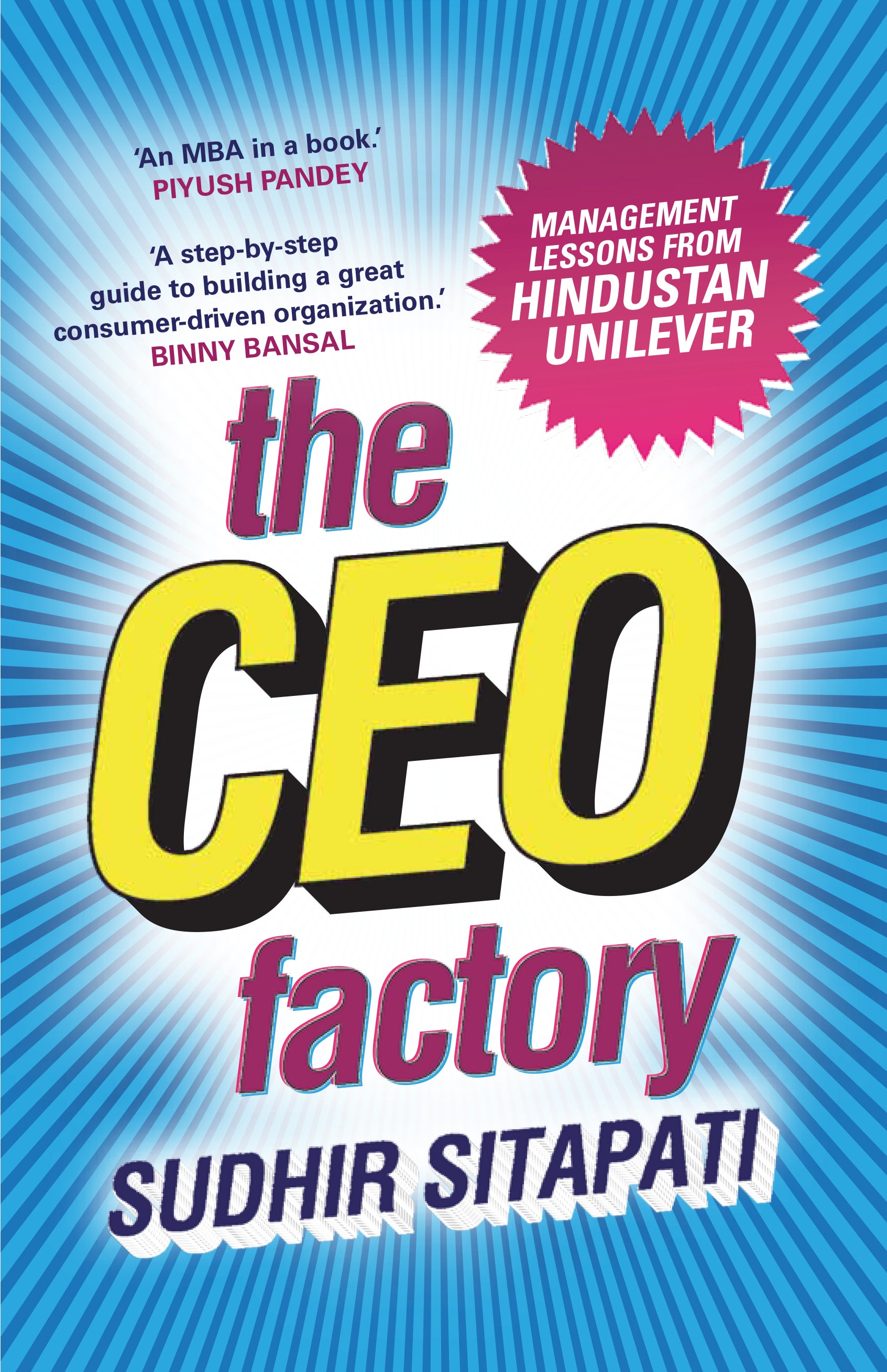
The CEO Factory
Does a leadership factory develop judgment, or reproduce one institution's preferred leader?
An India-centered lens on how operating systems, brands, markets, and talent practices shape leadership.
- Edition
- Paperback, ISBN 9789353451141.
- Reviewed
- August 25, 2026
- Sources
- 2
Lens
The book redirects attention from exceptional individuals to the operating system around them. Market exposure, delegation, brands, pricing, field experience, and talent practices shape the judgments an institution repeatedly produces.
An insider account can reveal mechanism and still carry institutional loyalty. HUL’s scale, consumer categories, history, and Indian market position limit direct transfer to smaller firms or other sectors.
Leadership is trained by work
Formal courses matter less than the repeated decisions an institution asks people to make. Assignments determine which markets they encounter. Measures determine what they notice. Reviews determine which errors can be discussed. Promotions reveal which behaviors the institution actually values.
This makes leadership development an operating question. If managers are expected to understand customers but spend no time near distribution or use, the system is training abstraction. If ownership is praised but every decision is escalated, the system is training permission seeking.
Brands and markets as a school
The book’s setting matters. Consumer goods work connects product, price, distribution, communication, and local market knowledge. Rotations across these problems can build general managers who see a business as a connected system rather than a collection of functions.
Yet repeated success can narrow the template. A model developed in a large, established FMCG company may favor people who thrive in its rhythms and definitions of performance. Entrepreneurial, technical, public-sector, or care-centered institutions may require different judgment.
Where this lens is useful
Use it when an organization asks why it lacks leaders for the next level. Before searching for traits or hiring externally, inspect the assignments, authority, feedback, incentives, and consequences through which current leaders are formed.
It is also useful for succession. A company that produces capable leaders repeatedly is less dependent on identifying one heroic individual.
A reversible experiment
Choose one behavior leaders say they want. Map the assignment, incentive, information, and review practice that currently trains the opposite behavior.
Change one condition for a defined period and look for a behavioral difference. Do not announce a new leadership value while leaving the training system intact.
Counter-lens
An institution can produce impressive leaders and still reproduce its exclusions, blind spots, and preferred style. Promotion evidence should be examined across gender, caste, class, region, disability, educational route, and dissenting perspective where reliable data is available.
Strong systems can also overfit people to one company. Leadership quality must be judged in context, not inferred from the reputation of the factory.
Reflection
- Which HUL practices travel beyond FMCG?
- Who is excluded by a successful leadership template?
Evidence
The selected edition of The CEO Factory establishes what the book argues. It does not independently prove this synthesis: An India-centered lens on how operating systems, brands, markets, and talent practices shape leadership. Verify consequential causal and transfer claims outside the book, identify the comparison class, and assign confidence claim by claim.
Limits
The transfer boundary for The CEO Factory is built into its question: Does a leadership factory develop judgment, or reproduce one institution’s preferred leader? Do not generalize from a memorable example or retrospective success. Test domain, timing, resources, incentives, power, consent, and who bears the downside.
Apply to my situation
For KNOLTOK, treat The CEO Factory as a proposed decision aid rather than a personal claim. Its book-specific move is: Map one leadership behavior to the system that trains, rewards, and corrects it. Change one condition before asking for a different leader. For this application, record why ‘Map one leadership behavior to the system that trains, rewards, and corrects it. Change one condition before asking for a different leader’ fits the current case, which source supports it, who is affected, and what evidence would block transfer.
Experiment
Use the proposed move from The CEO Factory: Map one leadership behavior to the system that trains, rewards, and corrects it. Change one condition before asking for a different leader. Run one low-cost, reversible case. Record the baseline, expected signal, alternative explanation, affected parties, stop condition, and review date. Preserve contrary observations.
Revision
Revise The CEO Factory when edition verification changes a book-derived claim, independent evidence changes confidence, or application exposes a material failure mode. Narrow claims that outrun their sources. Retire the mechanism if fair tests repeatedly fail or its harms cannot be contained.
Continue the inquiry
Research this book lens with AI
Research The CEO Factory as a maintained KNOLTOK lens, not as a summary or endorsement. Reader question: Does a leadership factory develop judgment, or reproduce one institution's preferred leader? Current synthesis: An India-centered lens on how operating systems, brands, markets, and talent practices shape leadership. Current evidence status: practice-informed. Selected primary edition and provenance: title: "The CEO Factory: Management Lessons from Hindustan Unilever"; author: "Sudhir Sitapati"; publisher: "Juggernaut Books"; publication date: "2019-12-17"; edition note: "Paperback, ISBN 9789353451141."; URL: "https://koha.srmap.edu.in/cgi-bin/koha/opac-MARCdetail.pl?biblionumber=18104" Current Lens claim to test: The book redirects attention from exceptional individuals to the operating system around them. Market exposure, delegation, brands, pricing, field experience, and talent practices shape the judgments an institution repeatedly produces. An insider account can reveal mechanism and still carry institutional loyalty. HUL's scale, consumer categories, history, and Indian market position limit direct transfer to smaller firms or other sectors. Leadership is trained by work Formal courses matter less than the repeated decisions an institution asks people to make. Assignments determine which markets they encounter. Measures determine what they notice. Reviews determine which errors can be Current Counter-lens to strengthen or correct: An institution can produce impressive leaders and still reproduce its exclusions, blind spots, and preferred style. Promotion evidence should be examined across gender, caste, class, region, disability, educational route, and dissenting perspective where reliable data is available. Strong systems can also overfit people to one company. Leadership quality must be judged in context, not inferred from the reputation of the factory. Current Limits to verify: The transfer boundary for The CEO Factory is built into its question: Does a leadership factory develop judgment, or reproduce one institution's preferred leader? Do not generalize from a memorable example or retrospective success. Test domain, timing, resources, incentives, power, consent, and who bears the downside. Practical move under consideration: Map one leadership behavior to the system that trains, rewards, and corrects it. Change one condition before asking for a different leader. Research these claims through strategy, organizational evidence, incentives, base rates, selection effects, and stakeholder outcomes; psychology, behavior change, construct validity, intervention evidence, and structural explanations; systems research, causal mechanisms, measurement, feedback, boundary conditions, and second-order effects; organizational behavior, power, worker experience, governance, law, and accountable dissent. Verify book-derived formulations against the selected edition and do not silently substitute another edition. Separate: what the book claims; KNOLTOK's interpretation; independent evidence; application proposals; recognition or influence; credible disagreement; and unresolved uncertainty. Treat sales, fame, anecdotes, cases, and publisher or company claims as reach or self-description, not independent proof. Do not invent quotations, page numbers, personal experience, outcomes, authorial intent, or consensus. Do not infer Utpal Vaishnav's private view beyond the text above. Start with the registered sources below, assess their interests and limitations, and then find stronger primary records, peer-reviewed research, authoritative datasets, critical scholarship, or stakeholder evidence. Do not merely repeat the registered sources: - https://koha.srmap.edu.in/cgi-bin/koha/opac-MARCdetail.pl?biblionumber=18104 - https://www.inkl.com/news/review-the-ceo-factory-by-sudhir-sitapati Return a claim ledger with 6 to 12 material claims. For each provide: exact claim; claim class; attribution; edition or page verification status; best supporting evidence with a direct link; strongest counterevidence or alternative explanation with a direct link; confidence as high, medium, low, or unresolved; transfer conditions; affected stakeholders; possible harm if overstated; and a keep, narrow, rewrite, or remove recommendation. Then provide source-quality notes, missing perspectives, contradictions with the current lens, 3 to 5 proposed revisions, one reversible experiment with baseline and stop condition, and explicit revision or retirement triggers. Use direct links and full citations. Quote only when exact wording materially matters and has been verified.
About this lens
Primary book: The CEO Factory by Sudhir Sitapati, Paperback, ISBN 9789353451141.
Lens author: Utpal Vaishnav. The interpretation, personal experience, and conclusions belong to the lens author.
AI assistance: AI assisted with research, structure, and drafting. Utpal Vaishnav approved the central lens boundary. No insider experience was invented.
Human review: Utpal Vaishnav
- 2026-08-25: Created the K200-B01 review draft.