
Book lens / Published
The Artist's Way
Does creative practice require belief in inspiration, or can ritual make room for work before belief arrives?
A lens on morning pages, artist dates, and creative recovery that treats ritual as a practice for attention, not proven therapy or a compulsory spiritual program.
- Edition
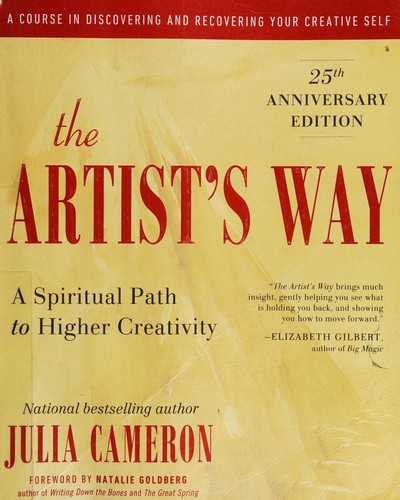
- Twenty-fifth anniversary paperback edition. ISBN 9780143129257. The work was first published in 1992.
- Reviewed
- August 26, 2026
- Sources
- 3
Lens
Regular private writing and deliberate encounters with curiosity can lower the threshold for creative work. Their value should be judged through changed practice, not spiritual certainty or testimonial promise.
A lens on morning pages, artist dates, and creative recovery that treats ritual as a practice for attention, not proven therapy or a compulsory spiritual program. The useful move is not to adopt a slogan. It is to distinguish the book’s proposal from the conditions under which that proposal is responsible.
Morning pages
Use uncensored private writing to notice mental residue and recurring material.
Artist date
Protect solitary contact with curiosity, play, and sensory input.
Recovery
Frame blocked creativity as a relationship that can be rebuilt through practice.
Optional spirituality
Separate useful ritual from metaphysical claims a reader does not share.
Counter-lens
Creativity blocks can arise from skill gaps, discrimination, poverty, disability, care burden, trauma, depression, or exploitative markets. Private ritual may help attention while leaving those causes unchanged. Compulsory positivity or spirituality can also estrange readers from otherwise usable practices.
Evidence
The program is practice-led and supported mainly by durable adoption and testimony. Publishers Weekly ranked the anniversary edition #1 on its Religion Nonfiction bestseller list dated September 11, 2023, documenting unusual longevity. That ranking does not establish therapeutic efficacy or prove that three pages and weekly dates are optimal doses.
The applications for The Artist’s Way are editorial transfers directed at this question: Does creative practice require belief in inspiration, or can ritual make room for work before belief arrives? They remain proposed experiments, not reported outcomes or claims that Utpal Vaishnav has used the method. Their evidence must be assessed separately from the book’s influence or the coherence of its argument.
Limits
- The practices are not established clinical treatments.
- Morning pages may increase rumination for some people.
- Anecdotal success is vulnerable to selection and survivorship bias.
- Creative recovery still requires craft, feedback, opportunity, and conditions.
Apply to my situation
Define one stalled creative practice and one barrier class: attention, skill, fear, resources, access, or feedback. Use morning pages only for attention and pattern discovery. Choose a different remedy when the barrier belongs elsewhere.
Experiment
Run the core ritual for two weeks with a stop rule. Track starts, time spent making, emotional aftereffects, sleep, rumination, and one piece of work advanced. Compare with the prior two weeks. Continue, modify, or stop based on the whole pattern.
Reflection
- What barrier can this ritual actually address?
- Which spiritual term needs translation or rejection?
- Is private writing opening work or replacing it?
- What external support would make creativity materially possible?
Revision
Revise when evidence on expressive writing or rumination changes, when the practice is mistaken for therapy, or when edition comparison alters the program. Preserve the difference between durable influence and verified effect.
Sources
- Julia Cameron, The Artist’s Way. TarcherPerigee, 2016. ISBN 9780143129257. Edition record.
- Julia Cameron, The Artist’s Way anniversary edition. Publishers Weekly, 2023.
- Julia Cameron, The Artist’s Way. Penguin Random House, 2016.
Continue the inquiry
Research this book lens with AI
Research The Artist's Way as a maintained KNOLTOK lens, not as a summary or endorsement. Reader question: Does creative practice require belief in inspiration, or can ritual make room for work before belief arrives? Current synthesis: A lens on morning pages, artist dates, and creative recovery that treats ritual as a practice for attention, not proven therapy or a compulsory spiritual program. Current evidence status: mixed. Selected primary edition and provenance: title: "The Artist's Way"; author: "Julia Cameron"; publisher: "TarcherPerigee"; publication date: "2016-10-25"; edition note: "Twenty-fifth anniversary paperback edition. ISBN 9780143129257. The work was first published in 1992."; URL: "https://penguinrandomhouselibrary.com/book/?isbn=9780143129257" Current Lens claim to test: Regular private writing and deliberate encounters with curiosity can lower the threshold for creative work. Their value should be judged through changed practice, not spiritual certainty or testimonial promise. A lens on morning pages, artist dates, and creative recovery that treats ritual as a practice for attention, not proven therapy or a compulsory spiritual program. The useful move is not to adopt a slogan. It is to distinguish the book's proposal from the conditions under which that proposal is responsible. Morning pages Use uncensored private writing to notice mental residue and recurring material. Artist date Current Counter-lens to strengthen or correct: Creativity blocks can arise from skill gaps, discrimination, poverty, disability, care burden, trauma, depression, or exploitative markets. Private ritual may help attention while leaving those causes unchanged. Compulsory positivity or spirituality can also estrange readers from otherwise usable practices. Current Limits to verify: - The practices are not established clinical treatments. - Morning pages may increase rumination for some people. - Anecdotal success is vulnerable to selection and survivorship bias. - Creative recovery still requires craft, feedback, opportunity, and conditions. Practical move under consideration: For seven mornings, write three private longhand pages without editing. Pair the week with one solitary, low-cost encounter chosen only for curiosity. Review effects after the practice, not during it. Research these claims through literary form, authorial context, reception, and the boundary between interpretation and external fact; strategy, organizational evidence, incentives, base rates, selection effects, and stakeholder outcomes; psychology, behavior change, construct validity, intervention evidence, and structural explanations; religious studies, historical context, testimony, practice outcomes, and metaphysical claims. Verify book-derived formulations against the selected edition and do not silently substitute another edition. Separate: what the book claims; KNOLTOK's interpretation; independent evidence; application proposals; recognition or influence; credible disagreement; and unresolved uncertainty. Treat sales, fame, anecdotes, cases, and publisher or company claims as reach or self-description, not independent proof. Do not invent quotations, page numbers, personal experience, outcomes, authorial intent, or consensus. Do not infer Utpal Vaishnav's private view beyond the text above. Start with the registered sources below, assess their interests and limitations, and then find stronger primary records, peer-reviewed research, authoritative datasets, critical scholarship, or stakeholder evidence. Do not merely repeat the registered sources: - https://penguinrandomhouselibrary.com/book/?isbn=9780143129257 - https://www.publishersweekly.com/pw/nielsen/ReligionNonfiction/20230911.html Return a claim ledger with 6 to 12 material claims. For each provide: exact claim; claim class; attribution; edition or page verification status; best supporting evidence with a direct link; strongest counterevidence or alternative explanation with a direct link; confidence as high, medium, low, or unresolved; transfer conditions; affected stakeholders; possible harm if overstated; and a keep, narrow, rewrite, or remove recommendation. Then provide source-quality notes, missing perspectives, contradictions with the current lens, 3 to 5 proposed revisions, one reversible experiment with baseline and stop condition, and explicit revision or retirement triggers. Use direct links and full citations. Quote only when exact wording materially matters and has been verified.
About this lens
Primary book: The Artist's Way by Julia Cameron, Twenty-fifth anniversary paperback edition. ISBN 9780143129257. The work was first published in 1992.
Lens author: Utpal Vaishnav. The interpretation, personal experience, and conclusions belong to the lens author.
AI assistance: AI assisted with source discovery, comparison, structure, and drafting. Utpal Vaishnav accepted the exact K200-B04 lens text for publication and remains responsible for the released synthesis. No personal experience, outcome, quotation, or page reference was invented.
Human review: Utpal Vaishnav
- 2026-08-26: Created the K200-B04 private review draft from the confirmed selection, with a full eight-section architecture and edition-specific source record.
- 2026-08-26: Accepted the exact K200-B04 lens text and prepared it for publication with the verified local cover.