
Book lens / Published
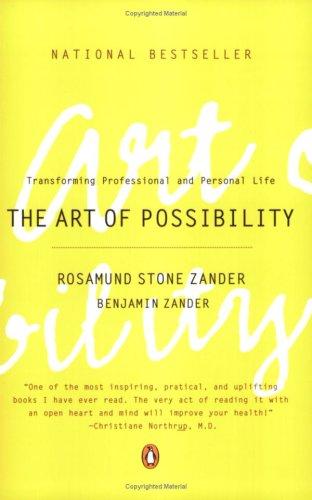
The Art of Possibility
When does a possibility frame enlarge responsible action, and when does it deny real constraints?
A practice-based lens on contribution, interpretation, and leadership that uses reframing to widen action while keeping evidence, power, and constraint visible.
- Edition
- First US hardcover edition. ISBN 9780875847702.
- Reviewed
- August 26, 2026
- Sources
- 3
Lens
A new frame can reveal actions hidden by scarcity or ranking. It is useful when it generates responsible experiments and dangerous when it relabels material constraint or justified dissent as poor attitude.
A practice-based lens on contribution, interpretation, and leadership that uses reframing to widen action while keeping evidence, power, and constraint visible. The useful move is not to adopt a slogan. It is to distinguish the book’s proposal from the conditions under which that proposal is responsible.
Frames
Distinguish an interpretation from the whole situation.
Contribution
Ask what can be added rather than where one ranks.
Enrollment
Invite participation through shared possibility rather than hidden pressure.
Reality test
Let evidence and affected people challenge the new frame.
Counter-lens
Frames matter, and facts constrain frames. A worker cannot reframe away unsafe conditions; a group cannot enroll someone into consent; a leader cannot call criticism scarcity thinking. Possibility becomes responsible when it increases truthful options and distributes agency rather than demanding enthusiasm.
Evidence
The book offers twelve practices through stories, teaching, psychotherapy, and conducting experience. Penguin Random House identifies the later paperback as a national bestseller and attributes favorable reception to The Boston Globe. These establish reach and reception, not controlled evidence that the practices cause the described transformations.
The applications for The Art of Possibility are editorial transfers directed at this question: When does a possibility frame enlarge responsible action, and when does it deny real constraints? They remain proposed experiments, not reported outcomes or claims that Utpal Vaishnav has used the method. Their evidence must be assessed separately from the book’s influence or the coherence of its argument.
Limits
- Anecdotes illustrate possibility but do not establish effect size.
- Reframing can individualize institutional failure.
- Enrollment can become manipulation when refusal is costly.
- Rosamund Stone Zander’s coauthorship and therapeutic contribution must remain visible.
Apply to my situation
Invite affected people to name what the current frame excludes before proposing a new one. Define a small test, a disconfirming observation, and a stop condition. A possibility frame earns trust by admitting what would show it is wrong.
Experiment
For one stalled collaboration, solicit three descriptions independently. Create one alternative frame that preserves the hardest fact from each. Test it through a two-week action and measure participation, burden, dissent, and result, not enthusiasm alone.
Reflection
- Who gains agency under the new frame?
- Which fact is hardest for the possibility story to hold?
- Can participants refuse enrollment without penalty?
- What evidence would return us to the old diagnosis?
Revision
Revise if the practices are presented as validated psychology, if coauthorship is obscured, or if an application suppresses material constraints or dissent.
Sources
- Rosamund Stone Zander and Benjamin Zander, The Art of Possibility. Harvard Business School Press, 2000. ISBN 9780875847702. Edition record.
- Rosamund Stone Zander and Benjamin Zander, The Art of Possibility. Penguin Random House, 2002.
- Rosamund Stone Zander and Benjamin Zander, The Art of Possibility. Open British National Bibliography, 2002.
Continue the inquiry
Research this book lens with AI
Research The Art of Possibility as a maintained KNOLTOK lens, not as a summary or endorsement. Reader question: When does a possibility frame enlarge responsible action, and when does it deny real constraints? Current synthesis: A practice-based lens on contribution, interpretation, and leadership that uses reframing to widen action while keeping evidence, power, and constraint visible. Current evidence status: mixed. Selected primary edition and provenance: title: "The Art of Possibility"; author: "Rosamund Stone Zander and Benjamin Zander"; publisher: "Harvard Business School Press"; publication date: "2000-09-01"; edition note: "First US hardcover edition. ISBN 9780875847702."; URL: "https://www.penguinrandomhouse.com/books/289694/the-art-of-possibility-by-rosamund-stone-zander-and-benjamin-zander/" Current Lens claim to test: A new frame can reveal actions hidden by scarcity or ranking. It is useful when it generates responsible experiments and dangerous when it relabels material constraint or justified dissent as poor attitude. A practice-based lens on contribution, interpretation, and leadership that uses reframing to widen action while keeping evidence, power, and constraint visible. The useful move is not to adopt a slogan. It is to distinguish the book's proposal from the conditions under which that proposal is responsible. Frames Distinguish an interpretation from the whole situation. Contribution Ask what can be added rather than where Current Counter-lens to strengthen or correct: Frames matter, and facts constrain frames. A worker cannot reframe away unsafe conditions; a group cannot enroll someone into consent; a leader cannot call criticism scarcity thinking. Possibility becomes responsible when it increases truthful options and distributes agency rather than demanding enthusiasm. Current Limits to verify: - Anecdotes illustrate possibility but do not establish effect size. - Reframing can individualize institutional failure. - Enrollment can become manipulation when refusal is costly. - Rosamund Stone Zander’s coauthorship and therapeutic contribution must remain visible. Practical move under consideration: Take one stuck situation and write the current frame, what it makes visible, and what it excludes. Generate one alternative frame and one reversible action that would test it. Research these claims through strategy, organizational evidence, incentives, base rates, selection effects, and stakeholder outcomes; psychology, behavior change, construct validity, intervention evidence, and structural explanations; systems research, causal mechanisms, measurement, feedback, boundary conditions, and second-order effects; organizational behavior, power, worker experience, governance, law, and accountable dissent. Verify book-derived formulations against the selected edition and do not silently substitute another edition. Separate: what the book claims; KNOLTOK's interpretation; independent evidence; application proposals; recognition or influence; credible disagreement; and unresolved uncertainty. Treat sales, fame, anecdotes, cases, and publisher or company claims as reach or self-description, not independent proof. Do not invent quotations, page numbers, personal experience, outcomes, authorial intent, or consensus. Do not infer Utpal Vaishnav's private view beyond the text above. Start with the registered sources below, assess their interests and limitations, and then find stronger primary records, peer-reviewed research, authoritative datasets, critical scholarship, or stakeholder evidence. Do not merely repeat the registered sources: - https://www.penguinrandomhouse.com/books/289694/the-art-of-possibility-by-rosamund-stone-zander-and-benjamin-zander/ - https://obnb.uk/p13454471-the-art-of-possibility Return a claim ledger with 6 to 12 material claims. For each provide: exact claim; claim class; attribution; edition or page verification status; best supporting evidence with a direct link; strongest counterevidence or alternative explanation with a direct link; confidence as high, medium, low, or unresolved; transfer conditions; affected stakeholders; possible harm if overstated; and a keep, narrow, rewrite, or remove recommendation. Then provide source-quality notes, missing perspectives, contradictions with the current lens, 3 to 5 proposed revisions, one reversible experiment with baseline and stop condition, and explicit revision or retirement triggers. Use direct links and full citations. Quote only when exact wording materially matters and has been verified.
About this lens
Primary book: The Art of Possibility by Rosamund Stone Zander and Benjamin Zander, First US hardcover edition. ISBN 9780875847702.
Lens author: Utpal Vaishnav. The interpretation, personal experience, and conclusions belong to the lens author.
AI assistance: AI assisted with source discovery, comparison, structure, and drafting. Utpal Vaishnav accepted the exact K200-B04 lens text for publication and remains responsible for the released synthesis. No personal experience, outcome, quotation, or page reference was invented.
Human review: Utpal Vaishnav
- 2026-08-26: Created the K200-B04 private review draft from the confirmed selection, with a full eight-section architecture and edition-specific source record.
- 2026-08-26: Accepted the exact K200-B04 lens text and prepared it for publication with the verified local cover.