
Book lens / Published
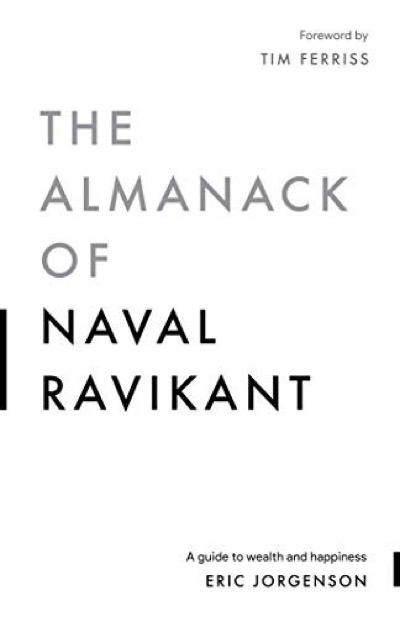
The Almanack of Naval Ravikant
How can specific knowledge, leverage, long-term relationships, and compounding change the way a person builds wealth?
A personal reading of genuine curiosity, leverage, long-term games, and compounding in The Almanack of Naval Ravikant.
- Edition
- Reading edition identified by Utpal Vaishnav through Amazon ASIN B0F9VM4V5N. Public bibliographic details remain unverified.
- Reviewed
- August 24, 2026
- Sources
- 3
Lens
How can specific knowledge, leverage, long-term relationships, and compounding change the way a person builds wealth?
Evidence
The ideas I retained form a sequence.
Build specific knowledge by pursuing genuine curiosity rather than forcing yourself into rigid career tracks. Then use leverage so that the value of what you know is not limited to the hours you can personally sell. Labor and capital are the traditional forms of leverage.
Play long-term games with long-term people. Give good decisions, useful work, trust, and relationships enough time for compounding to do its job.
The sequence matters. Leverage without knowledge can scale something weak. A long time horizon with the wrong people can compound the wrong incentives. The ideas become useful when they reinforce each other.
Evidence and reasoning
Build specific knowledge
Specific knowledge begins with genuine curiosity. It directs learning toward questions a person is willing to pursue deeply, even when no conventional career track has yet validated them.
This does not make career tracks useless. It warns against treating a standard track as a substitute for discovering what a person can uniquely learn, combine, and contribute.
Scale with leverage
Time is precious because it cannot be replenished. If income depends only on hours sold, the scale of the work remains tied to the scale of personal time.
Labor and capital are traditional forms of leverage. They can increase what one person’s knowledge or judgment can influence. They also bring responsibility because their use affects other people’s time, incentives, and risk.
Play long-term games with long-term people
A long-term game changes the quality of a decision. Reputation, trust, shared context, and repeated cooperation can accumulate. Short-term extraction becomes more costly when the relationship is expected to continue.
The choice of people matters as much as the length of the game. Time compounds what is repeatedly practiced, whether it is healthy or harmful.
Let compounding work
Compounding connects knowledge, leverage, and relationships. Knowledge can build on prior knowledge. Good work can create more opportunity. Trust can reduce the cost of future cooperation.
Compounding requires continuity, but continuity alone is not proof of progress. The underlying action and relationship still need to deserve repetition.
Counter-lens
Advice about leverage can sound universal while depending on access to capital, technology, networks, or labor. Success can make a principle appear more inevitable than it was. Specific knowledge can also become a flattering label for an interest that has not yet produced value.
The book is a curated work. Eric Jorgenson selected and organized statements from different contexts. Each important idea should be traced back to its original setting before the compressed wording is treated as a complete argument.
Reflection
- Identify where genuine curiosity led Utpal beyond a conventional track.
- Distinguish leverage that creates value from leverage that merely transfers risk.
- Examine how to identify long-term people before a long history exists.
- Trace the selected passages to Naval Ravikant’s original interviews, posts, or podcasts.
Limits
The transfer boundary for The Almanack of Naval Ravikant is built into its question: How can specific knowledge, leverage, long-term relationships, and compounding change the way a person builds wealth? Do not generalize from a memorable example or retrospective success. Test domain, timing, resources, incentives, power, consent, and who bears the downside.
Apply to my situation
For KNOLTOK, treat The Almanack of Naval Ravikant as a proposed decision aid rather than a personal claim. Its book-specific move is: test one bounded application before generalizing. For this application, record why ‘test one bounded application’ fits the current case, which source supports it, who is affected, and what evidence would block transfer.
Experiment
Use the proposed move from The Almanack of Naval Ravikant: Test one bounded application before generalizing. Run one low-cost, reversible case. Record the baseline, expected signal, alternative explanation, affected parties, stop condition, and review date. Preserve contrary observations.
Sources
- Eric Jorgenson, The Almanack of Naval Ravikant: A Guide to Wealth and Happiness. Confirmed Amazon reading record
- Eric Jorgenson, official Navalmanack site
- Eric Jorgenson, official freely distributed book PDF, 2020.
Revision
- Human author: Utpal Vaishnav.
- Human reviewer: Utpal Vaishnav.
- AI assisted with structure, editing, source separation, and research preparation.
- Exact text approved for publication on August 24, 2026.
Continue the inquiry
Research this book lens with AI
Research The Almanack of Naval Ravikant as a maintained KNOLTOK lens, not as a summary or endorsement. Reader question: How can specific knowledge, leverage, long-term relationships, and compounding change the way a person builds wealth? Current synthesis: A personal reading of genuine curiosity, leverage, long-term games, and compounding in The Almanack of Naval Ravikant. Current evidence status: not stated. Selected primary edition and provenance: title: "The Almanack of Naval Ravikant: A Guide to Wealth and Happiness"; author: "Eric Jorgenson"; edition note: "Reading edition identified by Utpal Vaishnav through Amazon ASIN B0F9VM4V5N. Public bibliographic details remain unverified."; URL: "https://www.amazon.com/exec/obidos/ASIN/B0F9VM4V5N" Current Lens claim to test: How can specific knowledge, leverage, long-term relationships, and compounding change the way a person builds wealth? Current Counter-lens to strengthen or correct: Advice about leverage can sound universal while depending on access to capital, technology, networks, or labor. Success can make a principle appear more inevitable than it was. Specific knowledge can also become a flattering label for an interest that has not yet produced value. The book is a curated work. Eric Jorgenson selected and organized statements from different contexts. Each important idea should be traced back to its original setting before the compressed wording is treated as a complete argument. Current Limits to verify: The transfer boundary for The Almanack of Naval Ravikant is built into its question: How can specific knowledge, leverage, long-term relationships, and compounding change the way a person builds wealth? Do not generalize from a memorable example or retrospective success. Test domain, timing, resources, incentives, power, consent, and who bears the downside. Practical move under consideration: Run one reversible test and preserve contrary evidence. Research these claims through strategy, organizational evidence, incentives, base rates, selection effects, and stakeholder outcomes; systems research, causal mechanisms, measurement, feedback, boundary conditions, and second-order effects; finance, survivorship, leverage, downside allocation, distribution, and institutional opportunity; political economy, law, legitimacy, geography, distribution, and affected communities. Verify book-derived formulations against the selected edition and do not silently substitute another edition. Separate: what the book claims; KNOLTOK's interpretation; independent evidence; application proposals; recognition or influence; credible disagreement; and unresolved uncertainty. Treat sales, fame, anecdotes, cases, and publisher or company claims as reach or self-description, not independent proof. Do not invent quotations, page numbers, personal experience, outcomes, authorial intent, or consensus. Do not infer Utpal Vaishnav's private view beyond the text above. Start with the registered sources below, assess their interests and limitations, and then find stronger primary records, peer-reviewed research, authoritative datasets, critical scholarship, or stakeholder evidence. Do not merely repeat the registered sources: - https://www.amazon.com/exec/obidos/ASIN/B0F9VM4V5N - https://www.navalmanack.com/ - https://navalmanack.s3.amazonaws.com/Eric-Jorgenson_The-Almanack-of-Naval-Ravikant_Final.pdf Return a claim ledger with 6 to 12 material claims. For each provide: exact claim; claim class; attribution; edition or page verification status; best supporting evidence with a direct link; strongest counterevidence or alternative explanation with a direct link; confidence as high, medium, low, or unresolved; transfer conditions; affected stakeholders; possible harm if overstated; and a keep, narrow, rewrite, or remove recommendation. Then provide source-quality notes, missing perspectives, contradictions with the current lens, 3 to 5 proposed revisions, one reversible experiment with baseline and stop condition, and explicit revision or retirement triggers. Use direct links and full citations. Quote only when exact wording materially matters and has been verified.
About this lens
Primary book: The Almanack of Naval Ravikant by Eric Jorgenson, Reading edition identified by Utpal Vaishnav through Amazon ASIN B0F9VM4V5N. Public bibliographic details remain unverified.
Lens author: Utpal Vaishnav. The interpretation, personal experience, and conclusions belong to the lens author.
AI assistance: AI assisted with structure, editing, source separation, and research preparation. The selected ideas and conclusions attributed to Utpal Vaishnav are his and were accepted by Utpal Vaishnav for publication.
Human review: Utpal Vaishnav
- 2026-08-13: Prepared with AI as a research scaffold.
- 2026-08-15: Added Utpal Vaishnav's selected ideas, confirmed the Amazon reading record, and promoted the lens to review.