
Book lens / Published
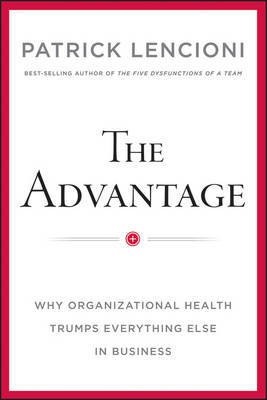
The Advantage
Why can organizational health become a durable advantage even when competitors can copy strategy and technology?
A curated lens on Patrick Lencioni's case for cohesive leadership, organizational clarity, repeated communication, and systems that reinforce what matters.
- Edition
- First-edition hardcover. ISBN 9780470941522. Wiley records disagree on page count, listing 240 and 256 pages; exact-copy confirmation remains required.
- Reviewed
- August 24, 2026
- Sources
- 2
Lens
An organization can have intelligent people, a credible strategy, and capable technology while remaining difficult to operate.
Lencioni’s argument is that organizational health creates an advantage because it reduces politics and confusion, helps people coordinate, and makes the organization’s intelligence usable. Health is not a soft addition to performance. It is the condition that allows other strengths to work together.
Evidence
Build a cohesive leadership team
Clarity is fragile when leaders do not trust one another, debate important questions, commit to decisions, hold one another accountable, and focus on shared results.
Cohesion does not require constant agreement. It requires enough trust and discipline to surface disagreement before a decision and support the decision afterward.
Create clarity
People cannot align around a direction that leaders have not made explicit. A useful leadership team develops shared answers about purpose, behavior, priorities, strategy, and responsibility.
The value is not in producing elegant statements. It is in resolving ambiguity that would otherwise be answered differently across the organization.
Overcommunicate clarity
One announcement rarely changes an organization. Important ideas need repetition through different settings and from leaders whose actions remain consistent with the message.
Repetition can feel excessive to the person sending it while remaining insufficient for the person expected to act on it.
Reinforce clarity
Recruiting, onboarding, performance management, recognition, compensation, and dismissal all teach people what the organization actually values.
A stated priority that is contradicted by these systems becomes ceremonial. Reinforcement turns clarity into an operating pattern.
Apply to my situation
This lens is useful when capable teams repeatedly lose energy to politics, conflicting priorities, unclear ownership, or meetings that circulate information without producing commitment.
A practical inquiry is to ask:
- What must the leadership team agree to make clear?
- Where do leaders behave as separate functions instead of one team?
- Which messages require repetition?
- Which systems reward behavior that contradicts the stated direction?
Counter-lens
Organizational health cannot substitute for a viable strategy, ethical conduct, product quality, capital, or changing market conditions. A cohesive organization can still pursue the wrong goal.
Clarity can also harden into conformity. Healthy disagreement, protected dissent, and evidence that challenges leadership remain necessary.
The claim that health trumps everything else is best treated as Lencioni’s organizing thesis, not universal causal proof. Its practical value is to make coordination and operating health visible alongside conventional strategy and finance.
Limits
The transfer boundary for The Advantage is built into its question: Why can organizational health become a durable advantage even when competitors can copy strategy and technology? Do not generalize from a memorable example or retrospective success. Test domain, timing, resources, incentives, power, consent, and who bears the downside.
Experiment
Use the proposed move from The Advantage: Test one bounded application before generalizing. Run one low-cost, reversible case. Record the baseline, expected signal, alternative explanation, affected parties, stop condition, and review date. Preserve contrary observations.
Reflection
- What did The Advantage help me notice about this question: Why can organizational health become a durable advantage even when competitors can copy strategy and technology?
- Which part is book-derived claim, independent evidence, interpretation, application, or metaphor?
- What alternative explanation fits the same result?
- Who benefits, who pays, who did not choose the exposure, and who can appeal?
- What observation would make me narrow or abandon this specific lens?
Sources
- Patrick Lencioni, The Advantage: Why Organizational Health Trumps Everything Else in Business. Jossey-Bass, 2012. First-edition hardcover, ISBN 9780470941522. Wiley edition record.
- Wiley newsroom record.
Revision
This is a curated knowledge lens, not a claim that its applications happened to the lens author. Curated and authored by Utpal Vaishnav.
Continue the inquiry
Research this book lens with AI
Research The Advantage as a maintained KNOLTOK lens, not as a summary or endorsement. Reader question: Why can organizational health become a durable advantage even when competitors can copy strategy and technology? Current synthesis: A curated lens on Patrick Lencioni's case for cohesive leadership, organizational clarity, repeated communication, and systems that reinforce what matters. Current evidence status: not stated. Selected primary edition and provenance: title: "The Advantage: Why Organizational Health Trumps Everything Else in Business"; author: "Patrick Lencioni"; publisher: "Jossey-Bass, an imprint of John Wiley & Sons"; publication date: "2012-03-20"; edition note: "First-edition hardcover. ISBN 9780470941522. Wiley records disagree on page count, listing 240 and 256 pages; exact-copy confirmation remains required."; URL: "https://www.wiley.com/en-us/The+Advantage%3A+Why+Organizational+Health+Trumps+Everything+Else+In+Business-p-9780470941522" Current Lens claim to test: An organization can have intelligent people, a credible strategy, and capable technology while remaining difficult to operate. Lencioni's argument is that organizational health creates an advantage because it reduces politics and confusion, helps people coordinate, and makes the organization's intelligence usable. Health is not a soft addition to performance. It is the condition that allows other strengths to work together. Current Counter-lens to strengthen or correct: Organizational health cannot substitute for a viable strategy, ethical conduct, product quality, capital, or changing market conditions. A cohesive organization can still pursue the wrong goal. Clarity can also harden into conformity. Healthy disagreement, protected dissent, and evidence that challenges leadership remain necessary. The claim that health trumps everything else is best treated as Lencioni's organizing thesis, not universal causal proof. Its practical value is to make coordination and operating health visible alongside conventional strategy and finance. Current Limits to verify: The transfer boundary for The Advantage is built into its question: Why can organizational health become a durable advantage even when competitors can copy strategy and technology? Do not generalize from a memorable example or retrospective success. Test domain, timing, resources, incentives, power, consent, and who bears the downside. Practical move under consideration: Run one reversible test and preserve contrary evidence. Research these claims through strategy, organizational evidence, incentives, base rates, selection effects, and stakeholder outcomes; psychology, behavior change, construct validity, intervention evidence, and structural explanations; systems research, causal mechanisms, measurement, feedback, boundary conditions, and second-order effects; organizational behavior, power, worker experience, governance, law, and accountable dissent. Verify book-derived formulations against the selected edition and do not silently substitute another edition. Separate: what the book claims; KNOLTOK's interpretation; independent evidence; application proposals; recognition or influence; credible disagreement; and unresolved uncertainty. Treat sales, fame, anecdotes, cases, and publisher or company claims as reach or self-description, not independent proof. Do not invent quotations, page numbers, personal experience, outcomes, authorial intent, or consensus. Do not infer Utpal Vaishnav's private view beyond the text above. Start with the registered sources below, assess their interests and limitations, and then find stronger primary records, peer-reviewed research, authoritative datasets, critical scholarship, or stakeholder evidence. Do not merely repeat the registered sources: - https://www.wiley.com/en-us/The+Advantage%3A+Why+Organizational+Health+Trumps+Everything+Else+In+Business-p-9780470941522 - https://newsroom.wiley.com/press-releases/press-release-details/2012/The-Advantage-Why-Organizational-Health-Trumps-Everything-Else-In-Business/default.aspx Return a claim ledger with 6 to 12 material claims. For each provide: exact claim; claim class; attribution; edition or page verification status; best supporting evidence with a direct link; strongest counterevidence or alternative explanation with a direct link; confidence as high, medium, low, or unresolved; transfer conditions; affected stakeholders; possible harm if overstated; and a keep, narrow, rewrite, or remove recommendation. Then provide source-quality notes, missing perspectives, contradictions with the current lens, 3 to 5 proposed revisions, one reversible experiment with baseline and stop condition, and explicit revision or retirement triggers. Use direct links and full citations. Quote only when exact wording materially matters and has been verified.
About this lens
Primary book: The Advantage by Patrick Lencioni, First-edition hardcover. ISBN 9780470941522. Wiley records disagree on page count, listing 240 and 256 pages; exact-copy confirmation remains required.
Lens author: Utpal Vaishnav. The interpretation, personal experience, and conclusions belong to the lens author.
AI assistance: AI assisted with intake extraction, bibliographic research, structure, and editing. Utpal Vaishnav selected the book and lens, determined the synthesis and boundaries, and accepted responsibility for the published synthesis.
Human review: Utpal Vaishnav
- 2026-08-23: Created a books-first review lens and matched the first-edition hardcover ISBN to Wiley records; retained the unresolved page-count discrepancy.