
Book lens / Published
The 7 Habits of Highly Effective People
How can the seven habits become a practical operating system for leadership, priorities, relationships, and lifelong learning?
A personal reading of how the seven habits shaped Utpal Vaishnav's leadership, intentionality, negotiation, listening, co-creation, and learning.
- Edition
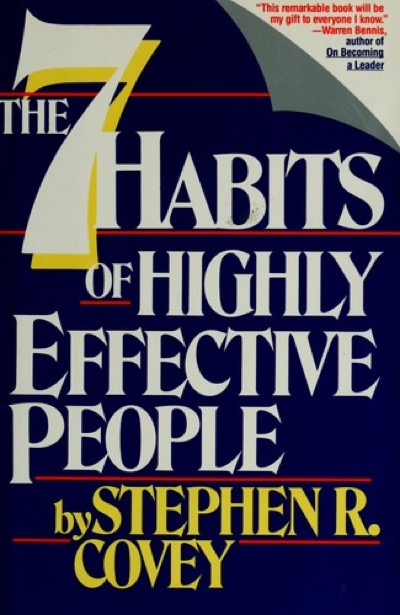
- Confirmed physical edition. 358 pages. ISBN 9780671663988; Open Library edition OL24362766M.
- Reviewed
- August 24, 2026
- Sources
- 1
Lens
How can the seven habits become a practical operating system for leadership, priorities, relationships, and lifelong learning?
Evidence
The seven habits helped me because they did not remain seven ideas. They became ways to lead, choose, negotiate, listen, collaborate, and keep learning.
Being proactive shaped my leadership more than any other habit. I applied it in chess, programming, business, and almost every area of work and life. It changed my position from waiting for circumstances to acting on what I could influence.
Beginning with the end in mind made me more intentional. Putting first things first came later. It helped me reduce my ego because the first thing was not always the thing I liked. Its priority did not depend on my preference.
The public habits shaped how I worked with people. Thinking win-win became the basis of every negotiation I led. Seeking first to understand helped me consciously refine my listening and empathy. Synergy planted the seeds of co-creation, which is important to how I see the future.
Sharpening the saw gave these habits continuity. I subscribed to lifelong learning.
Evidence and reasoning
Be proactive
Proactivity became the governing habit for me. I applied it in chess, programming, business, and almost every area of work and life.
The lens still needs concrete examples before it can say precisely how the habit changed an action or outcome.
Begin with the end in mind
This habit made me more intentional. The lens still needs a concrete example of what changed when the end was defined first.
Put first things first
I learned this habit late. Its effect was partly operational and partly personal. It taught me that importance and preference are different.
Doing the first thing sometimes meant placing the needs of the work ahead of the task that protected my comfort or ego.
Think win-win
Win-win became the basis of every negotiation I led.
This does not mean that every negotiation produces equal outcomes or that every interest can be reconciled. It establishes the kind of outcome I look for.
Seek first to understand, then to be understood
This habit gave me a deliberate practice for listening. It made empathy something to exercise consciously rather than something to assume I already possessed.
The lens still needs an example that distinguishes understanding from agreement and shows what changed in the conversation.
Synergize
Synergy planted the seeds of co-creation for me. The idea matters because I see the future as something people build together, not merely something one person designs and others accept.
Co-creation still requires judgment. Collaboration is not automatically better because more people participate.
Sharpen the saw
This habit reinforced my commitment to lifelong learning. Renewal keeps an operating system from becoming a rigid identity.
Counter-lens
The habits can overstate individual control when institutions, power, resources, or circumstances constrain the available choices. A win-win orientation does not remove unequal bargaining power. Listening does not resolve every conflict. Proactivity can become blame if it ignores what a person cannot control.
The framework remains useful to me when responsibility is paired with an honest view of constraints.
Reflection
- Identify concrete decisions that show how proactivity changed the action taken.
- Examine when win-win negotiation is possible and when withdrawal is the better choice.
- Test co-creation against situations that require clear individual accountability.
- Research the evidence for the framework without treating popularity as validation.
Limits
The transfer boundary for The 7 Habits of Highly Effective People is built into its question: How can the seven habits become a practical operating system for leadership, priorities, relationships, and lifelong learning? Do not generalize from a memorable example or retrospective success. Test domain, timing, resources, incentives, power, consent, and who bears the downside.
Apply to my situation
For KNOLTOK, treat The 7 Habits of Highly Effective People as a proposed decision aid rather than a personal claim. Its book-specific move is: test one bounded application before generalizing. For this application, record why ‘test one bounded application’ fits the current case, which source supports it, who is affected, and what evidence would block transfer.
Experiment
Use the proposed move from The 7 Habits of Highly Effective People: Test one bounded application before generalizing. Run one low-cost, reversible case. Record the baseline, expected signal, alternative explanation, affected parties, stop condition, and review date. Preserve contrary observations.
Sources
- Stephen R. Covey, The 7 Habits of Highly Effective People. Simon & Schuster, 1989. Confirmed physical edition, ISBN 9780671663988. Open Library edition record
Revision
- Human author: Utpal Vaishnav.
- Human reviewer: Utpal Vaishnav.
- AI assisted with structure, editing, and research preparation.
- Exact text approved for publication on August 24, 2026.
Continue the inquiry
Research this book lens with AI
Research The 7 Habits of Highly Effective People as a maintained KNOLTOK lens, not as a summary or endorsement. Reader question: How can the seven habits become a practical operating system for leadership, priorities, relationships, and lifelong learning? Current synthesis: A personal reading of how the seven habits shaped Utpal Vaishnav's leadership, intentionality, negotiation, listening, co-creation, and learning. Current evidence status: not stated. Selected primary edition and provenance: title: "The 7 Habits of Highly Effective People"; author: "Stephen R. Covey"; publisher: "Simon & Schuster"; publication date: "1989"; edition note: "Confirmed physical edition. 358 pages. ISBN 9780671663988; Open Library edition OL24362766M."; URL: "https://openlibrary.org/books/OL24362766M/The_7_Habits_of_Highly_Effective_People" Current Lens claim to test: How can the seven habits become a practical operating system for leadership, priorities, relationships, and lifelong learning? Current Counter-lens to strengthen or correct: The habits can overstate individual control when institutions, power, resources, or circumstances constrain the available choices. A win-win orientation does not remove unequal bargaining power. Listening does not resolve every conflict. Proactivity can become blame if it ignores what a person cannot control. The framework remains useful to me when responsibility is paired with an honest view of constraints. Current Limits to verify: The transfer boundary for The 7 Habits of Highly Effective People is built into its question: How can the seven habits become a practical operating system for leadership, priorities, relationships, and lifelong learning? Do not generalize from a memorable example or retrospective success. Test domain, timing, resources, incentives, power, consent, and who bears the downside. Practical move under consideration: Run one reversible test and preserve contrary evidence. Research these claims through strategy, organizational evidence, incentives, base rates, selection effects, and stakeholder outcomes; psychology, behavior change, construct validity, intervention evidence, and structural explanations; systems research, causal mechanisms, measurement, feedback, boundary conditions, and second-order effects; organizational behavior, power, worker experience, governance, law, and accountable dissent. Verify book-derived formulations against the selected edition and do not silently substitute another edition. Separate: what the book claims; KNOLTOK's interpretation; independent evidence; application proposals; recognition or influence; credible disagreement; and unresolved uncertainty. Treat sales, fame, anecdotes, cases, and publisher or company claims as reach or self-description, not independent proof. Do not invent quotations, page numbers, personal experience, outcomes, authorial intent, or consensus. Do not infer Utpal Vaishnav's private view beyond the text above. Start with the registered sources below, assess their interests and limitations, and then find stronger primary records, peer-reviewed research, authoritative datasets, critical scholarship, or stakeholder evidence. Do not merely repeat the registered sources: - https://openlibrary.org/books/OL24362766M/The_7_Habits_of_Highly_Effective_People Return a claim ledger with 6 to 12 material claims. For each provide: exact claim; claim class; attribution; edition or page verification status; best supporting evidence with a direct link; strongest counterevidence or alternative explanation with a direct link; confidence as high, medium, low, or unresolved; transfer conditions; affected stakeholders; possible harm if overstated; and a keep, narrow, rewrite, or remove recommendation. Then provide source-quality notes, missing perspectives, contradictions with the current lens, 3 to 5 proposed revisions, one reversible experiment with baseline and stop condition, and explicit revision or retirement triggers. Use direct links and full citations. Quote only when exact wording materially matters and has been verified.
About this lens
Primary book: The 7 Habits of Highly Effective People by Stephen R. Covey, Confirmed physical edition. 358 pages. ISBN 9780671663988; Open Library edition OL24362766M.
Lens author: Utpal Vaishnav. The interpretation, personal experience, and conclusions belong to the lens author.
AI assistance: AI assisted with structure, editing, and research preparation. The applications and conclusions attributed to Utpal Vaishnav are his and were accepted by Utpal Vaishnav for publication.
Human review: Utpal Vaishnav
- 2026-08-13: Prepared with AI as a research scaffold.
- 2026-08-15: Added Utpal Vaishnav's authorial input, confirmed the physical edition, and promoted the lens to review.