
Book lens / Published
Surrounded by Idiots
Can a behavioral shorthand improve communication without reducing people to four fixed types?
A critical lens on the practical appeal, scientific limits, and social costs of four-color personality classification.
- Edition
- English edition, ISBN 9781250179944. Translated by Martin Pender and Rod Bradbury.
- Reviewed
- August 26, 2026
- Sources
- 4
Lens
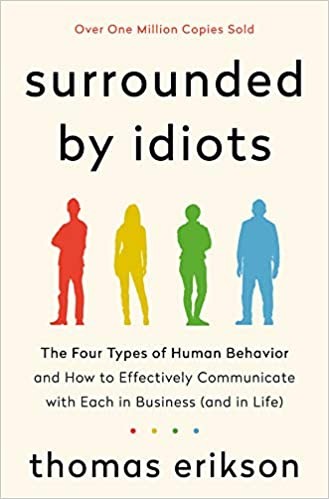
The book offers a relief that many teams want: difficult behavior becomes legible. A direct person can be understood as task focused, an expressive person as socially energized, a patient person as stability seeking, and an analytical person as detail oriented. The colors are easy to remember and easy to discuss.
Ease is not validity. Human personality is not divided into four natural kinds, and a memorable diagram does not establish a sound psychological instrument. Behavior changes with role, safety, culture, fatigue, incentives, expertise, and the people present. The same person may speak quickly during a crisis, deliberate carefully over a contract, and avoid conflict with a powerful manager.
The useful question is not, “What color is this person?” It is, “What am I observing, what else could explain it, and what communication would help here?”
What this lens retains
- People differ in pace, directness, appetite for detail, and preferred forms of interaction.
- Communication should be adapted to the receiver, not only expressed in the sender’s default style.
- Conflict sometimes comes from mismatched expectations rather than bad intent.
- A shared vocabulary can make a difficult conversation easier to begin.
- Observation should lead to curiosity, not certainty.
Used lightly, a shorthand can remind a fast speaker to provide context or a detailed writer to lead with the decision. The adjustment is useful because it responds to feedback, not because a color has revealed an essence.
Counter-lens
The strongest counter-lens is not a better set of colors. It is dimensional, contextual description.
Personality research generally models traits as continua rather than 4 natural kinds. Even scientifically studied trait models do not license a manager to infer ability, motive, or destiny from a label. Their predictive relationships with work outcomes are probabilistic, usually modest, and dependent on role, measure, and context.
For communication, direct inquiry is often more useful than assessment. Ask whether the person wants a decision first or supporting detail, synchronous discussion or written review, time to think or rapid iteration. A stated preference is not permanent either, but it can be corrected by the person it concerns.
Evidence
The book’s reach and accessibility are well documented. That establishes cultural influence, not psychometric validity.
Luoma and Hirvonen’s 2026 analysis is unusually direct: it classifies the DISC or DISA framework used by the book as pseudoscience and the related workplace practices as “social pseudotechnologies.” Their important point is that a workshop can feel useful for reasons that do not validate the theory. It may create permission to discuss conflict, provide memorable prompts, increase attention, or produce expectancy effects.
The evidence boundary is therefore sharper than this lens previously stated:
- differences in behavior and communication preference are real;
- the four-color taxonomy is not an established scientific account of those differences;
- practical usefulness, when reported, does not prove the taxonomy true;
- no hiring, promotion, diagnosis, or capability decision should rest on a color assignment.
Limits
Classification changes the relationship
Once a label is assigned, confirmation bias can do the rest. Ambiguous behavior is interpreted as evidence for the type. Contradictions are treated as exceptions. Managers may assign roles, assess potential, or explain conflict through the label rather than through work evidence.
That is especially risky for people already misread by dominant workplace norms. Neurodivergent communication, second-language speech, disability, gendered expectations, racial stereotypes, and differences in power can all be recoded as personality. A tool intended to create understanding can make exclusion sound objective.
The commercial ecosystem matters too. Books, assessments, workshops, and certifications can reinforce one another without producing independent validation. Sales and organizational adoption show reach. They do not prove that the categories measure stable traits or improve decisions.
The title creates another risk. Beginning from the premise that other people are idiots can turn misunderstanding into contempt. Communication improves when the other person remains an informant about their own needs, not an object to decode.
Behavior before type
Describe the event without the color. “She asked for the supporting assumptions before approving the proposal” is more useful than “She is blue.” The first statement can be checked and discussed. The second invites a fixed identity.
Then add context. Was the decision high risk? Had earlier estimates failed? Did the team omit information? Finally, ask the person what would make the next exchange effective. This protects the practical insight, that communication can be adapted, while removing the false certainty.
Apply to my situation
In a federated organization or multi-project system, color labels would create false portability. A leader who is terse in a capital-allocation review may behave differently while mentoring, negotiating, or handling a crisis. The decision context, authority, information, and consequence all change.
Use a behavior record instead:
- What did the person do or say?
- In what role and under what constraint?
- What effect did it have on the work?
- What alternative explanations remain possible?
- What communication preference can I ask them to confirm?
For KNOLTOK, this lens should function as a critical case study in how a memorable framework can outrun its evidence. It should never be presented as a personality tool offered by the library.
Experiment
For one week, prohibit color labels in a team discussion. Record the behavior, context, effect, and request instead. Compare whether the resulting action is more specific. If the shorthand does not improve prediction or mutual understanding, retire it.
Before the week begins, record one prediction that the color model would make. Do not tell the person which color has been assigned. At the end, ask whether the behavioral description was accurate and useful. The other person’s correction counts as data; agreement by the labeler alone does not.
Reflection
- What psychometric evidence supports or contradicts the underlying framework?
- How stable are observed preferences across situations and cultures?
- What happens when employers use typologies in selection or promotion?
- Which communication adjustments help without requiring classification?
- What harm becomes possible when a manager mistakes ease of use for validity?
- Am I describing observed behavior or protecting an existing impression?
- Would I make the same inference if status, culture, disability, gender, or language were different?
Revision
Revise or retire this lens if stronger independent psychometric evidence establishes a specific DISC instrument for a specific bounded use. The evidence would need construct validity, reliability, incremental validity over simpler observation, and a defensible account of harms.
Until then, the revision rule is strict: new popularity, testimonials, certification programs, or company adoption do not raise the evidence status.
Lens notes
- Evidence status: contested.
- Bestseller status is evidence of reach, not psychological validity.
- Curated and authored by Utpal Vaishnav; no personal diagnosis or experience is claimed.
- Publication state: published on August 26, 2026; materially corrected later the same day after independent evidence review.
Continue the inquiry
Research this book lens with AI
Research Surrounded by Idiots as a maintained KNOLTOK lens, not as a summary or endorsement. Reader question: Can a behavioral shorthand improve communication without reducing people to four fixed types? Current synthesis: A critical lens on the practical appeal, scientific limits, and social costs of four-color personality classification. Current evidence status: contested. Selected primary edition and provenance: title: "Surrounded by Idiots"; author: "Thomas Erikson"; publisher: "St. Martin's Essentials"; publication date: "2019-07-30"; edition note: "English edition, ISBN 9781250179944. Translated by Martin Pender and Rod Bradbury."; URL: "https://openlibrary.org/isbn/9781250179944" Current Lens claim to test: The book offers a relief that many teams want: difficult behavior becomes legible. A direct person can be understood as task focused, an expressive person as socially energized, a patient person as stability seeking, and an analytical person as detail oriented. The colors are easy to remember and easy to discuss. Ease is not validity. Human personality is not divided into four natural kinds, and a memorable diagram does not establish a sound psychological instrument. Behavior changes with role, safety, culture, fatigue, incentives, expertise, and the people present. The same person may speak quickly during Current Counter-lens to strengthen or correct: The strongest counter-lens is not a better set of colors. It is dimensional, contextual description. Personality research generally models traits as continua rather than 4 natural kinds. Even scientifically studied trait models do not license a manager to infer ability, motive, or destiny from a label. Their predictive relationships with work outcomes are probabilistic, usually modest, and dependent on role, measure, and context. For communication, direct inquiry is often more useful than assessment. Ask whether the person wants a decision first or supporting detail, synchronous discussion or written review, time to think or rapid iteration. Current Limits to verify: Classification changes the relationship Once a label is assigned, confirmation bias can do the rest. Ambiguous behavior is interpreted as evidence for the type. Contradictions are treated as exceptions. Managers may assign roles, assess potential, or explain conflict through the label rather than through work evidence. That is especially risky for people already misread by dominant workplace norms. Neurodivergent communication, second-language speech, disability, gendered expectations, racial stereotypes, and differences in power can all be recoded as personality. A tool intended to create understanding can make exclusion sound objective. The commercial ecosystem matters too. Books, assessments, Practical move under consideration: Replace one color label with a specific observed behavior, its context, and a direct question about what the person needs. Research these claims through psychology, behavior change, construct validity, intervention evidence, and structural explanations; systems research, causal mechanisms, measurement, feedback, boundary conditions, and second-order effects; organizational behavior, power, worker experience, governance, law, and accountable dissent; finance, survivorship, leverage, downside allocation, distribution, and institutional opportunity. Verify book-derived formulations against the selected edition and do not silently substitute another edition. Separate: what the book claims; KNOLTOK's interpretation; independent evidence; application proposals; recognition or influence; credible disagreement; and unresolved uncertainty. Treat sales, fame, anecdotes, cases, and publisher or company claims as reach or self-description, not independent proof. Do not invent quotations, page numbers, personal experience, outcomes, authorial intent, or consensus. Do not infer Utpal Vaishnav's private view beyond the text above. Start with the registered sources below, assess their interests and limitations, and then find stronger primary records, peer-reviewed research, authoritative datasets, critical scholarship, or stakeholder evidence. Do not merely repeat the registered sources: - https://openlibrary.org/isbn/9781250179944 - https://www.publishersweekly.com/9781250179944 - https://doi.org/10.1111/theo.70076 - https://doi.org/10.1146/annurev-orgpsych-032414-111441 Return a claim ledger with 6 to 12 material claims. For each provide: exact claim; claim class; attribution; edition or page verification status; best supporting evidence with a direct link; strongest counterevidence or alternative explanation with a direct link; confidence as high, medium, low, or unresolved; transfer conditions; affected stakeholders; possible harm if overstated; and a keep, narrow, rewrite, or remove recommendation. Then provide source-quality notes, missing perspectives, contradictions with the current lens, 3 to 5 proposed revisions, one reversible experiment with baseline and stop condition, and explicit revision or retirement triggers. Use direct links and full citations. Quote only when exact wording materially matters and has been verified.
About this lens
Primary book: Surrounded by Idiots by Thomas Erikson, English edition, ISBN 9781250179944. Translated by Martin Pender and Rod Bradbury.
Lens author: Utpal Vaishnav. The interpretation, personal experience, and conclusions belong to the lens author.
AI assistance: AI assisted with research, structure, and drafting. No psychological diagnosis, scientific consensus, or personal observation was invented.
Human review: Utpal Vaishnav
- 2026-08-26: Prepared the K200-B03 local review lens.
- 2026-08-26: Reclassified the four-color model as pseudoscientific rather than merely simplified, and added evidence, application, experiment, reflection, and revision boundaries.