
Book lens / Published
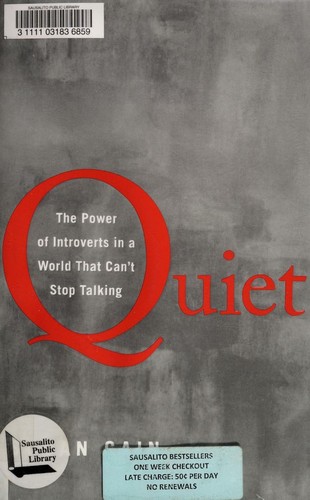
Quiet
How do we make room for reflective temperaments without turning introversion into a superior identity?
A lens on the institutions and habits that reward visible assertiveness while overlooking reflective, low-stimulation, or privately developed forms of contribution.
- Edition
- First US hardcover edition. ISBN 9780307352149.
- Reviewed
- August 26, 2026
- Sources
- 3
Lens
Temperament affects preferred stimulation and expression, but it does not determine courage, competence, warmth, or leadership. Design participation so several forms of contribution can become visible.
A lens on the institutions and habits that reward visible assertiveness while overlooking reflective, low-stimulation, or privately developed forms of contribution. The useful move is not to adopt a slogan. It is to distinguish the book’s proposal from the conditions under which that proposal is responsible.
Stimulation
Notice that people differ in the amount and kind of stimulation they prefer.
Preparation
Let considered contribution develop before social speed becomes the selection mechanism.
Plural participation
Offer spoken, written, synchronous, and asynchronous paths into shared work.
No hierarchy
Do not turn a critique of the extrovert ideal into an introvert ideal.
Counter-lens
A temperament frame can make institutional bias visible, but it can also become identity essentialism. Quiet is not automatically insight, speaking is not automatically shallowness, and leadership is not owned by either style. Shyness, social anxiety, autism, depression, trauma, and sensory sensitivity must not be collapsed into introversion.
Evidence
The book integrates personality research, reporting, and case material. Its #1 New York Times bestseller status establishes exceptional reach. Mainstream personality research generally treats introversion and extraversion as dimensional traits, not sealed types, and behavior also varies with role, culture, safety, and situation.
The applications for Quiet are editorial transfers directed at this question: How do we make room for reflective temperaments without turning introversion into a superior identity? They remain proposed experiments, not reported outcomes or claims that Utpal Vaishnav has used the method. Their evidence must be assessed separately from the book’s influence or the coherence of its argument.
Limits
- Introversion and extraversion are continua, not two kinds of people.
- Self-description can shift across context and life stage.
- The book’s cultural critique is shaped heavily by US institutions.
- Participation design cannot by itself repair harassment, exclusion, or clinical distress.
Apply to my situation
Audit one recurring meeting. Who receives the question early, who speaks first, whose interruption is tolerated, and what input remains invisible? Add one reflection-first channel and compare whether the decision uses a wider range of evidence.
Experiment
For four meetings, collect two minutes of silent written input before discussion and an asynchronous response afterward. Track unique concerns raised, speaking concentration, decision changes, and participant burden. Keep the practice only if it improves evidence and access rather than merely lengthening the meeting.
Reflection
- Which behavior is being rewarded: insight, speed, confidence, or familiarity?
- Where does the environment create unnecessary stimulation?
- What would make participation safer without prescribing one style?
- When does temperament language conceal a skill gap or power problem?
Revision
Revise if personality research materially changes the trait model, if applications reinforce binary identity, or if participation experiments do not improve decision quality or access.
Sources
- Susan Cain, Quiet. Crown, 2012. ISBN 9780307352149. Edition record.
- Susan Cain, Quiet. Penguin Random House, 2012.
- William Fleeson and Eranda Jayawickreme, Personality and Social Psychology: Moving Toward a More Perfect Union. Annual Review of Psychology, 2021.
Continue the inquiry
Research this book lens with AI
Research Quiet as a maintained KNOLTOK lens, not as a summary or endorsement. Reader question: How do we make room for reflective temperaments without turning introversion into a superior identity? Current synthesis: A lens on the institutions and habits that reward visible assertiveness while overlooking reflective, low-stimulation, or privately developed forms of contribution. Current evidence status: mixed. Selected primary edition and provenance: title: "Quiet"; author: "Susan Cain"; publisher: "Crown"; publication date: "2012-01-24"; edition note: "First US hardcover edition. ISBN 9780307352149."; URL: "https://www.penguinrandomhouse.com/books/22821/quiet-by-susan-cain/9780307352149/" Current Lens claim to test: Temperament affects preferred stimulation and expression, but it does not determine courage, competence, warmth, or leadership. Design participation so several forms of contribution can become visible. A lens on the institutions and habits that reward visible assertiveness while overlooking reflective, low-stimulation, or privately developed forms of contribution. The useful move is not to adopt a slogan. It is to distinguish the book's proposal from the conditions under which that proposal is responsible. Stimulation Notice that people differ in the amount and kind of stimulation they prefer. Preparation Let considered contribution develop before social speed becomes Current Counter-lens to strengthen or correct: A temperament frame can make institutional bias visible, but it can also become identity essentialism. Quiet is not automatically insight, speaking is not automatically shallowness, and leadership is not owned by either style. Shyness, social anxiety, autism, depression, trauma, and sensory sensitivity must not be collapsed into introversion. Current Limits to verify: - Introversion and extraversion are continua, not two kinds of people. - Self-description can shift across context and life stage. - The book’s cultural critique is shaped heavily by US institutions. - Participation design cannot by itself repair harassment, exclusion, or clinical distress. Practical move under consideration: Before the next group decision, circulate the question in advance, gather independent written responses, and let discussion follow rather than precede reflection. Research these claims through strategy, organizational evidence, incentives, base rates, selection effects, and stakeholder outcomes; psychology, behavior change, construct validity, intervention evidence, and structural explanations; organizational behavior, power, worker experience, governance, law, and accountable dissent. Verify book-derived formulations against the selected edition and do not silently substitute another edition. Separate: what the book claims; KNOLTOK's interpretation; independent evidence; application proposals; recognition or influence; credible disagreement; and unresolved uncertainty. Treat sales, fame, anecdotes, cases, and publisher or company claims as reach or self-description, not independent proof. Do not invent quotations, page numbers, personal experience, outcomes, authorial intent, or consensus. Do not infer Utpal Vaishnav's private view beyond the text above. Start with the registered sources below, assess their interests and limitations, and then find stronger primary records, peer-reviewed research, authoritative datasets, critical scholarship, or stakeholder evidence. Do not merely repeat the registered sources: - https://www.penguinrandomhouse.com/books/22821/quiet-by-susan-cain/9780307352149/ - https://www.penguinrandomhouse.com/books/22821/quiet-by-susan-cain/9780307452207/ - https://doi.org/10.1146/annurev-psych-020620-114709 Return a claim ledger with 6 to 12 material claims. For each provide: exact claim; claim class; attribution; edition or page verification status; best supporting evidence with a direct link; strongest counterevidence or alternative explanation with a direct link; confidence as high, medium, low, or unresolved; transfer conditions; affected stakeholders; possible harm if overstated; and a keep, narrow, rewrite, or remove recommendation. Then provide source-quality notes, missing perspectives, contradictions with the current lens, 3 to 5 proposed revisions, one reversible experiment with baseline and stop condition, and explicit revision or retirement triggers. Use direct links and full citations. Quote only when exact wording materially matters and has been verified.
About this lens
Primary book: Quiet by Susan Cain, First US hardcover edition. ISBN 9780307352149.
Lens author: Utpal Vaishnav. The interpretation, personal experience, and conclusions belong to the lens author.
AI assistance: AI assisted with source discovery, comparison, structure, and drafting. Utpal Vaishnav accepted the exact K200-B04 lens text for publication and remains responsible for the released synthesis. No personal experience, outcome, quotation, or page reference was invented.
Human review: Utpal Vaishnav
- 2026-08-26: Created the K200-B04 private review draft from the confirmed selection, with a full eight-section architecture and edition-specific source record.
- 2026-08-26: Accepted the exact K200-B04 lens text and prepared it for publication with the verified local cover.