
Book lens / Published
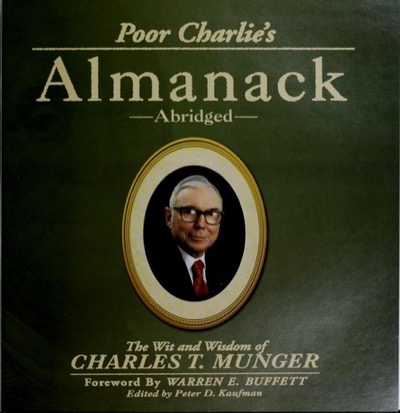
Poor Charlie's Almanack
How can multidisciplinary mental models and inversion become an operating system for clearer decisions?
A personal reading of multidisciplinary thinking, connected mental models, inversion, and error avoidance in Poor Charlie's Almanack.
- Edition
- Confirmed abridged hardcover edition. ISBN 9781578643387; Open Library edition OL8755100M.
- Reviewed
- August 24, 2026
- Sources
- 1
Lens
How can multidisciplinary mental models and inversion become an operating system for clearer decisions?
Evidence
Learn the big ideas from multiple fields, including psychology, history, mathematics, physics, and economics. Do not rely on a single academic discipline or familiar tool to explain every situation.
The value comes from connecting the ideas. A collection of isolated models is another set of slogans. A working lattice helps one model correct the blind spots of another and becomes an operating system for clearer, more accurate decisions.
Inversion makes the operating system practical. Ask how a plan or goal could go completely wrong. Remove avoidable errors instead of trying to act brilliantly smart all the time. Solve backward so that obstacles can be prevented before they become outcomes.
Evidence and reasoning
Learn across disciplines
Every discipline notices some variables and ignores others. Psychology can explain incentives or misjudgment that a financial model misses. History can expose patterns that look novel only because the time horizon is short. Mathematics can test intuition. Physics can train attention on constraints and systems.
The point is not to become an expert in every field. It is to learn enough of the important ideas to recognize when one frame is inadequate.
Connect the models
Models become useful when they interact. A decision about growth may require economics, incentives, probability, organizational behavior, and historical comparison at the same time.
An operating system does more than store concepts. It helps choose which questions to ask, which evidence to seek, and which explanation to distrust.
Invert
Inversion begins with failure. Instead of asking only how a plan can succeed, ask what would guarantee that it fails.
This shifts attention toward preventable errors, hidden dependencies, perverse incentives, and irreversible risks. It is often easier to identify what must not happen than to predict the exact path to success.
Remove stupidity before seeking brilliance
The attraction of a brilliant move can hide ordinary failure modes. Error avoidance is less glamorous, but it protects the base from which better decisions can compound.
This is not an argument against ambition or originality. It is a sequencing rule: remove the obvious ways to lose before optimizing the upside.
Counter-lens
Multidisciplinary thinking can create false confidence. A person may know the name of a model without understanding the discipline that produced it. Analogies can travel farther than their evidence permits. With enough models, it is always possible to explain a past outcome after it occurs.
Inversion can also become excessive caution. Preventing every imaginable failure can prevent action. The method needs judgment about probability, consequence, reversibility, and the cost of delay.
Reflection
- Capture a real decision in which two models produced a better conclusion than one.
- Identify a plan that improved after being inverted.
- Distinguish productive error avoidance from fear-driven inaction.
- Trace important talks and attributed quotations to primary records.
Limits
The transfer boundary for Poor Charlie’s Almanack is built into its question: How can multidisciplinary mental models and inversion become an operating system for clearer decisions? Do not generalize from a memorable example or retrospective success. Test domain, timing, resources, incentives, power, consent, and who bears the downside.
Apply to my situation
For KNOLTOK, treat Poor Charlie’s Almanack as a proposed decision aid rather than a personal claim. Its book-specific move is: test one bounded application before generalizing. For this application, record why ‘test one bounded application’ fits the current case, which source supports it, who is affected, and what evidence would block transfer.
Experiment
Use the proposed move from Poor Charlie’s Almanack: Test one bounded application before generalizing. Run one low-cost, reversible case. Record the baseline, expected signal, alternative explanation, affected parties, stop condition, and review date. Preserve contrary observations.
Sources
- Charles T. Munger, Poor Charlie’s Almanack: The Wit and Wisdom of Charles T. Munger. Walsworth Publishing Company, 2005. Confirmed abridged hardcover edition, ISBN 9781578643387. Open Library edition record
Revision
- Human author: Utpal Vaishnav.
- Human reviewer: Utpal Vaishnav.
- AI assisted with structure, editing, and research preparation.
- Exact text approved for publication on August 24, 2026.
Continue the inquiry
Research this book lens with AI
Research Poor Charlie's Almanack as a maintained KNOLTOK lens, not as a summary or endorsement. Reader question: How can multidisciplinary mental models and inversion become an operating system for clearer decisions? Current synthesis: A personal reading of multidisciplinary thinking, connected mental models, inversion, and error avoidance in Poor Charlie's Almanack. Current evidence status: not stated. Selected primary edition and provenance: title: "Poor Charlie's Almanack: The Wit and Wisdom of Charles T. Munger"; author: "Charles T. Munger"; publisher: "Walsworth Publishing Company"; publication date: "2005"; edition note: "Confirmed abridged hardcover edition. ISBN 9781578643387; Open Library edition OL8755100M."; URL: "https://openlibrary.org/books/OL8755100M/Poor_Charlie%27s_Almanack" Current Lens claim to test: How can multidisciplinary mental models and inversion become an operating system for clearer decisions? Current Counter-lens to strengthen or correct: Multidisciplinary thinking can create false confidence. A person may know the name of a model without understanding the discipline that produced it. Analogies can travel farther than their evidence permits. With enough models, it is always possible to explain a past outcome after it occurs. Inversion can also become excessive caution. Preventing every imaginable failure can prevent action. The method needs judgment about probability, consequence, reversibility, and the cost of delay. Current Limits to verify: The transfer boundary for Poor Charlie's Almanack is built into its question: How can multidisciplinary mental models and inversion become an operating system for clearer decisions? Do not generalize from a memorable example or retrospective success. Test domain, timing, resources, incentives, power, consent, and who bears the downside. Practical move under consideration: Run one reversible test and preserve contrary evidence. Research these claims through literary form, authorial context, reception, and the boundary between interpretation and external fact; strategy, organizational evidence, incentives, base rates, selection effects, and stakeholder outcomes; psychology, behavior change, construct validity, intervention evidence, and structural explanations; systems research, causal mechanisms, measurement, feedback, boundary conditions, and second-order effects. Verify book-derived formulations against the selected edition and do not silently substitute another edition. Separate: what the book claims; KNOLTOK's interpretation; independent evidence; application proposals; recognition or influence; credible disagreement; and unresolved uncertainty. Treat sales, fame, anecdotes, cases, and publisher or company claims as reach or self-description, not independent proof. Do not invent quotations, page numbers, personal experience, outcomes, authorial intent, or consensus. Do not infer Utpal Vaishnav's private view beyond the text above. Start with the registered sources below, assess their interests and limitations, and then find stronger primary records, peer-reviewed research, authoritative datasets, critical scholarship, or stakeholder evidence. Do not merely repeat the registered sources: - https://openlibrary.org/books/OL8755100M/Poor_Charlie%27s_Almanack Return a claim ledger with 6 to 12 material claims. For each provide: exact claim; claim class; attribution; edition or page verification status; best supporting evidence with a direct link; strongest counterevidence or alternative explanation with a direct link; confidence as high, medium, low, or unresolved; transfer conditions; affected stakeholders; possible harm if overstated; and a keep, narrow, rewrite, or remove recommendation. Then provide source-quality notes, missing perspectives, contradictions with the current lens, 3 to 5 proposed revisions, one reversible experiment with baseline and stop condition, and explicit revision or retirement triggers. Use direct links and full citations. Quote only when exact wording materially matters and has been verified.
About this lens
Primary book: Poor Charlie's Almanack by Charles T. Munger, Confirmed abridged hardcover edition. ISBN 9781578643387; Open Library edition OL8755100M.
Lens author: Utpal Vaishnav. The interpretation, personal experience, and conclusions belong to the lens author.
AI assistance: AI assisted with structure, editing, and research preparation. The selected ideas and conclusions attributed to Utpal Vaishnav are his and were accepted by Utpal Vaishnav for publication.
Human review: Utpal Vaishnav
- 2026-08-13: Prepared with AI as a research scaffold.
- 2026-08-15: Added Utpal Vaishnav's selected ideas, confirmed the abridged physical edition, and promoted the lens to review.