
Book lens / Published
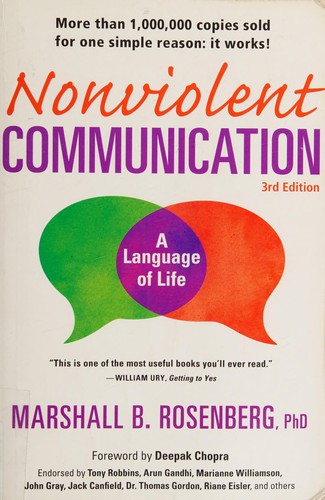
Nonviolent Communication
Can a compassionate communication method remain honest about anger, power, and situations in which mutuality is absent?
A lens on observation, feeling, need, and request that treats NVC as a learnable communication scaffold, not a complete theory of conflict, safety, or justice.
- Edition
- Third edition paperback. ISBN 9781892005281.
- Reviewed
- August 26, 2026
- Sources
- 3
Lens
Separating observation from evaluation and making clear requests can reduce avoidable escalation. The method must not suppress judgment, disguise demands, or require empathy toward someone who is unsafe.
A lens on observation, feeling, need, and request that treats NVC as a learnable communication scaffold, not a complete theory of conflict, safety, or justice. The useful move is not to adopt a slogan. It is to distinguish the book’s proposal from the conditions under which that proposal is responsible.
Observation
Describe what occurred before assigning motive or character.
Feeling
Name internal experience without making another person its sole cause.
Need
Identify the value or condition at stake without claiming one strategy is mandatory.
Request
Ask for a specific action while preserving a genuine possibility of refusal.
Counter-lens
Evaluation is not always violence. Naming discrimination, deception, breach, or danger can be necessary. A smooth four-part statement does not equal justice, and an abuser can learn empathic vocabulary without relinquishing control. Communication repair is appropriate only where enough safety and mutuality exist.
Evidence
PuddleDancer reports more than eight million copies in over forty languages; as the dedicated publisher, that is interested evidence of reach. A 2023 scoping review of compassionate communication found varied applications and promising findings but questioned parts of Rosenberg’s theory and the uneven research base. Reach should not be mistaken for established clinical efficacy.
The applications for Nonviolent Communication are editorial transfers directed at this question: Can a compassionate communication method remain honest about anger, power, and situations in which mutuality is absent? They remain proposed experiments, not reported outcomes or claims that Utpal Vaishnav has used the method. Their evidence must be assessed separately from the book’s influence or the coherence of its argument.
Limits
- The empirical literature is heterogeneous and includes small or nonrandomized studies.
- The four-part form can sound scripted or become covert persuasion.
- Needs language varies across cultures and contexts.
- Individual dialogue cannot resolve structural violence by itself.
Apply to my situation
Use the four parts first as private clarification. Then ask whether the relationship is safe, whether the request can be refused, and whether a boundary or external process is more appropriate. Keep accurate moral and institutional language where harm must be named.
Experiment
In three low-stakes conversations, prepare an observation and request in advance. Record whether defensiveness, clarity, mutual understanding, or agreement changed. Agreement is not the sole outcome. Stop if the method makes a boundary less clear.
Reflection
- Can the other person safely say no?
- What judgment must remain explicit?
- Is empathy being demanded from the less powerful party?
- Would mediation, policy, or separation address the problem better?
Revision
Revise when higher-quality intervention research changes the evidence assessment, when the lens polices justified anger, or when use in coercive contexts creates harm.
Sources
- Marshall B. Rosenberg, Nonviolent Communication. PuddleDancer Press, 2015. ISBN 9781892005281. Edition record.
- Marshall B. Rosenberg, Nonviolent Communication: A Language of Life, Third Edition. PuddleDancer Press, 2015.
- A. Sinclair and colleagues, Compassionate communication: a scoping review. Frontiers in Communication, 2023.
Continue the inquiry
Research this book lens with AI
Research Nonviolent Communication as a maintained KNOLTOK lens, not as a summary or endorsement. Reader question: Can a compassionate communication method remain honest about anger, power, and situations in which mutuality is absent? Current synthesis: A lens on observation, feeling, need, and request that treats NVC as a learnable communication scaffold, not a complete theory of conflict, safety, or justice. Current evidence status: mixed. Selected primary edition and provenance: title: "Nonviolent Communication"; author: "Marshall B. Rosenberg"; publisher: "PuddleDancer Press"; publication date: "2015-09-01"; edition note: "Third edition paperback. ISBN 9781892005281."; URL: "https://nonviolentcommunication.com/product/nvc/" Current Lens claim to test: Separating observation from evaluation and making clear requests can reduce avoidable escalation. The method must not suppress judgment, disguise demands, or require empathy toward someone who is unsafe. A lens on observation, feeling, need, and request that treats NVC as a learnable communication scaffold, not a complete theory of conflict, safety, or justice. The useful move is not to adopt a slogan. It is to distinguish the book's proposal from the conditions under which that proposal is responsible. Observation Describe what occurred before assigning motive or character. Feeling Name internal experience without making another person Current Counter-lens to strengthen or correct: Evaluation is not always violence. Naming discrimination, deception, breach, or danger can be necessary. A smooth four-part statement does not equal justice, and an abuser can learn empathic vocabulary without relinquishing control. Communication repair is appropriate only where enough safety and mutuality exist. Current Limits to verify: - The empirical literature is heterogeneous and includes small or nonrandomized studies. - The four-part form can sound scripted or become covert persuasion. - Needs language varies across cultures and contexts. - Individual dialogue cannot resolve structural violence by itself. Practical move under consideration: Rewrite one low-stakes complaint as four parts: observable event, your feeling, the need or value involved, and a specific request that the other person can refuse. Research these claims through strategy, organizational evidence, incentives, base rates, selection effects, and stakeholder outcomes; organizational behavior, power, worker experience, governance, law, and accountable dissent; political economy, law, legitimacy, geography, distribution, and affected communities; learning science, epistemology, replication, transfer, measurement, and alternative explanations. Verify book-derived formulations against the selected edition and do not silently substitute another edition. Separate: what the book claims; KNOLTOK's interpretation; independent evidence; application proposals; recognition or influence; credible disagreement; and unresolved uncertainty. Treat sales, fame, anecdotes, cases, and publisher or company claims as reach or self-description, not independent proof. Do not invent quotations, page numbers, personal experience, outcomes, authorial intent, or consensus. Do not infer Utpal Vaishnav's private view beyond the text above. Start with the registered sources below, assess their interests and limitations, and then find stronger primary records, peer-reviewed research, authoritative datasets, critical scholarship, or stakeholder evidence. Do not merely repeat the registered sources: - https://nonviolentcommunication.com/product/nvc/ - https://www.frontiersin.org/journals/communication/articles/10.3389/fcomm.2023.1294586/full Return a claim ledger with 6 to 12 material claims. For each provide: exact claim; claim class; attribution; edition or page verification status; best supporting evidence with a direct link; strongest counterevidence or alternative explanation with a direct link; confidence as high, medium, low, or unresolved; transfer conditions; affected stakeholders; possible harm if overstated; and a keep, narrow, rewrite, or remove recommendation. Then provide source-quality notes, missing perspectives, contradictions with the current lens, 3 to 5 proposed revisions, one reversible experiment with baseline and stop condition, and explicit revision or retirement triggers. Use direct links and full citations. Quote only when exact wording materially matters and has been verified.
About this lens
Primary book: Nonviolent Communication by Marshall B. Rosenberg, Third edition paperback. ISBN 9781892005281.
Lens author: Utpal Vaishnav. The interpretation, personal experience, and conclusions belong to the lens author.
AI assistance: AI assisted with source discovery, comparison, structure, and drafting. Utpal Vaishnav accepted the exact K200-B04 lens text for publication and remains responsible for the released synthesis. No personal experience, outcome, quotation, or page reference was invented.
Human review: Utpal Vaishnav
- 2026-08-26: Created the K200-B04 private review draft from the confirmed selection, with a full eight-section architecture and edition-specific source record.
- 2026-08-26: Accepted the exact K200-B04 lens text and prepared it for publication with the verified local cover.