
Book lens / Published
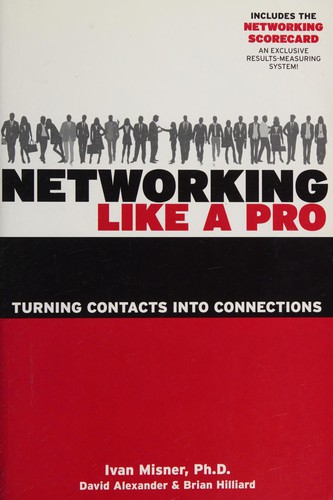
Networking Like a Pro
Can professional networking remain reciprocal when everyone is measuring its commercial return?
A lens on trust, referrals, social capital, and the ethical line between relationship building and instrumental contact.
- Edition
- Original edition, ISBN 9781599183565. The 2017 revised edition has different principal author credits.
- Reviewed
- August 26, 2026
- Sources
- 2
Lens
Networking becomes uncomfortable when a person senses that friendliness is only a route to extraction. The book tries to replace random contact collection with a disciplined practice of credibility, contribution, follow-up, and referral. Its strongest insight is that useful networks are built before an urgent request arrives.
That does not resolve the ethical tension. A relationship may be generous and commercially useful at the same time. The problem is concealment. If every conversation is scored by its expected return, attention shifts from the person to the asset they might become.
The lens therefore asks what reciprocity requires when participants have unequal status, access, time, and need. Giving first can express care. It can also create an unspoken debt.
Evidence
- Trust accumulates through reliable conduct rather than a single introduction.
- A specific request is easier to evaluate than vague pressure to “help.”
- Referrals transfer reputation, so the referrer carries real risk.
- Following up should add context or value rather than merely demand attention.
- Networks need maintenance even when no transaction is imminent.
These practices can improve professional relationships because they clarify expectations. They are not formulas that oblige another person to respond.
The unequal network
Advice to use one’s network assumes access to one. Family wealth, elite education, geography, disability, caregiving, language, race, caste, and organizational status influence who can enter a room and whose message receives an answer. Treating results as pure networking skill hides these starting conditions.
Referral systems can also reproduce sameness. People recommend those they know, and people often know others like themselves. A high-trust network may be efficient for insiders while remaining closed to capable outsiders.
The authors’ connection to BNI is material context. Their practitioner experience may make the guidance useful, while the organization benefits from a worldview in which formal networking systems are valuable. This interest should be visible rather than treated as disqualifying or ignored.
Reciprocity without debt
Before making a request, name its cost. A warm introduction asks someone to lend reputation and time. Make refusal easy. Do not treat a prior favor as a claim on the other person’s future action.
Contribution should also be useful to the receiver. Sending generic articles, forced introductions, or unsolicited advice can create work while allowing the sender to feel generous. Ask what help is wanted.
Experiment
Review 10 recent professional interactions. Mark each as contribution, request, maintenance, or mutual work. Identify any relationship contacted only when something was needed. Choose one honest repair: acknowledge the pattern, offer specific value, or stop pretending the connection is close.
Reflection
- Which findings on social capital distinguish bonding from bridging networks?
- How do referral systems amplify opportunity and exclusion?
- What consent and privacy rules should govern introductions?
- Which parts of the 2009 advice are dated by online platforms?
Revision
- Evidence status: practice-informed.
- Edition credit is locked to the 2009 three-author version.
- Curated and authored by Utpal Vaishnav; no personal network outcome is claimed.
- Publication state: published on August 26, 2026.
Counter-lens
For Networking Like a Pro, test the strongest answer to the same reader question: Can professional networking remain reciprocal when everyone is measuring its commercial return? Ask whether context, selection, incentives, prior capability, power, or survivorship explains the result better than the book’s favored mechanism. Disagreement is evidence to examine, not proof that the reader failed to understand the author.
Limits
The transfer boundary for Networking Like a Pro is built into its question: Can professional networking remain reciprocal when everyone is measuring its commercial return? Do not generalize from a memorable example or retrospective success. Test domain, timing, resources, incentives, power, consent, and who bears the downside.
Apply to my situation
For KNOLTOK, treat Networking Like a Pro as a proposed decision aid rather than a personal claim. Its book-specific move is: Before asking a contact for help, state the relationship, the specific request, the cost to them, and an easy way to decline. For this application, record why ‘Before asking a contact for help, state the relationship, the specific request, the cost to them, and an easy way to decline’ fits the current case, which source supports it, who is affected, and what evidence would block transfer.
Continue the inquiry
Research this book lens with AI
Research Networking Like a Pro as a maintained KNOLTOK lens, not as a summary or endorsement. Reader question: Can professional networking remain reciprocal when everyone is measuring its commercial return? Current synthesis: A lens on trust, referrals, social capital, and the ethical line between relationship building and instrumental contact. Current evidence status: practice-informed. Selected primary edition and provenance: title: "Networking Like a Pro: Turning Contacts into Connections"; author: "Ivan Misner and David Alexander and Brian Hilliard"; publisher: "Entrepreneur Press"; publication date: "2009-10-06"; edition note: "Original edition, ISBN 9781599183565. The 2017 revised edition has different principal author credits."; URL: "https://openlibrary.org/isbn/9781599183565" Current Lens claim to test: Networking becomes uncomfortable when a person senses that friendliness is only a route to extraction. The book tries to replace random contact collection with a disciplined practice of credibility, contribution, follow-up, and referral. Its strongest insight is that useful networks are built before an urgent request arrives. That does not resolve the ethical tension. A relationship may be generous and commercially useful at the same time. The problem is concealment. If every conversation is scored by its expected return, attention shifts from the person to the asset they might become. The lens therefore asks what Current Counter-lens to strengthen or correct: For Networking Like a Pro, test the strongest answer to the same reader question: Can professional networking remain reciprocal when everyone is measuring its commercial return? Ask whether context, selection, incentives, prior capability, power, or survivorship explains the result better than the book's favored mechanism. Disagreement is evidence to examine, not proof that the reader failed to understand the author. Current Limits to verify: The transfer boundary for Networking Like a Pro is built into its question: Can professional networking remain reciprocal when everyone is measuring its commercial return? Do not generalize from a memorable example or retrospective success. Test domain, timing, resources, incentives, power, consent, and who bears the downside. Practical move under consideration: Before asking a contact for help, state the relationship, the specific request, the cost to them, and an easy way to decline. Research these claims through systems research, causal mechanisms, measurement, feedback, boundary conditions, and second-order effects; organizational behavior, power, worker experience, governance, law, and accountable dissent; finance, survivorship, leverage, downside allocation, distribution, and institutional opportunity; political economy, law, legitimacy, geography, distribution, and affected communities. Verify book-derived formulations against the selected edition and do not silently substitute another edition. Separate: what the book claims; KNOLTOK's interpretation; independent evidence; application proposals; recognition or influence; credible disagreement; and unresolved uncertainty. Treat sales, fame, anecdotes, cases, and publisher or company claims as reach or self-description, not independent proof. Do not invent quotations, page numbers, personal experience, outcomes, authorial intent, or consensus. Do not infer Utpal Vaishnav's private view beyond the text above. Start with the registered sources below, assess their interests and limitations, and then find stronger primary records, peer-reviewed research, authoritative datasets, critical scholarship, or stakeholder evidence. Do not merely repeat the registered sources: - https://openlibrary.org/isbn/9781599183565 - https://www.simonandschuster.com/books/Networking-Like-a-Pro/Brian-Hilliard/9781599186047 Return a claim ledger with 6 to 12 material claims. For each provide: exact claim; claim class; attribution; edition or page verification status; best supporting evidence with a direct link; strongest counterevidence or alternative explanation with a direct link; confidence as high, medium, low, or unresolved; transfer conditions; affected stakeholders; possible harm if overstated; and a keep, narrow, rewrite, or remove recommendation. Then provide source-quality notes, missing perspectives, contradictions with the current lens, 3 to 5 proposed revisions, one reversible experiment with baseline and stop condition, and explicit revision or retirement triggers. Use direct links and full citations. Quote only when exact wording materially matters and has been verified.
About this lens
Primary book: Networking Like a Pro by Ivan Misner and David Alexander and Brian Hilliard, Original edition, ISBN 9781599183565. The 2017 revised edition has different principal author credits.
Lens author: Utpal Vaishnav. The interpretation, personal experience, and conclusions belong to the lens author.
AI assistance: AI assisted with research, structure, and drafting. No referral outcome, relationship, or personal networking experience was invented.
Human review: Utpal Vaishnav
- 2026-08-26: Prepared the K200-B03 local review lens using the original three-author edition.