
Book lens / Published
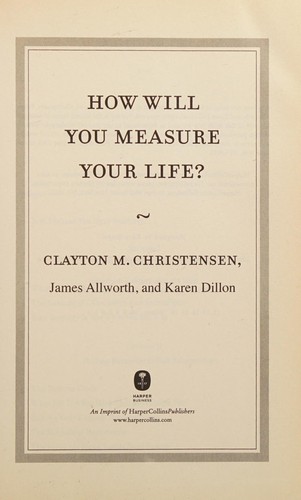
How Will You Measure Your Life?
What happens when the resources of a life reveal priorities that its stated values do not?
A lens on using actual allocations of time, energy, money, and attention to test whether work, relationships, and integrity match professed priorities.
- Edition
- First US hardcover edition. ISBN 9780062102416.
- Reviewed
- August 26, 2026
- Sources
- 3
Lens
Values become operational through repeated allocation. Examine what receives scarce resources, then correct the pattern before short-term rewards quietly define the life.
A lens on using actual allocations of time, energy, money, and attention to test whether work, relationships, and integrity match professed priorities. The useful move is not to adopt a slogan. It is to distinguish the book’s proposal from the conditions under which that proposal is responsible.
Resource allocation
Treat time, money, and attention as evidence of enacted priority.
Different clocks
Notice that career feedback is often faster than relationship feedback.
Marginal choices
Examine small exceptions that accumulate into character or neglect.
Plural value
Refuse one metric for work, family, integrity, health, and community.
Counter-lens
A calendar can reveal priority and also reveal coercion. Paid work, care, disability administration, and poverty can consume resources without expressing preference. Quantification may clarify a mismatch, but a life is not a portfolio whose relationships can be optimized by return. Fidelity, duty, love, and justice resist a single measure.
Evidence
The book adapts management theories as analogies for personal decisions and grew from Christensen’s 2010 Harvard Business Review essay. Its New York Times bestseller status demonstrates reach. The transfer from firms to lives remains interpretive; it should be judged by whether it improves attention and choices, not presented as experimentally established life science.
The applications for How Will You Measure Your Life? are editorial transfers directed at this question: What happens when the resources of a life reveal priorities that its stated values do not? They remain proposed experiments, not reported outcomes or claims that Utpal Vaishnav has used the method. Their evidence must be assessed separately from the book’s influence or the coherence of its argument.
Limits
- Management theories function here mainly as metaphors.
- Resource patterns can reflect constraint rather than value.
- The authors’ cultural and religious assumptions are situated, not universal.
- Full coauthor attribution is necessary.
Apply to my situation
Select three domains and define one observable sign of adequate care in each. Review actual allocation without moralizing every hour. Identify a mismatch that is genuinely discretionary and negotiate one recurring correction with anyone affected.
Experiment
For four weeks, protect one small recurring allocation for a neglected priority. Track whether it survives urgent demands, what it displaces, and whether the affected relationship or practice experiences it as useful. A protected block is evidence of allocation, not proof of a good life.
Reflection
- Which metric gives work an unfair advantage?
- What allocation is compulsory rather than chosen?
- Which small exception is becoming a precedent?
- Who should help define what adequate care means?
Revision
Revise when the business analogy hides constraint, when measurement crowds out relational judgment, or when primary-text checking changes attribution among the three authors.
Sources
- Clayton M. Christensen and James Allworth and Karen Dillon, How Will You Measure Your Life?. HarperBusiness, 2012. ISBN 9780062102416. Edition record.
- Clayton M. Christensen, James Allworth, and Karen Dillon, How Will You Measure Your Life?. Christensen Institute, 2012.
- Clayton M. Christensen, How Will You Measure Your Life?. Harvard Business Review, 2010.
Continue the inquiry
Research this book lens with AI
Research How Will You Measure Your Life? as a maintained KNOLTOK lens, not as a summary or endorsement. Reader question: What happens when the resources of a life reveal priorities that its stated values do not? Current synthesis: A lens on using actual allocations of time, energy, money, and attention to test whether work, relationships, and integrity match professed priorities. Current evidence status: mixed. Selected primary edition and provenance: title: "How Will You Measure Your Life?"; author: "Clayton M. Christensen and James Allworth and Karen Dillon"; publisher: "HarperBusiness"; publication date: "2012-05-15"; edition note: "First US hardcover edition. ISBN 9780062102416."; URL: "https://www.harpercollins.com/products/how-will-you-measure-your-life-clayton-m-christensenjames-allworthkaren-dillon" Current Lens claim to test: Values become operational through repeated allocation. Examine what receives scarce resources, then correct the pattern before short-term rewards quietly define the life. A lens on using actual allocations of time, energy, money, and attention to test whether work, relationships, and integrity match professed priorities. The useful move is not to adopt a slogan. It is to distinguish the book's proposal from the conditions under which that proposal is responsible. Resource allocation Treat time, money, and attention as evidence of enacted priority. Different clocks Notice that career feedback is often faster than relationship feedback. Marginal choices Current Counter-lens to strengthen or correct: A calendar can reveal priority and also reveal coercion. Paid work, care, disability administration, and poverty can consume resources without expressing preference. Quantification may clarify a mismatch, but a life is not a portfolio whose relationships can be optimized by return. Fidelity, duty, love, and justice resist a single measure. Current Limits to verify: - Management theories function here mainly as metaphors. - Resource patterns can reflect constraint rather than value. - The authors’ cultural and religious assumptions are situated, not universal. - Full coauthor attribution is necessary. Practical move under consideration: Compare last month’s calendar and discretionary spending with three stated priorities. Choose one recurring allocation to stop, protect, or renegotiate. Research these claims through strategy, organizational evidence, incentives, base rates, selection effects, and stakeholder outcomes; systems research, causal mechanisms, measurement, feedback, boundary conditions, and second-order effects; political economy, law, legitimacy, geography, distribution, and affected communities; learning science, epistemology, replication, transfer, measurement, and alternative explanations. Verify book-derived formulations against the selected edition and do not silently substitute another edition. Separate: what the book claims; KNOLTOK's interpretation; independent evidence; application proposals; recognition or influence; credible disagreement; and unresolved uncertainty. Treat sales, fame, anecdotes, cases, and publisher or company claims as reach or self-description, not independent proof. Do not invent quotations, page numbers, personal experience, outcomes, authorial intent, or consensus. Do not infer Utpal Vaishnav's private view beyond the text above. Start with the registered sources below, assess their interests and limitations, and then find stronger primary records, peer-reviewed research, authoritative datasets, critical scholarship, or stakeholder evidence. Do not merely repeat the registered sources: - https://www.harpercollins.com/products/how-will-you-measure-your-life-clayton-m-christensenjames-allworthkaren-dillon - https://www.christenseninstitute.org/book/how-will-you-measure-your-life/ - https://hbr.org/2010/07/how-will-you-measure-your-life Return a claim ledger with 6 to 12 material claims. For each provide: exact claim; claim class; attribution; edition or page verification status; best supporting evidence with a direct link; strongest counterevidence or alternative explanation with a direct link; confidence as high, medium, low, or unresolved; transfer conditions; affected stakeholders; possible harm if overstated; and a keep, narrow, rewrite, or remove recommendation. Then provide source-quality notes, missing perspectives, contradictions with the current lens, 3 to 5 proposed revisions, one reversible experiment with baseline and stop condition, and explicit revision or retirement triggers. Use direct links and full citations. Quote only when exact wording materially matters and has been verified.
About this lens
Primary book: How Will You Measure Your Life? by Clayton M. Christensen and James Allworth and Karen Dillon, First US hardcover edition. ISBN 9780062102416.
Lens author: Utpal Vaishnav. The interpretation, personal experience, and conclusions belong to the lens author.
AI assistance: AI assisted with source discovery, comparison, structure, and drafting. Utpal Vaishnav accepted the exact K200-B04 lens text for publication and remains responsible for the released synthesis. No personal experience, outcome, quotation, or page reference was invented.
Human review: Utpal Vaishnav
- 2026-08-26: Created the K200-B04 private review draft from the confirmed selection, with a full eight-section architecture and edition-specific source record.
- 2026-08-26: Accepted the exact K200-B04 lens text and prepared it for publication with the verified local cover.