
Book lens / Published
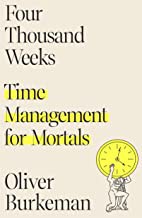
Four Thousand Weeks
If time can never be mastered, what deserves the finite portion we can actually give?
A counter-productivity lens on finitude: the task is not to fit everything in, but to choose what will receive a life while accepting what must remain undone.
- Edition
- First US hardcover edition. ISBN 9780374159122.
- Reviewed
- August 26, 2026
- Sources
- 3
Lens
Time management becomes more honest when it begins with limits. Commit to a few worthwhile obligations, tolerate the discomfort of exclusion, and stop using efficiency to postpone the choice.
A counter-productivity lens on finitude: the task is not to fit everything in, but to choose what will receive a life while accepting what must remain undone. The useful move is not to adopt a slogan. It is to distinguish the book’s proposal from the conditions under which that proposal is responsible.
Finitude
Begin with the impossibility of doing everything.
Choice
Let commitment exclude alternatives rather than keeping every future open.
Fixed volume
Limit active work instead of relying on faster processing.
Presence
Notice when optimization becomes a way to avoid living the chosen activity.
Counter-lens
Limits are not distributed equally. A salaried knowledge worker may choose a closed list; a caregiver, shift worker, or person navigating poverty may inherit urgent demands. Acceptance can become an alibi for institutions that underresource work. The lens therefore pairs personal finitude with collective questions about workload, care, and power.
Evidence
The book is philosophical and journalistic synthesis, not a clinical time-management trial. Its New York Times and Sunday Times bestseller status establishes reach. Its central contribution is a critique: efficiency frequently increases the supply of tasks and expectations instead of delivering the imagined state of being finished.
The applications for Four Thousand Weeks are editorial transfers directed at this question: If time can never be mastered, what deserves the finite portion we can actually give? They remain proposed experiments, not reported outcomes or claims that Utpal Vaishnav has used the method. Their evidence must be assessed separately from the book’s influence or the coherence of its argument.
Limits
- Four thousand weeks is a memorable average, not an individual forecast.
- The argument does not show that planning or productivity methods are useless.
- Choice is constrained by money, disability, care, law, and institutional power.
- Acceptance must not normalize preventable overload.
Apply to my situation
Look at the calendar and task system as a record of sacrifice. Identify what the current commitments crowd out. Choose one omission consciously, communicate it to affected people, and protect one block for a commitment that would otherwise remain perpetually “important but later.”
Experiment
For two weeks, cap active discretionary projects at three. Keep a waiting list without starting from it. Track completions, renegotiations, anxiety, unplanned duties, and time spent reorganizing work. The test is whether a smaller active field improves presence and integrity, not whether every request disappears.
Reflection
- Which imagined future requires everything to be under control first?
- What does the calendar reveal that stated values conceal?
- Whose labor makes my chosen slowness possible?
- Which obligation should be refused, shared, or redesigned rather than accepted?
Revision
Revise if the lens turns finitude into lifestyle privilege, if readers interpret acceptance as passivity, or if better evidence changes the account of workload and well-being. Keep the distinction between philosophical argument and measured effect explicit.
Sources
- Oliver Burkeman, Four Thousand Weeks. Farrar, Straus and Giroux, 2021. ISBN 9780374159122. Edition record.
- Oliver Burkeman, Four Thousand Weeks. Oliver Burkeman.
- James Parker, The Guru Who Says No to Getting Things Done. The Atlantic, 2024.
Continue the inquiry
Research this book lens with AI
Research Four Thousand Weeks as a maintained KNOLTOK lens, not as a summary or endorsement. Reader question: If time can never be mastered, what deserves the finite portion we can actually give? Current synthesis: A counter-productivity lens on finitude: the task is not to fit everything in, but to choose what will receive a life while accepting what must remain undone. Current evidence status: mixed. Selected primary edition and provenance: title: "Four Thousand Weeks"; author: "Oliver Burkeman"; publisher: "Farrar, Straus and Giroux"; publication date: "2021-08-10"; edition note: "First US hardcover edition. ISBN 9780374159122."; URL: "https://us.macmillan.com/books/9780374159122/fourthousandweeks/" Current Lens claim to test: Time management becomes more honest when it begins with limits. Commit to a few worthwhile obligations, tolerate the discomfort of exclusion, and stop using efficiency to postpone the choice. A counter-productivity lens on finitude: the task is not to fit everything in, but to choose what will receive a life while accepting what must remain undone. The useful move is not to adopt a slogan. It is to distinguish the book's proposal from the conditions under which that proposal is responsible. Finitude Begin with the impossibility of doing everything. Choice Let commitment exclude alternatives rather Current Counter-lens to strengthen or correct: Limits are not distributed equally. A salaried knowledge worker may choose a closed list; a caregiver, shift worker, or person navigating poverty may inherit urgent demands. Acceptance can become an alibi for institutions that underresource work. The lens therefore pairs personal finitude with collective questions about workload, care, and power. Current Limits to verify: - Four thousand weeks is a memorable average, not an individual forecast. - The argument does not show that planning or productivity methods are useless. - Choice is constrained by money, disability, care, law, and institutional power. - Acceptance must not normalize preventable overload. Practical move under consideration: Write a closed list of no more than three active commitments for this week and a deliberate “not now” list. Finish, abandon, or renegotiate one before adding another. Research these claims through strategy, organizational evidence, incentives, base rates, selection effects, and stakeholder outcomes; systems research, causal mechanisms, measurement, feedback, boundary conditions, and second-order effects; political economy, law, legitimacy, geography, distribution, and affected communities; learning science, epistemology, replication, transfer, measurement, and alternative explanations. Verify book-derived formulations against the selected edition and do not silently substitute another edition. Separate: what the book claims; KNOLTOK's interpretation; independent evidence; application proposals; recognition or influence; credible disagreement; and unresolved uncertainty. Treat sales, fame, anecdotes, cases, and publisher or company claims as reach or self-description, not independent proof. Do not invent quotations, page numbers, personal experience, outcomes, authorial intent, or consensus. Do not infer Utpal Vaishnav's private view beyond the text above. Start with the registered sources below, assess their interests and limitations, and then find stronger primary records, peer-reviewed research, authoritative datasets, critical scholarship, or stakeholder evidence. Do not merely repeat the registered sources: - https://us.macmillan.com/books/9780374159122/fourthousandweeks/ - https://www.oliverburkeman.com/fourthousandweeks - https://www.theatlantic.com/magazine/archive/2024/11/meditations-for-mortals-four-thousand-weeks-review/679955/ Return a claim ledger with 6 to 12 material claims. For each provide: exact claim; claim class; attribution; edition or page verification status; best supporting evidence with a direct link; strongest counterevidence or alternative explanation with a direct link; confidence as high, medium, low, or unresolved; transfer conditions; affected stakeholders; possible harm if overstated; and a keep, narrow, rewrite, or remove recommendation. Then provide source-quality notes, missing perspectives, contradictions with the current lens, 3 to 5 proposed revisions, one reversible experiment with baseline and stop condition, and explicit revision or retirement triggers. Use direct links and full citations. Quote only when exact wording materially matters and has been verified.
About this lens
Primary book: Four Thousand Weeks by Oliver Burkeman, First US hardcover edition. ISBN 9780374159122.
Lens author: Utpal Vaishnav. The interpretation, personal experience, and conclusions belong to the lens author.
AI assistance: AI assisted with source discovery, comparison, structure, and drafting. Utpal Vaishnav accepted the exact K200-B04 lens text for publication and remains responsible for the released synthesis. No personal experience, outcome, quotation, or page reference was invented.
Human review: Utpal Vaishnav
- 2026-08-26: Created the K200-B04 private review draft from the confirmed selection, with a full eight-section architecture and edition-specific source record.
- 2026-08-26: Accepted the exact K200-B04 lens text and prepared it for publication with the verified local cover.