
Book lens / Published
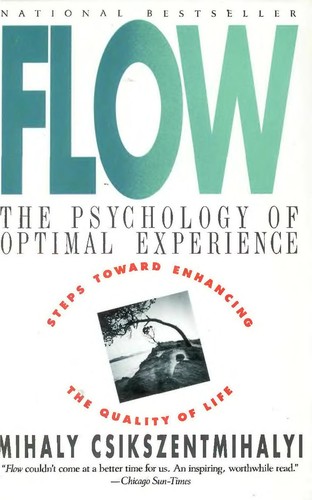
Flow
Does deep absorption make an activity meaningful, or can flow hide what the activity is doing to us and others?
A lens on challenge, skill, attention, and intrinsic reward that treats flow as information about experience, not proof that an activity is valuable or harmless.
- Edition
- Modern Classics paperback edition. ISBN 9780061339202. First published in 1990.
- Reviewed
- August 26, 2026
- Sources
- 3
Lens
Flow can emerge when clear goals, usable feedback, and a workable balance of challenge and skill organize attention. It can improve experience, but ethical value must be judged separately.
A lens on challenge, skill, attention, and intrinsic reward that treats flow as information about experience, not proof that an activity is valuable or harmless. The useful move is not to adopt a slogan. It is to distinguish the book’s proposal from the conditions under which that proposal is responsible.
Challenge-skill balance
Adjust difficulty so the task stretches rather than floods or deadens attention.
Clear goals
Make the next meaningful action legible.
Feedback
Reduce the delay between action and information.
Ethical separation
Judge the worth of the activity independently from the quality of absorption.
Counter-lens
Absorption narrows awareness. That can be useful for practice and dangerous for judgment. Gambling, games engineered for compulsion, extremist work, and exploitative jobs can all absorb attention. A person may also lack autonomy over task, feedback, difficulty, or interruption. The counter-lens asks not only “Was I engaged?” but “What did the engagement serve?”
Evidence
The book synthesizes experience-sampling research and interviews into a theory of optimal experience. Springer’s collected works document decades of research and applications, while later scholarship continues to examine measurement, personality, culture, performance, and well-being. Evidence that people report flow is stronger than claims that flow can always be deliberately switched on or that it produces virtue.
The applications for Flow are editorial transfers directed at this question: Does deep absorption make an activity meaningful, or can flow hide what the activity is doing to us and others? They remain proposed experiments, not reported outcomes or claims that Utpal Vaishnav has used the method. Their evidence must be assessed separately from the book’s influence or the coherence of its argument.
Limits
- Flow is commonly measured through self-report and retrospective description.
- The balance of challenge and skill is dynamic and difficult to calibrate externally.
- Deep engagement can coexist with fatigue, compulsion, or harmful purpose.
- Popular neuroscience claims about flow often exceed the book and established evidence.
Apply to my situation
Use a two-axis review after a work session. Score the quality of engagement and the worth of the activity separately. If engagement is low but purpose is high, redesign goals, difficulty, or feedback. If engagement is high but purpose is low or harmful, do not treat absorption as permission to continue.
Experiment
Run three 45-minute sessions on the same valuable task. Change only one condition per session: clarity of the next goal, speed of feedback, or difficulty. Record absorption, anxiety, boredom, output quality, and recovery cost. Keep the condition that improves the whole pattern, not merely time disappearance.
Reflection
- What makes this activity worthy before it becomes absorbing?
- Is difficulty stretching skill or masking missing support?
- Who controls interruption and feedback?
- What cost becomes invisible while attention is narrowed?
Revision
Revise when measurement reviews materially change the evidence for flow, when primary-text checking changes a retained mechanism, or when an application confuses engagement with performance or moral value.
Sources
- Mihaly Csikszentmihalyi, Flow. Harper Perennial Modern Classics, 2008. ISBN 9780061339202. Edition record.
- Mihaly Csikszentmihalyi, Flow and the Foundations of Positive Psychology. Springer, 2014.
- Los Angeles Times Book Review, Flow. Los Angeles Times.
Continue the inquiry
Research this book lens with AI
Research Flow as a maintained KNOLTOK lens, not as a summary or endorsement. Reader question: Does deep absorption make an activity meaningful, or can flow hide what the activity is doing to us and others? Current synthesis: A lens on challenge, skill, attention, and intrinsic reward that treats flow as information about experience, not proof that an activity is valuable or harmless. Current evidence status: mixed. Selected primary edition and provenance: title: "Flow"; author: "Mihaly Csikszentmihalyi"; publisher: "Harper Perennial Modern Classics"; publication date: "2008-07-01"; edition note: "Modern Classics paperback edition. ISBN 9780061339202. First published in 1990."; URL: "https://www.harperacademic.com/book/9780061339202/flow/" Current Lens claim to test: Flow can emerge when clear goals, usable feedback, and a workable balance of challenge and skill organize attention. It can improve experience, but ethical value must be judged separately. A lens on challenge, skill, attention, and intrinsic reward that treats flow as information about experience, not proof that an activity is valuable or harmless. The useful move is not to adopt a slogan. It is to distinguish the book's proposal from the conditions under which that proposal is responsible. Challenge-skill balance Adjust difficulty so the task stretches rather than floods or deadens attention. Clear goals Current Counter-lens to strengthen or correct: Absorption narrows awareness. That can be useful for practice and dangerous for judgment. Gambling, games engineered for compulsion, extremist work, and exploitative jobs can all absorb attention. A person may also lack autonomy over task, feedback, difficulty, or interruption. The counter-lens asks not only “Was I engaged?” but “What did the engagement serve?” Current Limits to verify: - Flow is commonly measured through self-report and retrospective description. - The balance of challenge and skill is dynamic and difficult to calibrate externally. - Deep engagement can coexist with fatigue, compulsion, or harmful purpose. - Popular neuroscience claims about flow often exceed the book and established evidence. Practical move under consideration: Choose one worthwhile activity. Define a clear next goal, shorten the feedback loop, remove one interruption, and adjust difficulty until attention is stretched without being overwhelmed. Research these claims through psychology, behavior change, construct validity, intervention evidence, and structural explanations; systems research, causal mechanisms, measurement, feedback, boundary conditions, and second-order effects; organizational behavior, power, worker experience, governance, law, and accountable dissent; learning science, epistemology, replication, transfer, measurement, and alternative explanations. Verify book-derived formulations against the selected edition and do not silently substitute another edition. Separate: what the book claims; KNOLTOK's interpretation; independent evidence; application proposals; recognition or influence; credible disagreement; and unresolved uncertainty. Treat sales, fame, anecdotes, cases, and publisher or company claims as reach or self-description, not independent proof. Do not invent quotations, page numbers, personal experience, outcomes, authorial intent, or consensus. Do not infer Utpal Vaishnav's private view beyond the text above. Start with the registered sources below, assess their interests and limitations, and then find stronger primary records, peer-reviewed research, authoritative datasets, critical scholarship, or stakeholder evidence. Do not merely repeat the registered sources: - https://www.harperacademic.com/book/9780061339202/flow/ - https://link.springer.com/book/10.1007/978-94-017-9088-8 Return a claim ledger with 6 to 12 material claims. For each provide: exact claim; claim class; attribution; edition or page verification status; best supporting evidence with a direct link; strongest counterevidence or alternative explanation with a direct link; confidence as high, medium, low, or unresolved; transfer conditions; affected stakeholders; possible harm if overstated; and a keep, narrow, rewrite, or remove recommendation. Then provide source-quality notes, missing perspectives, contradictions with the current lens, 3 to 5 proposed revisions, one reversible experiment with baseline and stop condition, and explicit revision or retirement triggers. Use direct links and full citations. Quote only when exact wording materially matters and has been verified.
About this lens
Primary book: Flow by Mihaly Csikszentmihalyi, Modern Classics paperback edition. ISBN 9780061339202. First published in 1990.
Lens author: Utpal Vaishnav. The interpretation, personal experience, and conclusions belong to the lens author.
AI assistance: AI assisted with source discovery, comparison, structure, and drafting. Utpal Vaishnav accepted the exact K200-B04 lens text for publication and remains responsible for the released synthesis. No personal experience, outcome, quotation, or page reference was invented.
Human review: Utpal Vaishnav
- 2026-08-26: Created the K200-B04 private review draft from the confirmed selection, with a full eight-section architecture and edition-specific source record.
- 2026-08-26: Accepted the exact K200-B04 lens text and prepared it for publication with the verified local cover.