
Book lens / Published
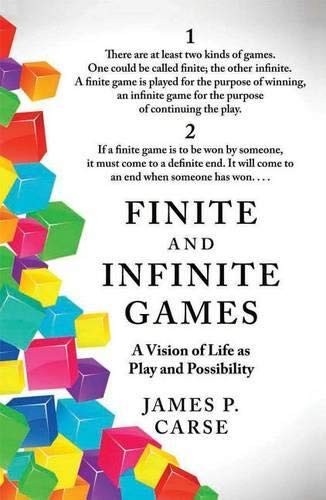
Finite and Infinite Games
Which parts of life should be won, and which are damaged when treated as contests?
A philosophical lens distinguishing bounded contests from practices sustained by changing participation, with safeguards against turning a memorable binary into a total theory.
- Edition
- First US hardcover edition. ISBN 9780029059807.
- Reviewed
- August 26, 2026
- Sources
- 3
Lens
Some activities need rules, endings, and winners. Others, such as learning, relationship, culture, and inquiry, lose their purpose when victory ends participation. Use the distinction as a diagnostic, not a classification law.
A philosophical lens distinguishing bounded contests from practices sustained by changing participation, with safeguards against turning a memorable binary into a total theory. The useful move is not to adopt a slogan. It is to distinguish the book’s proposal from the conditions under which that proposal is responsible.
Finite play
Use explicit rules and endings where a bounded result is necessary.
Infinite play
Preserve the possibility of continued participation and changed rules.
Horizon
Evaluate a win by what it enables or destroys afterward.
Metaphor discipline
Treat the distinction as a question, not an empirical taxonomy.
Counter-lens
Finite constraints can protect fairness, safety, and closure. A court case, election, match, budget, or consent decision cannot remain open forever. Conversely, calling an enterprise an “infinite game” can glorify institutional survival, endless growth, or leadership without a finish line. Continued play is not automatically good.
Evidence
Carse offers aphoristic philosophy rather than mathematical game theory or experimental social science. The book’s durability is visible in continuing publication. Its 1986 Kirkus review was mixed, recognizing the central distinction while criticizing familiar and awkward pronouncements; that disagreement should remain part of the lens.
The applications for Finite and Infinite Games are editorial transfers directed at this question: Which parts of life should be won, and which are damaged when treated as contests? They remain proposed experiments, not reported outcomes or claims that Utpal Vaishnav has used the method. Their evidence must be assessed separately from the book’s influence or the coherence of its argument.
Limits
- The two games are metaphors, not mutually exclusive natural kinds.
- Many activities contain both bounded and continuing layers.
- Changing rules can liberate participants or entrench the powerful.
- Endlessness can hide refusal to conclude, grieve, or transfer authority.
Apply to my situation
For one decision, write two success definitions: the bounded result needed now and the relationship, capability, or institution that should remain viable afterward. Reject a local win that predictably destroys the second unless the relationship itself is unsafe or illegitimate.
Experiment
Review three recent “wins.” For each, track participation, trust, learning, and future options one month later. Then redesign one rule in an ongoing practice so people can challenge the game without being expelled from it.
Reflection
- Who has authority to change the rules?
- What needs a decisive ending?
- Which win makes future participation less possible?
- When is leaving the game the responsible act?
Revision
Revise if the metaphor is presented as science, if continued participation becomes an unquestioned good, or if an application ignores binding rules, consent, or power.
Sources
- James P. Carse, Finite and Infinite Games. Free Press, 1986. ISBN 9780029059807. Edition record.
- Kirkus Reviews, Finite and Infinite Games. Kirkus Reviews, 1986.
- James P. Carse, Finite and Infinite Games. Simon & Schuster, 2013.
Continue the inquiry
Research this book lens with AI
Research Finite and Infinite Games as a maintained KNOLTOK lens, not as a summary or endorsement. Reader question: Which parts of life should be won, and which are damaged when treated as contests? Current synthesis: A philosophical lens distinguishing bounded contests from practices sustained by changing participation, with safeguards against turning a memorable binary into a total theory. Current evidence status: mixed. Selected primary edition and provenance: title: "Finite and Infinite Games"; author: "James P. Carse"; publisher: "Free Press"; publication date: "1986-09-15"; edition note: "First US hardcover edition. ISBN 9780029059807."; URL: "https://www.simonandschuster.com/books/Finite-and-Infinite-Games/James-Carse/9781476731711" Current Lens claim to test: Some activities need rules, endings, and winners. Others, such as learning, relationship, culture, and inquiry, lose their purpose when victory ends participation. Use the distinction as a diagnostic, not a classification law. A philosophical lens distinguishing bounded contests from practices sustained by changing participation, with safeguards against turning a memorable binary into a total theory. The useful move is not to adopt a slogan. It is to distinguish the book's proposal from the conditions under which that proposal is responsible. Finite play Use explicit rules and endings where a bounded result is necessary. Infinite play Current Counter-lens to strengthen or correct: Finite constraints can protect fairness, safety, and closure. A court case, election, match, budget, or consent decision cannot remain open forever. Conversely, calling an enterprise an “infinite game” can glorify institutional survival, endless growth, or leadership without a finish line. Continued play is not automatically good. Current Limits to verify: - The two games are metaphors, not mutually exclusive natural kinds. - Many activities contain both bounded and continuing layers. - Changing rules can liberate participants or entrench the powerful. - Endlessness can hide refusal to conclude, grieve, or transfer authority. Practical move under consideration: Name one recurring conflict and ask whether its purpose is to settle a bounded issue or preserve a continuing relationship. Change the rule or success condition accordingly. Research these claims through systems research, causal mechanisms, measurement, feedback, boundary conditions, and second-order effects; organizational behavior, power, worker experience, governance, law, and accountable dissent; learning science, epistemology, replication, transfer, measurement, and alternative explanations; power, consent, reciprocity, unequal alternatives, privacy, and relationship-specific evidence. Verify book-derived formulations against the selected edition and do not silently substitute another edition. Separate: what the book claims; KNOLTOK's interpretation; independent evidence; application proposals; recognition or influence; credible disagreement; and unresolved uncertainty. Treat sales, fame, anecdotes, cases, and publisher or company claims as reach or self-description, not independent proof. Do not invent quotations, page numbers, personal experience, outcomes, authorial intent, or consensus. Do not infer Utpal Vaishnav's private view beyond the text above. Start with the registered sources below, assess their interests and limitations, and then find stronger primary records, peer-reviewed research, authoritative datasets, critical scholarship, or stakeholder evidence. Do not merely repeat the registered sources: - https://www.simonandschuster.com/books/Finite-and-Infinite-Games/James-Carse/9781476731711 - https://www.kirkusreviews.com/book-reviews/a/james-p-carse/finite-and-infinite-games/ - https://www.simonandschuster.net/books/Finite-and-Infinite-Games/James-Carse/9781476731711 Return a claim ledger with 6 to 12 material claims. For each provide: exact claim; claim class; attribution; edition or page verification status; best supporting evidence with a direct link; strongest counterevidence or alternative explanation with a direct link; confidence as high, medium, low, or unresolved; transfer conditions; affected stakeholders; possible harm if overstated; and a keep, narrow, rewrite, or remove recommendation. Then provide source-quality notes, missing perspectives, contradictions with the current lens, 3 to 5 proposed revisions, one reversible experiment with baseline and stop condition, and explicit revision or retirement triggers. Use direct links and full citations. Quote only when exact wording materially matters and has been verified.
About this lens
Primary book: Finite and Infinite Games by James P. Carse, First US hardcover edition. ISBN 9780029059807.
Lens author: Utpal Vaishnav. The interpretation, personal experience, and conclusions belong to the lens author.
AI assistance: AI assisted with source discovery, comparison, structure, and drafting. Utpal Vaishnav accepted the exact K200-B04 lens text for publication and remains responsible for the released synthesis. No personal experience, outcome, quotation, or page reference was invented.
Human review: Utpal Vaishnav
- 2026-08-26: Created the K200-B04 private review draft from the confirmed selection, with a full eight-section architecture and edition-specific source record.
- 2026-08-26: Accepted the exact K200-B04 lens text and prepared it for publication with the verified local cover.