
Book lens / Published
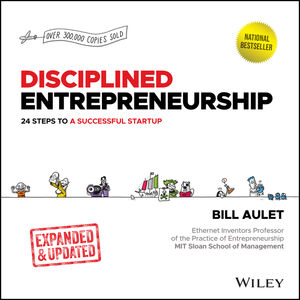
Disciplined Entrepreneurship
Does entrepreneurial discipline reduce avoidable uncertainty, or create false confidence in a process that cannot remove market discovery?
A lens on structured customer discovery, market choice, economics, experimentation, and the nonlinearity of venture creation.
- Edition
- ISBN 9781394222520.
- Reviewed
- August 25, 2026
- Sources
- 1
Lens
Entrepreneurship is often narrated as intuition, charisma, or inspired risk. Aulet’s framework makes the work inspectable through market selection, customer definition, value, acquisition, economics, product design, and testing. Its strength is a common language for assumptions that founders otherwise leave implicit. Discipline does not remove uncertainty. It determines which uncertainty deserves evidence next and helps a team distinguish learning from motion.
Evidence
- A narrow initial market can make learning more specific.
- Customer description needs behavior and purchasing structure, not demographic labels alone.
- Unit economics belong beside product enthusiasm.
- A process earns trust by exposing weak assumptions, not by producing completed worksheets.
Apply to my situation
For KNOLTOK, use Disciplined Entrepreneurship to examine this exact question: Does entrepreneurial discipline reduce avoidable uncertainty, or create false confidence in a process that cannot remove market discovery? Begin with the proposed move, ‘Identify the weakest customer or economic assumption in the current venture and run the smallest test that could disconfirm it’. State the mechanism, transfer conditions, affected people, contrary evidence, and the observation that would change the decision. This is an application proposal, not a claim that Utpal Vaishnav has used it or obtained a particular result.
Counter-lens
A 24-step representation can imply linearity even when discovery forces repeated returns. The framework emerged from MIT-linked technology entrepreneurship and may travel poorly to small local firms, regulated sectors, social ventures, or contexts with limited capital. Wiley’s award-winning and bestselling descriptions are publisher claims until independently specified. Method completion cannot validate customer need, ethical legitimacy, timing, or team capability.
Experiment
Create an assumption ledger for customer, problem, value, access, price, and cost. Rank by consequence and uncertainty. Test the highest-risk assumption before producing more planning detail.
Record the initial assumption, intervention, observation, and next adjustment. Do not convert one result into a general law or personal identity claim.
Reflection
- Which claims about Disciplined Entrepreneurship belong to the selected edition, and which are later interpretation?
- What independent evidence would change the answer to this question: Does entrepreneurial discipline reduce avoidable uncertainty, or create false confidence in a process that cannot remove market discovery?
- Who benefits from the proposed move, who carries its downside, and who can appeal?
- Which domain, timing, cultural, institutional, or historical conditions limit transfer?
- What finding would require narrowing or retiring this lens?
Revision
- Evidence status: practice-informed.
- Curated and authored by Utpal Vaishnav; no personal reading or application is claimed.
- Publication state: K200-B02 exact text accepted by Utpal Vaishnav.
- Transfer condition: test the framework separately for technology ventures, local businesses, regulated sectors, and mission-led organizations before generalizing.
Limits
The transfer boundary for Disciplined Entrepreneurship is built into its question: Does entrepreneurial discipline reduce avoidable uncertainty, or create false confidence in a process that cannot remove market discovery? Do not generalize from a memorable example or retrospective success. Test domain, timing, resources, incentives, power, consent, and who bears the downside.
Continue the inquiry
Research this book lens with AI
Research Disciplined Entrepreneurship as a maintained KNOLTOK lens, not as a summary or endorsement. Reader question: Does entrepreneurial discipline reduce avoidable uncertainty, or create false confidence in a process that cannot remove market discovery? Current synthesis: A lens on structured customer discovery, market choice, economics, experimentation, and the nonlinearity of venture creation. Current evidence status: practice-informed. Selected primary edition and provenance: title: "Disciplined Entrepreneurship"; author: "Bill Aulet"; publisher: "Wiley"; publication date: "2024-04-02"; edition note: "ISBN 9781394222520."; URL: "https://www.wiley.com/en-us/Disciplined+Entrepreneurship%3A+24+Steps+to+a+Successful+Startup%2C+Expanded+%26+Updated%2C+2nd+Edition-p-9781394222520" Current Lens claim to test: Entrepreneurship is often narrated as intuition, charisma, or inspired risk. Aulet's framework makes the work inspectable through market selection, customer definition, value, acquisition, economics, product design, and testing. Its strength is a common language for assumptions that founders otherwise leave implicit. Discipline does not remove uncertainty. It determines which uncertainty deserves evidence next and helps a team distinguish learning from motion. Current Counter-lens to strengthen or correct: A 24-step representation can imply linearity even when discovery forces repeated returns. The framework emerged from MIT-linked technology entrepreneurship and may travel poorly to small local firms, regulated sectors, social ventures, or contexts with limited capital. Wiley's award-winning and bestselling descriptions are publisher claims until independently specified. Method completion cannot validate customer need, ethical legitimacy, timing, or team capability. Current Limits to verify: The transfer boundary for Disciplined Entrepreneurship is built into its question: Does entrepreneurial discipline reduce avoidable uncertainty, or create false confidence in a process that cannot remove market discovery? Do not generalize from a memorable example or retrospective success. Test domain, timing, resources, incentives, power, consent, and who bears the downside. Practical move under consideration: Identify the weakest customer or economic assumption in the current venture and run the smallest test that could disconfirm it. Research these claims through strategy, organizational evidence, incentives, base rates, selection effects, and stakeholder outcomes; psychology, behavior change, construct validity, intervention evidence, and structural explanations; organizational behavior, power, worker experience, governance, law, and accountable dissent; finance, survivorship, leverage, downside allocation, distribution, and institutional opportunity. Verify book-derived formulations against the selected edition and do not silently substitute another edition. Separate: what the book claims; KNOLTOK's interpretation; independent evidence; application proposals; recognition or influence; credible disagreement; and unresolved uncertainty. Treat sales, fame, anecdotes, cases, and publisher or company claims as reach or self-description, not independent proof. Do not invent quotations, page numbers, personal experience, outcomes, authorial intent, or consensus. Do not infer Utpal Vaishnav's private view beyond the text above. Start with the registered sources below, assess their interests and limitations, and then find stronger primary records, peer-reviewed research, authoritative datasets, critical scholarship, or stakeholder evidence. Do not merely repeat the registered sources: - https://www.wiley.com/en-us/Disciplined+Entrepreneurship%3A+24+Steps+to+a+Successful+Startup%2C+Expanded+%26+Updated%2C+2nd+Edition-p-9781394222520 Return a claim ledger with 6 to 12 material claims. For each provide: exact claim; claim class; attribution; edition or page verification status; best supporting evidence with a direct link; strongest counterevidence or alternative explanation with a direct link; confidence as high, medium, low, or unresolved; transfer conditions; affected stakeholders; possible harm if overstated; and a keep, narrow, rewrite, or remove recommendation. Then provide source-quality notes, missing perspectives, contradictions with the current lens, 3 to 5 proposed revisions, one reversible experiment with baseline and stop condition, and explicit revision or retirement triggers. Use direct links and full citations. Quote only when exact wording materially matters and has been verified.
About this lens
Primary book: Disciplined Entrepreneurship by Bill Aulet, ISBN 9781394222520.
Lens author: Utpal Vaishnav. The interpretation, personal experience, and conclusions belong to the lens author.
AI assistance: AI assisted with research, structure, and drafting. Utpal Vaishnav accepted the exact text for publication. No personal experience was invented.
Human review: Utpal Vaishnav
- 2026-08-25: Prepared the K200-B02 local review lens.
- 2026-08-25: Published after Utpal Vaishnav confirmed K200-B02 exact text.