
Book lens / Published
Dhandha
What can community enterprise traditions teach without turning a diverse people into a business stereotype?
A lens on family enterprise, community capital, adaptation, and the survivorship bias inside exemplary business stories.
- Edition
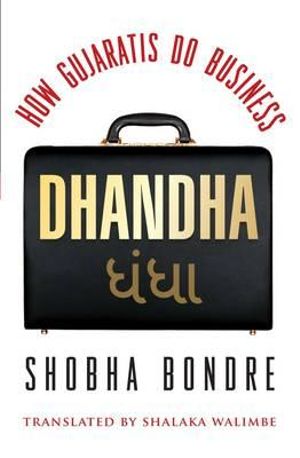
- English paperback, 296 pages, ISBN 9788184003123. Translated by Shalaka Walimbe.
- Reviewed
- August 26, 2026
- Sources
- 2
Lens
Business stories often make enterprise look like the expression of a remarkable individual. Dhandha directs attention toward something broader: family labor, community trust, apprenticeship, migration, reputation, thrift, informal finance, and the willingness to work within overlooked markets.
That shift is valuable. An entrepreneur rarely begins alone. Knowledge travels through relationships. Credit may be extended because a person is known. Relatives may contribute labor, housing, introductions, or risk capital. A community can reduce the cost of starting and increase the consequence of betraying trust.
The danger is turning those mechanisms into an ethnic essence. Gujarati communities are diverse, and selected successful entrepreneurs cannot establish that a people possess one commercial character. The lens should examine practices and institutions, not praise a stereotype.
Evidence
- Enterprise is embedded in relationships, not produced by individual will alone.
- Reputation can function as economic infrastructure where formal systems are weak or inaccessible.
- Families often pool risk across time and generations.
- Adaptation to place may matter more than attachment to a single business model.
- Frugality can preserve optionality, but it can also shift costs onto family members or workers.
These mechanisms deserve attention because they widen the unit of analysis. The relevant actor may be a household or network rather than a lone founder. Meaningful success then includes continuity, reciprocity, and responsibility to people whose invisible contributions made the business possible.
The missing ledger
Celebrated case studies usually begin after selection has occurred. We see the survivors. We rarely see families who used similar practices and failed, people who could not access the network, or successors who did not want the inherited obligation.
The success story may also undercount care work, unpaid labor, gendered sacrifice, employee risk, and the personal cost of migration. A business can be resilient because someone else absorbs instability. Without that ledger, communal enterprise becomes a flattering myth rather than an analyzable system.
Translation introduces another boundary. Tone, business terminology, regional references, and the framing of identity can shift between Marathi, English, Hindi, and later editions. The selected English paperback credits Shalaka Walimbe as translator, which must remain visible in any close discussion of wording.
From identity to mechanism
For each story, ask what actually carried the enterprise. Was it trade knowledge, supplier credit, family labor, customer trust, dense social ties, low personal consumption, or an ability to relocate? Then ask who had access to that mechanism and who bore its cost.
This approach allows learning without imitation theater. A reader outside the community cannot borrow a century of accumulated trust by adopting a slogan. The reader may still design reliable relationships, honor obligations, preserve cash, learn a trade, and build a reputation through repeated conduct.
Experiment
Choose one enterprise case. Draw a map with five columns: capital, knowledge, labor, trust, and risk. Record who supplied each resource and what they received. Add missing or uncertain contributors. Compare this system map with the heroic version of the story.
Reflection
- What do independent records confirm about the featured businesses?
- Which mechanisms recur without being unique to Gujarati communities?
- How do caste, gender, migration status, and generation alter access?
- What changed between the original and translated editions?
Revision
- Evidence status: mixed.
- Selected edition: 2013 English paperback, translated by Shalaka Walimbe.
- Curated and authored by Utpal Vaishnav; no personal experience is claimed.
- Publication state: published on August 26, 2026.
Counter-lens
For Dhandha, test the strongest answer to the same reader question: What can community enterprise traditions teach without turning a diverse people into a business stereotype? Ask whether context, selection, incentives, prior capability, power, or survivorship explains the result better than the book’s favored mechanism. Disagreement is evidence to examine, not proof that the reader failed to understand the author.
Limits
The transfer boundary for Dhandha is built into its question: What can community enterprise traditions teach without turning a diverse people into a business stereotype? Do not generalize from a memorable example or retrospective success. Test domain, timing, resources, incentives, power, consent, and who bears the downside.
Apply to my situation
For KNOLTOK, treat Dhandha as a proposed decision aid rather than a personal claim. Its book-specific move is: For one case, map the capital, labor, trust, risk, and family obligations that made the outcome possible, including costs the success story leaves out. For this application, record why ‘For one case, map the capital, labor, trust, risk, and family obligations that made the outcome possible, including costs the success story leaves out’ fits the current case, which source supports it, who is affected, and what evidence would block transfer.
Continue the inquiry
Research this book lens with AI
Research Dhandha as a maintained KNOLTOK lens, not as a summary or endorsement. Reader question: What can community enterprise traditions teach without turning a diverse people into a business stereotype? Current synthesis: A lens on family enterprise, community capital, adaptation, and the survivorship bias inside exemplary business stories. Current evidence status: mixed. Selected primary edition and provenance: title: "Dhandha: How Gujaratis Do Business"; author: "Shobha Bondre"; publisher: "Random House India"; publication date: "2013-05-22"; edition note: "English paperback, 296 pages, ISBN 9788184003123. Translated by Shalaka Walimbe."; URL: "https://www.penguin.co.in/book/dhandha/" Current Lens claim to test: Business stories often make enterprise look like the expression of a remarkable individual. Dhandha directs attention toward something broader: family labor, community trust, apprenticeship, migration, reputation, thrift, informal finance, and the willingness to work within overlooked markets. That shift is valuable. An entrepreneur rarely begins alone. Knowledge travels through relationships. Credit may be extended because a person is known. Relatives may contribute labor, housing, introductions, or risk capital. A community can reduce the cost of starting and increase the consequence of betraying trust. The danger is turning those mechanisms into an ethnic essence. Gujarati communities Current Counter-lens to strengthen or correct: For Dhandha, test the strongest answer to the same reader question: What can community enterprise traditions teach without turning a diverse people into a business stereotype? Ask whether context, selection, incentives, prior capability, power, or survivorship explains the result better than the book's favored mechanism. Disagreement is evidence to examine, not proof that the reader failed to understand the author. Current Limits to verify: The transfer boundary for Dhandha is built into its question: What can community enterprise traditions teach without turning a diverse people into a business stereotype? Do not generalize from a memorable example or retrospective success. Test domain, timing, resources, incentives, power, consent, and who bears the downside. Practical move under consideration: For one case, map the capital, labor, trust, risk, and family obligations that made the outcome possible, including costs the success story leaves out. Research these claims through strategy, organizational evidence, incentives, base rates, selection effects, and stakeholder outcomes; systems research, causal mechanisms, measurement, feedback, boundary conditions, and second-order effects; organizational behavior, power, worker experience, governance, law, and accountable dissent; finance, survivorship, leverage, downside allocation, distribution, and institutional opportunity. Verify book-derived formulations against the selected edition and do not silently substitute another edition. Separate: what the book claims; KNOLTOK's interpretation; independent evidence; application proposals; recognition or influence; credible disagreement; and unresolved uncertainty. Treat sales, fame, anecdotes, cases, and publisher or company claims as reach or self-description, not independent proof. Do not invent quotations, page numbers, personal experience, outcomes, authorial intent, or consensus. Do not infer Utpal Vaishnav's private view beyond the text above. Start with the registered sources below, assess their interests and limitations, and then find stronger primary records, peer-reviewed research, authoritative datasets, critical scholarship, or stakeholder evidence. Do not merely repeat the registered sources: - https://www.penguin.co.in/book/dhandha/ - https://www.penguin.co.in/book/dhandha-2/ Return a claim ledger with 6 to 12 material claims. For each provide: exact claim; claim class; attribution; edition or page verification status; best supporting evidence with a direct link; strongest counterevidence or alternative explanation with a direct link; confidence as high, medium, low, or unresolved; transfer conditions; affected stakeholders; possible harm if overstated; and a keep, narrow, rewrite, or remove recommendation. Then provide source-quality notes, missing perspectives, contradictions with the current lens, 3 to 5 proposed revisions, one reversible experiment with baseline and stop condition, and explicit revision or retirement triggers. Use direct links and full citations. Quote only when exact wording materially matters and has been verified.
About this lens
Primary book: Dhandha by Shobha Bondre, English paperback, 296 pages, ISBN 9788184003123. Translated by Shalaka Walimbe.
Lens author: Utpal Vaishnav. The interpretation, personal experience, and conclusions belong to the lens author.
AI assistance: AI assisted with research, structure, and drafting. No cultural trait, translation credit, personal experience, or business outcome was invented.
Human review: Utpal Vaishnav
- 2026-08-26: Prepared the K200-B03 local review lens.
- 2026-08-26: Verified the 2013 English cover and translator credit against the ISBN-specific catalog image.