
Book lens / Published
Breakthrough Advertising
If persuasion works by channeling existing desire, where does skilled communication end and exploitation begin?
A lens on market awareness, desire, direct-response craft, and the ethical duties created by powerful persuasion.
- Edition
- ISBN 9780932648549. The work was first published by Prentice-Hall in 1966.
- Reviewed
- August 26, 2026
- Sources
- 2
Lens
Eugene Schwartz argues that advertising does not create mass desire from nothing. It identifies a desire already present in a market and channels it toward a product. The craft lies in understanding awareness, sophistication, promise, mechanism, and the language through which relevance becomes visible.
This is a durable correction to self-centered marketing. The writer cannot compensate for absent demand through clever phrasing alone. Listening to the market matters.
The same insight raises the ethical stakes. Existing desire may be rooted in fear, shame, illness, loneliness, status anxiety, financial distress, or prejudice. A message can accurately detect that desire and still exploit it.
Evidence
- Begin with the audience’s existing problem and level of awareness.
- Match explanation to what the audience already understands.
- Distinguish a claim from the mechanism that could make it credible.
- Recognize that repeated market promises lose force as audiences become familiar with them.
- Treat copy as part of product and market fit, not magic applied afterward.
These are useful analytical tools. Their survival among practitioners is evidence of perceived utility, not proof that every technique works or remains acceptable.
Power over attention
Direct-response traditions optimize measurable action. Measurement can encourage learning, but the selected metric may be a click, lead, or purchase rather than informed welfare. A campaign can convert effectively while producing regret, debt, dependency, or mistrust.
Digital targeting deepens the problem. Modern platforms can infer vulnerability, personalize pressure, and repeat messages at a scale unavailable in 1966. Scarcity claims, social proof, health anxiety, and financial aspiration can be tested until they overcome resistance. Technical skill does not supply ethical permission.
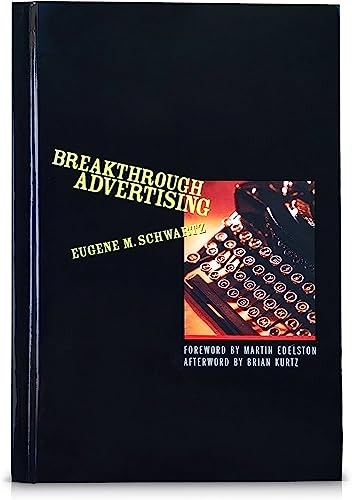
The book’s history also requires bibliographic care. Scarce originals, expensive authorized reprints, and unauthorized scans circulate together. A cover or quotation must be tied to an edition rather than to the mythology around the book.
Practitioner reverence can create its own authority loop. Writers recommend the book because respected writers recommend it, then cite that circulation as proof. Durable use is worth recording, but a claim about effectiveness still needs a defined outcome and comparison.
An ethical channel
Persuasion should preserve the audience’s capacity to judge. State the offer, evidence, limits, cost, and material risk. Do not intensify a fear beyond what the evidence supports. Do not imply that purchase proves intelligence, courage, belonging, or moral worth.
The standard is not neutral language. Communication can be vivid and persuasive. The boundary is whether it improves an informed choice or works by impairing one.
Experiment
Take one current message and identify the desire it channels. Write the strongest truthful version and the strongest manipulative version. Mark the differences in evidence, urgency, identity pressure, omission, and reversibility. Publish neither. Use the contrast to create an internal constraint list.
Reflection
- Which Schwartz concepts have independent empirical support?
- How has market sophistication changed under algorithmic targeting?
- Which audiences require stronger safeguards?
- What measures capture informed satisfaction rather than conversion alone?
Revision
- Evidence status: practice-informed.
- Practitioner adoption is not causal validation.
- Curated and authored by Utpal Vaishnav; no campaign outcome is claimed.
- Publication state: published on August 26, 2026.
Counter-lens
For Breakthrough Advertising, test the strongest answer to the same reader question: If persuasion works by channeling existing desire, where does skilled communication end and exploitation begin? Ask whether context, selection, incentives, prior capability, power, or survivorship explains the result better than the book’s favored mechanism. Disagreement is evidence to examine, not proof that the reader failed to understand the author.
Limits
The transfer boundary for Breakthrough Advertising is built into its question: If persuasion works by channeling existing desire, where does skilled communication end and exploitation begin? Do not generalize from a memorable example or retrospective success. Test domain, timing, resources, incentives, power, consent, and who bears the downside.
Apply to my situation
For KNOLTOK, treat Breakthrough Advertising as a proposed decision aid rather than a personal claim. Its book-specific move is: Audit one persuasive message for the desire it channels, the evidence it supplies, the risk it omits, and the audience vulnerability it may exploit. For this application, record why ‘Audit one persuasive message for the desire it channels, the evidence it supplies, the risk it omits, and the audience vulnerability it may exploit’ fits the current case, which source supports it, who is affected, and what evidence would block transfer.
Continue the inquiry
Research this book lens with AI
Research Breakthrough Advertising as a maintained KNOLTOK lens, not as a summary or endorsement. Reader question: If persuasion works by channeling existing desire, where does skilled communication end and exploitation begin? Current synthesis: A lens on market awareness, desire, direct-response craft, and the ethical duties created by powerful persuasion. Current evidence status: practice-informed. Selected primary edition and provenance: title: "Breakthrough Advertising: How to Write Ads That Shatter Traditions and Sales Records"; author: "Eugene M. Schwartz"; publisher: "Boardroom Books"; publication date: "1984-01-01"; edition note: "ISBN 9780932648549. The work was first published by Prentice-Hall in 1966."; URL: "https://openlibrary.org/isbn/9780932648549" Current Lens claim to test: Eugene Schwartz argues that advertising does not create mass desire from nothing. It identifies a desire already present in a market and channels it toward a product. The craft lies in understanding awareness, sophistication, promise, mechanism, and the language through which relevance becomes visible. This is a durable correction to self-centered marketing. The writer cannot compensate for absent demand through clever phrasing alone. Listening to the market matters. The same insight raises the ethical stakes. Existing desire may be rooted in fear, shame, illness, loneliness, status anxiety, financial distress, or prejudice. A message can accurately Current Counter-lens to strengthen or correct: For Breakthrough Advertising, test the strongest answer to the same reader question: If persuasion works by channeling existing desire, where does skilled communication end and exploitation begin? Ask whether context, selection, incentives, prior capability, power, or survivorship explains the result better than the book's favored mechanism. Disagreement is evidence to examine, not proof that the reader failed to understand the author. Current Limits to verify: The transfer boundary for Breakthrough Advertising is built into its question: If persuasion works by channeling existing desire, where does skilled communication end and exploitation begin? Do not generalize from a memorable example or retrospective success. Test domain, timing, resources, incentives, power, consent, and who bears the downside. Practical move under consideration: Audit one persuasive message for the desire it channels, the evidence it supplies, the risk it omits, and the audience vulnerability it may exploit. Research these claims through strategy, organizational evidence, incentives, base rates, selection effects, and stakeholder outcomes; psychology, behavior change, construct validity, intervention evidence, and structural explanations; systems research, causal mechanisms, measurement, feedback, boundary conditions, and second-order effects; finance, survivorship, leverage, downside allocation, distribution, and institutional opportunity. Verify book-derived formulations against the selected edition and do not silently substitute another edition. Separate: what the book claims; KNOLTOK's interpretation; independent evidence; application proposals; recognition or influence; credible disagreement; and unresolved uncertainty. Treat sales, fame, anecdotes, cases, and publisher or company claims as reach or self-description, not independent proof. Do not invent quotations, page numbers, personal experience, outcomes, authorial intent, or consensus. Do not infer Utpal Vaishnav's private view beyond the text above. Start with the registered sources below, assess their interests and limitations, and then find stronger primary records, peer-reviewed research, authoritative datasets, critical scholarship, or stakeholder evidence. Do not merely repeat the registered sources: - https://openlibrary.org/isbn/9780932648549 - https://www.profitadvisors.com/breakthrough.shtml Return a claim ledger with 6 to 12 material claims. For each provide: exact claim; claim class; attribution; edition or page verification status; best supporting evidence with a direct link; strongest counterevidence or alternative explanation with a direct link; confidence as high, medium, low, or unresolved; transfer conditions; affected stakeholders; possible harm if overstated; and a keep, narrow, rewrite, or remove recommendation. Then provide source-quality notes, missing perspectives, contradictions with the current lens, 3 to 5 proposed revisions, one reversible experiment with baseline and stop condition, and explicit revision or retirement triggers. Use direct links and full citations. Quote only when exact wording materially matters and has been verified.
About this lens
Primary book: Breakthrough Advertising by Eugene M. Schwartz, ISBN 9780932648549. The work was first published by Prentice-Hall in 1966.
Lens author: Utpal Vaishnav. The interpretation, personal experience, and conclusions belong to the lens author.
AI assistance: AI assisted with research, structure, and drafting. No advertising result, practitioner consensus, or personal campaign experience was invented.
Human review: Utpal Vaishnav
- 2026-08-26: Prepared the K200-B03 local review lens.