
Book lens / Published
Braiding Sweetgrass
What changes when gratitude is treated not as a feeling but as an obligation of reciprocity?
A lens on the meeting of Potawatomi teaching, botanical knowledge, story, and reciprocal responsibility that refuses to extract Indigenous thought into generic wellness advice.
- Edition
- First Milkweed Editions paperback edition. ISBN 9781571313560.
- Reviewed
- August 26, 2026
- Sources
- 3
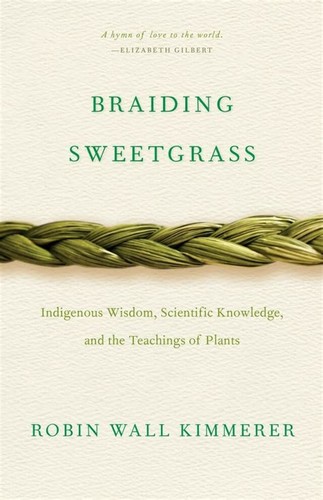
Lens
Receiving a gift can create responsibility: notice what sustains life, learn its conditions, restrain taking, and return care. Reciprocity is situated practice, not a decorative feeling.
A lens on the meeting of Potawatomi teaching, botanical knowledge, story, and reciprocal responsibility that refuses to extract Indigenous thought into generic wellness advice. The useful move is not to adopt a slogan. It is to distinguish the book’s proposal from the conditions under which that proposal is responsible.
Attention
Learn to recognize gifts and the conditions that make them possible.
Reciprocity
Let receiving generate a fitting return.
Plural knowledge
Keep scientific practice and Potawatomi teaching distinct enough to meet without erasure.
Restraint
Treat limits on taking as part of gratitude.
Counter-lens
Reciprocity language can be appropriated by readers who admire Indigenous ideas while leaving land, sovereignty, treaty, and extraction untouched. Nature is also not a simple moral instructor. Ecological relations include competition, disturbance, death, and scale-dependent tradeoffs. Responsible application must stay specific about source, place, and power.
Evidence
The book’s authority is braided rather than reducible to one evidence class: Kimmerer writes as a Potawatomi botanist, teacher, mother, and storyteller. Milkweed records #1 New York Times bestseller status and extended list presence; these are reach indicators. Scientific claims still require claim-specific checking, while teachings and stories require cultural and literary interpretation rather than laboratory validation.
The applications for Braiding Sweetgrass are editorial transfers directed at this question: What changes when gratitude is treated not as a feeling but as an obligation of reciprocity? They remain proposed experiments, not reported outcomes or claims that Utpal Vaishnav has used the method. Their evidence must be assessed separately from the book’s influence or the coherence of its argument.
Limits
- There is no single homogeneous “Indigenous worldview.”
- Translation into a personal habit can strip teaching from community and land.
- Bestseller status does not validate every empirical statement.
- Individual gratitude cannot substitute for institutional ecological change.
Apply to my situation
Choose one received good and map its ecological source, labor, ownership, waste, and governance. Ask what return is proportionate and welcomed rather than self-congratulatory. Prefer an existing local or Indigenous-led obligation over inventing a private ritual.
Experiment
For one month, pair each use of a chosen resource with a measured return: reduced consumption, restoration work, fair payment, or support for accountable stewardship. Record material effect and whose guidance shaped the action. Do not count gratitude alone as return.
Reflection
- Who defines a fitting return?
- What political obligation is hidden by private gratitude?
- Which knowledge claim is scientific, storied, ethical, or braided?
- How can attribution remain attached to nation, author, and place?
Revision
Revise when cultural review identifies extraction or flattening, when a scientific formulation changes, or when an application celebrates sentiment without material reciprocity.
Sources
- Robin Wall Kimmerer, Braiding Sweetgrass. Milkweed Editions, 2013. ISBN 9781571313560. Edition record.
- Robin Wall Kimmerer, Braiding Sweetgrass. Milkweed Editions, 2013.
- SUNY Distinguished Teaching Professor, Robin Wall Kimmerer. SUNY College of Environmental Science and Forestry.
Continue the inquiry
Research this book lens with AI
Research Braiding Sweetgrass as a maintained KNOLTOK lens, not as a summary or endorsement. Reader question: What changes when gratitude is treated not as a feeling but as an obligation of reciprocity? Current synthesis: A lens on the meeting of Potawatomi teaching, botanical knowledge, story, and reciprocal responsibility that refuses to extract Indigenous thought into generic wellness advice. Current evidence status: mixed. Selected primary edition and provenance: title: "Braiding Sweetgrass"; author: "Robin Wall Kimmerer"; publisher: "Milkweed Editions"; publication date: "2013-10-15"; edition note: "First Milkweed Editions paperback edition. ISBN 9781571313560."; URL: "https://milkweed.org/book/braiding-sweetgrass" Current Lens claim to test: Receiving a gift can create responsibility: notice what sustains life, learn its conditions, restrain taking, and return care. Reciprocity is situated practice, not a decorative feeling. A lens on the meeting of Potawatomi teaching, botanical knowledge, story, and reciprocal responsibility that refuses to extract Indigenous thought into generic wellness advice. The useful move is not to adopt a slogan. It is to distinguish the book's proposal from the conditions under which that proposal is responsible. Attention Learn to recognize gifts and the conditions that make them possible. Reciprocity Let receiving generate a fitting return. Plural Current Counter-lens to strengthen or correct: Reciprocity language can be appropriated by readers who admire Indigenous ideas while leaving land, sovereignty, treaty, and extraction untouched. Nature is also not a simple moral instructor. Ecological relations include competition, disturbance, death, and scale-dependent tradeoffs. Responsible application must stay specific about source, place, and power. Current Limits to verify: - There is no single homogeneous “Indigenous worldview.” - Translation into a personal habit can strip teaching from community and land. - Bestseller status does not validate every empirical statement. - Individual gratitude cannot substitute for institutional ecological change. Practical move under consideration: Trace one ordinary material, such as food, water, wood, or energy, to the living and human systems that provide it. Choose one concrete act of restraint, restoration, payment, or advocacy in return. Research these claims through literary form, authorial context, reception, and the boundary between interpretation and external fact; strategy, organizational evidence, incentives, base rates, selection effects, and stakeholder outcomes; psychology, behavior change, construct validity, intervention evidence, and structural explanations; systems research, causal mechanisms, measurement, feedback, boundary conditions, and second-order effects. Verify book-derived formulations against the selected edition and do not silently substitute another edition. Separate: what the book claims; KNOLTOK's interpretation; independent evidence; application proposals; recognition or influence; credible disagreement; and unresolved uncertainty. Treat sales, fame, anecdotes, cases, and publisher or company claims as reach or self-description, not independent proof. Do not invent quotations, page numbers, personal experience, outcomes, authorial intent, or consensus. Do not infer Utpal Vaishnav's private view beyond the text above. Start with the registered sources below, assess their interests and limitations, and then find stronger primary records, peer-reviewed research, authoritative datasets, critical scholarship, or stakeholder evidence. Do not merely repeat the registered sources: - https://milkweed.org/book/braiding-sweetgrass - https://www.esf.edu/faculty/kimmerer/ Return a claim ledger with 6 to 12 material claims. For each provide: exact claim; claim class; attribution; edition or page verification status; best supporting evidence with a direct link; strongest counterevidence or alternative explanation with a direct link; confidence as high, medium, low, or unresolved; transfer conditions; affected stakeholders; possible harm if overstated; and a keep, narrow, rewrite, or remove recommendation. Then provide source-quality notes, missing perspectives, contradictions with the current lens, 3 to 5 proposed revisions, one reversible experiment with baseline and stop condition, and explicit revision or retirement triggers. Use direct links and full citations. Quote only when exact wording materially matters and has been verified.
About this lens
Primary book: Braiding Sweetgrass by Robin Wall Kimmerer, First Milkweed Editions paperback edition. ISBN 9781571313560.
Lens author: Utpal Vaishnav. The interpretation, personal experience, and conclusions belong to the lens author.
AI assistance: AI assisted with source discovery, comparison, structure, and drafting. Utpal Vaishnav accepted the exact K200-B04 lens text for publication and remains responsible for the released synthesis. No personal experience, outcome, quotation, or page reference was invented.
Human review: Utpal Vaishnav
- 2026-08-26: Created the K200-B04 private review draft from the confirmed selection, with a full eight-section architecture and edition-specific source record.
- 2026-08-26: Accepted the exact K200-B04 lens text and prepared it for publication with the verified local cover.